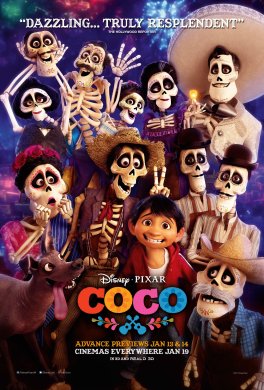
To Not Be Forgotten (Coco, 2017)

CoC0_PosterMiguel comes from a family that has erased music…and their great, great grandfather… fro the collective memories. But Miguel loves music.  He wants to sing like his idol, the late Ernesto De La Cruz. On the Day of the Dead, Miguel decides to take to heart De La Cruz’s motto of seizing your moment by performing a song at the talent show that evening.

When his grandmother discovers him with his guitar, she smashes it, angering Miguel. He discovers that his unknown great great grandfather is actually De La Cruz and so, after being unable to obtain a guitar from other musicians,  he tries to borrow the guitar from his great great grandfather’s crypt. Suddenly, he finds himself invisible to all around him…until he runs into skeletal beings…who seem to recognize him.  Miguel finds his relatives who have died have come to visit the land of the living for the celebration of the Day of the Dead.

He is brought back to the Land of the Dead, where his family works to get him back to the land of the living.  His Great Great Grandmother Mamá Imelda was held back by by their being no picture of her set out for the Day of the Dead.  When they find out that this is the fault of Miguel, she gifts him the blessing to return…but with the condition that he never seek to play music again. Miguel cannot help himself and ends up back in the Land of the Dead. But instead of accepting his Mamá Imelda’s blessing again, he refuses and seeks to find his Great Great Grandfather De La Cruz, certain he will give him the blessing he so needs, without condition. A con artist named Hector offers to help Miguel get to him in exchange for bringing his picture back to the land of the living and setting it out for the Day of the Dead.  But they are racing against time.  His family is trying to find him both in the Land of the Dead and the Land of the Living, and if he does not get back before sunrise? Miguel will be stuck in the Land of the Dead forever.

One might gripe that there is little about this story that is new.  Many, many times we have seen the story of the young kid or character who is out of step with their family or society in general. Pixar and animated kid movies have capitalized on this notion of the kid (or kid at heart) who has a dream and it really falls on the family (or society) to learn how wrong they were.  And there are elements of that here. His family reasons for erasing the existence of his Great Great Grandfather are understandable.  He walked away from the family…from his wife and daughter…never to be seen again.

But Coco has a much greater lesson for both Miguel and his family. Miguel must learn how important his family truly is to him.  Both Hector and Mamá Imelda express a disdain for musicians, and yet harbor beautiful talent.  We find both have been hurt by the musician’s life.

The infusion of music to the film is an infusion of emotion and life (I honestly cannot picture another artistic love for Miguel that would feel quite as powerful here). The songs connect us to Miguel, Mamá Imelda, Hector and De La Cruz.

Visually, the Land of the Dead is so celebratory and vibrant, it pulls you in, and the character designs allow for the quick adjustment to the fact that Hector is surrounded by decorative skeletons that are fun to watch.

Coco is a wonderfully beautiful fest for the eyes that is full of heart.

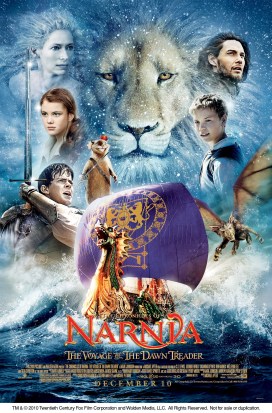
Narnia Quest Part 3 (Chronicles of Narnia: The Voyage of the Dawn Treader, 2010)

narnia-the-voyage-of-the-dawn-treader-movie-poster

Picking back up World War 2, Peter and Susan are with their father in America.  Lucy and Edmund, on the other hand, are stuck with their unpleasant cousin Eustace.  He is a remarkably anti-social kid.  One afternoon he breaks in on a conversation between Lucy and Edmund.  Lucy notices that a painting on the wall of a ship at sea seems to be moving. As Eustace berates them, water starts to poor from the frame of the painting, filling the room.  Suddenly, the children are afloat in the ocean and picked up by a passing ship.

The ship is the Dawn Treader, captained by Prince Caspian. On the ship, Lucy and Edmund are thrilled to see Caspian, Reepicheep and other Narnians.  Eustice is more…stupefied. Especially by things like a giant talking mouse. Who has a sword. Caspian explains that they are on a mission to find the missing seven Lords that were driven into exile by Lord Protector Miraz.  Reepicheep has a separate mission to reach the end of the world and enter Aslan’s land.

The journey brings them to various islands with a variety of obstacles.  Eventually, they find the dark island in their hopes to vanquish a dark force that is attacking Narnians.

This last part is a bit more confusing.  There is the addition of a Green Mist that is not in the books.  It appears to steal Narnian citizens and taken them from beyond the reach of Caspian. The film departs a lot from the book, changing character motivations and emphasizing others.

Disney was not involved in this film, instead, Walden Media teamed with 20th Century Fox for this installment.  The Narnia films have struggled, in part, from inconsistent releasing.  The first film came out in 2005, the second in 2008 and then this film in 2010. Compare this to the Lord of the Rings and Hobbit films, which were consistently a year apart.  Or the Harry Potter films, which had a fairly consistent schedule of every two years.  We are seeing Star Wars films already on a regular yearly schedule. Three films in five years easily disrupts momentum that trying to pull off an adaption like this needs.  Especially when Narnia does not have a variety of other outlets to be kept in the front of people’s minds.

And if the films had been ridiculously high quality, one might forgive the inconsistencies.  But there is the problem.

The Voyage of the Dawn Treader is easily the best of the three films. Will Pouter is exceptional as Eustace and takes him from being an insufferable brat to a good kid convincingly. Simon Pegg’s Reepicheep (taking over for Eddie Izzard from the previous film) gives a likable performance.

The film’s visual effects are strong, and the Eustace Dragon looks great.  And yet, the film never really manages to feel…urgent.  Edmund envies Peter, Lucy envies Susan…the temptation of the White Witch (again!). It all feels like we have been there before, even though the setting is new.

While better than the prior films, it still never gets to be what it wants, because what it wants is to be something other than the story C.S. Lewis told.

Narnia Quest Part 2 (The Chronicles of Narnia: Prince Caspian, 2008)

Narnia_002_PosterComing out three years after the Lion, the Witch and the Wardrobe, Prince Caspian picks up in Narnia, decades after the rule of the Pevensie family. The children had lived and ruled into adulthood, but returned to our world as children, with almost no time having passed.  But in Narnia, mankind has overrun Narnia.  The mythical creatures seem all but gone.

Lady Protectress Prunaprismia gives birth to a son, delighting her husband Lord Protector Miraz.  He calls to have the rightful heir to the throne, Prince Caspian, killed. Caspian’s tutor Professor Cornelius helps him escape. Cornelius has tried to teach Caspian in the forgotten ways of Narnia and Aslan. He gives him an ancient battle horn.

In his escape, Caspian runs into the original citizens of Narnia, whom he had believed to be myth.  In a fit of panic, he blows the horn, but the horn is not an ordinary artifact.  It actually calls the Pevensie children back to Narnia. They discover the ruins of their old castle, and come across their old weapons.  The children then discover Telmarine (the ruling class of Narnia) soldiers about to kill the dwarf Trumkin.  After saving him, they start to make their way back to the other hiding creatures of Narnia. Throughout the story, Lucy is certain she sees Aslan, but nobody else seems to see him.

Eventually, they reach and meet Caspian.  Caspian has cast in his lots with the citizens of Narnia against their Telmarine oppressors.  With the help of the Pevensies, they go on a mission to overthrow the Telmarines.

This is an okay follow up, though it pretty much has all the same positives and negatives of the previous film.  It is trying hard to be an epic, instead of trusting the story laid out before it.  The film invents a temptation to bring back the White Witch for the Pevensie kids that is entirely pointless and unneeded.

Prince Caspian is not terrible…but it really is just an average film adaption. Not great.  But decent enough.

Narnia Quest Part 1 (The Chronicles of Narnia: The Lion the Witch and the Wardrobe, 2005)

Narnia_001_PosterDuring World War 2, the four Pevensie children are sent to stay in the remote countryside with Professor Kirke.  A somewhat distant man, the kids try and pass the time by exploring his large home and playing games.  One day, during a game of hide and seek, youngest Lucy hides in a large wardrobe.  She discovers that there is something different with the Wardrobe.  As she pushes through coats, she suddenly finds herself in a snowy forest.
She runs into a Faun (half man and half goat) who timidly introduces himself as Mr. Tumnus.  When he discovers that Lucy is a “daughter of Eve”, he becomes worried and tries to hurry Lucy back to where she came. He explains there world (where there is no Christmas, but a seemingly endless winter) is ruled by a tyrant queen, the White Witch, who demands any member of the line of Adam and Eve should be brought to her.  Upon her return, her siblings do not believe Lucy.  And why would they?

That night, Lucy tries to return, and is unknowingly followed by Edmund.  Edmund meets the White Witch who wants him to bring his sibling to her.  She plays to his ego and desire for fanciful Turkish Delights candy.

Eventually, all the kids enter the wardrobe and find Mr. Tumnus is missing.  They are greeted by Mr. and Mrs. Beaver who are…well, talking Beavers.  The kids learn more of the curse upon Narnia, but that many believe the world will be released by the return of King Aslan and the children of Adam and Eve.  And so the children become drawn into a battle to save  the world of Narnia from the cruel White Queen.

The Chronicles of Narnia are the beloved children’s books by noted popular Christian apologist C.S. Lewis. The series has been adapted in the past.  There was a cartoon of the Lion the Witch and the Wardrobe from the BBC in 1979.  And four of the books* were adapted for a live action series (also from the BBC) in the late eighties. But the twin successes of the Lord of the Rings films and the Harry Potter series made things look viable for more fantasy.

And so, Disney and Walden Media combined forces to bring us the Chronicles of Narnia.  They brought in Andrew Adamson, who was known for Shrek and Shrek 2 before this.

Visually, the effects in the film are quite good.  Aslan looks like a real lion, not just a digital cartoon.  The makeup is effect for the creatures of Narnia.  The cast is good.  And yet…the Lion, the Witch and the Wardrobe feels a bit…flat.  It follows the main beats of the story, but it is clear that, rather than looking to the novels for guidance?  They were looking at the success of the Lord of the Rings.  Overwhelmingly so.  The emphasis is on “epic”.  And this is not really something at the heart of the Narnia books.  The books are short, in fact, much shorter than the Tolkien’s books.  I almost wonder if the seven books total more than the three Rings books.

A certain amount of comparison would be inevitable.  Lewis and Tolkien were close friends.  When it came to their work though, they had very different attitudes.  Tolkien had no real use for allegory.  But that is what drives the heart of the Narnia Books.  The allegory is as important as the story.

And the film does not really water down the allegory. Aslan is still clearly a stand in for Jesus. Though, some might feel that Aslan seems to have less bite.  He seems a bit warm and fuzzy and a little less…threatening…even for the minions of evil.

The Chronicles of Narnia: The Lion, the Witch and the Wardrobe very much wants to be the Lord of the Rings, and this causes the film to not carve out it’s own identity against the Lord of the Rings films. Instead, it feels like a pale comparison.


*Prince Caspian and the Voyage of the Dawn Treader were combined.

Two Rule Them All (The Lord of the Rings: The Two Towers, 2002)

LOTR_Two_Towers_PosterPicking up in the aftermath that split the fellowship apart, the Two Towers has a lot on it’s shoulders. Frodo and Sam are now on their own, making their way for Mount Doom to destroy the ring.  Aragorn, Legolas and Gimli are trying to rescue Merry and Pippin, who are believed to have been kidnapped by Orcs.
We quickly learn that Merry and Pippin found escape from the orcs on their own.  Aragorn, Legolas and Gimli are diverted by Gandalf who directs them to Rohan.  Gandalf realizes the time has come to prepare the armies of men for an epic battle against Sauron and his forces.

Rohan is under the influence of the Wizard Sauroman.  Their king is in a sickly trance, poisoned by Wormtongue, the agent of Sauroman.  Upon arrival, Gandalf excises the presence of Sauroman and chase out Wormtongue.  They warn the people there of the coming danger, and all agree they must make their way to an old fortress to protect everyone.

Meanwhile, Merry and Pippin discover the ancient race of Ents.  The Ents are ancient and sentient trees.  Pippin becomes determined to convince Treebeard and his fellow Ents to fight against the advancement of Sauroman and his orc army before it can join Sauron’s army.

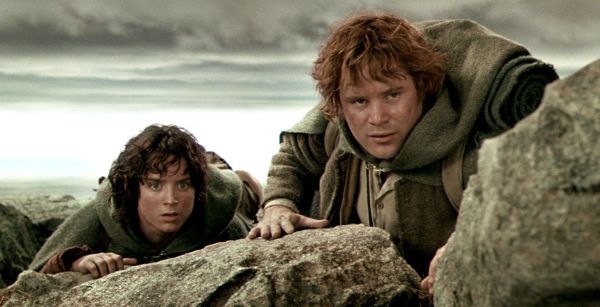
And of course, there is Frodo and Sam.  Theirs is a somewhat less exciting route, as they are trying to avoid being seen.  Frodo confronts Gollum, who has been shadowing he and Sam in his attempt to get the ring back. Frodo takes pity Gollum, and chooses to take him along as a guide.

In the first film, we only had glimpses of Gollum.  This character presented a huge challenge and still stands as a monumental achievement in CGI effects.  Coupled with a terrific performance by Andy Serkis, Gollum comes to tragic and frightening life.  Serkis takes on a voice that can seem almost painfully childish and monstrous…sometimes at the same moment.  The film has a great moment using reflections and camera angles in which Gollum argues with himself over serving Frodo faithfully versus betraying him and stealing the ring back.

In the book, the stories are separated into two parts.  The first half follows Frodo and Sam and the second half follows the other characters. In one way, this does allow some interesting storytelling moments.  Frodo and Sam’s story will reference them seeing stuff we only see played out in the second half of the book.  But it also can make the Two Towers a tough read.  It does not break up the story enough.

Gimli continues his slide into little more than comic relief and Legolas even ends up having plenty of his swashbuckling antics coming off as comedic and cheesy (using a shield as a surfboard).

The film also undermines the character of Farimir, brother of Boromir.  In the book he is not tempted by the ring in any way.  He is a strong and confident man in ways his older brother was not.  Unlike Tom Bombadil, this not being tempted is an effective statement of Farimir’s character.  The film makes him much less sure of himself.  He is haunted by the ghost of his brother and his father’s greater love for Boromir. He does, of course, make the choice he makes in the book, but the overly wrought drama of giving him severe daddy issues works against the character in frustrating ways.  Yes, it allows Sam to be a dramatic voice of reason…but it really is an unnecessary detour that also makes Farimir come off as needlessly cruel at times.

The Two Towers does start to feel a bit meandering at times.  The extended cut suffers from this even more, though some of the additional scenes are quite entertaining.  While not quite an Empire Strikes Back (which is a bit leaner storytelling) it still is a pretty impressive film.

Roid Rage Part 4 (Kull the Conqueror, 1997)

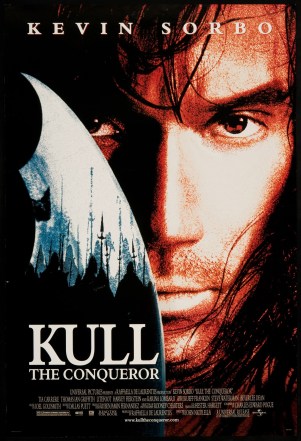
Kull_the_Conqueror_PosterBased on the popularity of Hercules the Legendary Journeys and Xena Warrior Princess, an attempt was made to revisit the worlds of Robert E. Howard.  This time, it was another of his sword and sorcery heroes.  Kull is a barbarian who blunders his way into the crown.
Really. He is trying to join an army, but the general mocks him, noting his army is comprised of men of noble blood and Kull is a mere barbarian.  The General is called back to the castle because the King is slaughtering all his next of kin. Kull shows up, gets into a fight with the king, slaying him.  As both the general and one of the King’s sons tries to claim the throne, the King gives them the finger and proclaims Kull King with his dying breath.

Rules are rules, and so Kull gets to live the good life.  Meanwhile, this shady guy with a beast man assistant is resurrecting an ancient sorceress who happens to be the magically babelicious Tia Carrere.  She plans to rule her kingdom again and seduces Kull.  After she and her minion convince everyone Kull was poisoned by a member of his Harem, Kull is tossed into slavery, but he escapes.  Then they go on a mission to get the magical power that can stop Carrere.

This is a pretty sub-par tale, even by fantasy standards.  It is not pulpy fun, and in spite of being a theatrical release? It feels like a weak TV movie. And frankly, the appeal of Sorbo is kind of lost on me here.

Kull is a lifeless adaption of Howard’s work.

Rise of a Zero (Hercules, 1997)

Hercules_Disney_PosterThe gods of Olympus are celebrating the birth of the son of Zeus and Hera (um…slight change from myth, Disney cannot be seen as endorsing extramarital god flings) Hercules.  Everybody seems happy except brother Hades. Hades attempts to turn Hercules mortal…but is only half successful, forcing Zeus to allow his son to be raised on earth by a poor couple of peasants. Hades is unaware that his plan was unsuccessful, mislead by his minions Pain and Panic, and believes Hercules is dead.
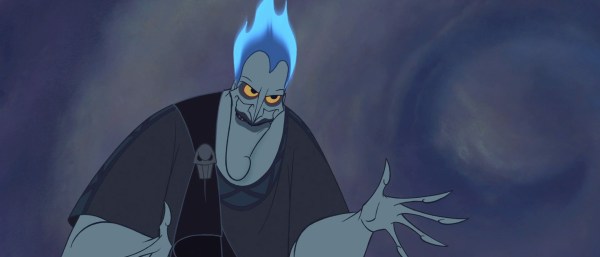
But years later, Hercules is a clumsy young man, who seems to cause trouble anywhere he goes, due to not being able to properly judge his own strength. He seeks the help of satyr Phil to train to become a true hero. Along the way he falls for “bad girl” Meg, who turns out to be a pawn of Hades. He is shocked to discover that Hercules is alive and sets out to get rid of Hercules and Zeus at the same time.

Frankly, James Woods is the best thing here. His Hades is a darkly comic jerk who is quite  bit of fun. The films tone and honor are kind of all over the place, and not particular effective (especially the whole mocking of “branding”, which rings kind of hollow as critical humor goes).

I really like the character design of the film.  The art style is unique from previous Disney animated features. Ultimately, we are left with a light film that is kind of a mess in it’s execution.

It is not something I plan to do often, but this essay from Lindsey Ellis on the film hits pretty much everything I like and dislike about the film.  And is more entertaining than my ramblings.

Galaxy Express (Danny Johnson Saves the World, 2015)

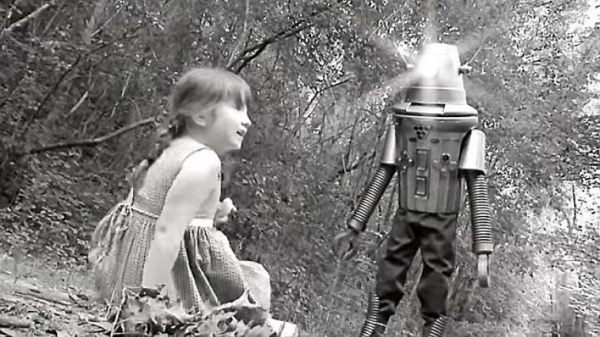
Mihm_Danny_Johnson_CoverChristopher R. Mihm often has a specific influence for a film.  For Danny Johnson Saves the World, he was focused on creating a family adventure.  It is the tale of young Danny Johnson (we’ve seen Danny in prior Mihmiverse films) who is playing a game of “hide and seek” with his friends when they run smack dab into an alien invasion of…puppets.  Danny has to save his friends and little sister from the diabolical Alien Queen (and her imbecilic King).  He is helped by an alien defector named Steve.

Danny Johnson Saves the World has a flashback framing device that is reminiscent of the Princess Bride and a Christmas Story as aged Danny Johnson (played by James Norgard) is telling his grandchildren a story as they wait for the Christmas Meal.

The film is a lot of fun and achieves its goal as a family film. There are action and monsters, but nothing too intense for younger viewers.  The effects have that look of a 50’s family sci-fi with a neat looking robot villain and a monster called Meat (it looks like something from Dungeons and Dragons) that features more classic stop-motion animation like we saw in the Late Night Double Feature.


Mythical Voyagers (Moana, 2016)

moana_posterDisney’s Moana is the second time they have visited Polynesian.  The first was the fun Lilo and Stitch. This time around, Moana goes for mythical adventure.

Moana is a young woman, destined to be chief of her island, like her father before her.  But part of her longs to go beyond the reef at the entrance to the island’s cove.  She tries to fulfill her duties, and is doing well, until she suggests going beyond the reef, as the fishermen are catching no fish.  The coconuts are spoiling.

The reason is, because long ago, the Demi-God Maui stole the heart of Te Fiti…and this resulted in a malevolent force spreading across the sea.  Moana’s people have not left the island for fears of what lies beyond the reef, but Moana finds no choice when the sea gives her the Heart of Te Fiti.  She seeks out Maui to make him right his wrong.  The two are forced to endure each other on the mission.

Mismatched heroes is nothing new, and yet, the personalities of Moana and Maui are quite charming.  This is in spite of the fact that Maui is a tremendously egotistical guy who sees everything he has done as heroic.  Moana is both responsible and adventurous, which is a bit more unique.  Often, it seems brash and impulsive heroes have to learn the lesson of responsibility.  Not Moana.

The fact is, rather than take the easy route of making impediments for Moana some brand of villain?  They opted for making them likeable and relatable.  The one time we see Moana’s father express anger, it is not cruel or abusive.  It is out of personal fear that Moana may be to much like him.  Her parents are loving.  Her grandmother is gentle, wise and goofy.

The writers and Dwayne Johnson are able to imbue Maui with charm even when he is being stubborn and selfish.  You want to see him turn it around.

The animation in Moana is vibrant and beautiful.  It is fluid, like the ocean it crosses.  The concept of Maui’s tattoos being a living part of him that act as a conscience is a terrific idea.  It is also worth noting that the tattoos are hand drawn and animated.  They are seamless with the digital animation.

The songs, by Hamilton’s Lin-Manuel Miranda, Opetaia Foa’i and Mark Mancina are both powerful and engaging fun.  The more Polynesian influenced songs play, they swell and explode with a certain power.  The more pop songs (there is one Bowie-esque songs that is truly enjoyable) make you want to move.

The story is inspiring, built on thoughtful dialog, along with a whole lot of humor.  I have tried to find something not to like.  But you know what?  I cannot.  Moana was pure joy to watch.

Create a free website or blog at WordPress.com.

Up ↑