Poisoned Earth pt 2 (the Curse, 1987)

The_Curse_PosterThis adaption of the Color of Space picks up at the time the meteorite crashes.  Going back to a small farm setting the focus is on the struggling Crane family.  The local realtor is working on a secretive deal to get people to sell their land to him cheap, but Nathan is holding out.

This film amps up Nathan as a religious man, making him a stern preacher.  His youngest son Zack feels out of place in his family.  There is the implication that his mother has a wandering eye and has been unfaithful.  The family is a bit stressed before the meteorite lands, but once it hits, the family starts to unravel.

This is closer to the original story, though as I recall, the religious emphasis  is more prominent in the movie.  The effects range from decent to blatantly obvious latex masks that do not blend very well at all. Claude Akins is very good at the role of deeply religious man teetering on the edge.

This is a decently fun adaption, clearly done on a restricted budget. One of only three films directed by actor David Keith, this showed some promise.  The Curse became an anthology series with three more direct to video films.  The Curse II: the Bite (which I have a soft spot for) and the Curse III: Blood Sacrifice and a film not actually made for the franchise call Catacombs (but titled as the Curse 4: the Ultimate Sacrifice) had no connection to the first film, and none were based on Lovecraft either.

Again, this is a decent adaption, it is definitely very much a product of the eighties, even in its reflection of the world encroaching on the struggling farmer. But it is a fun watch.
Poisoned Earth pt 1 (Die, Monster, Die!, 1965)

Die_Monster_Die_PosterLovecraft is a writer that, in spite of his personal failings (you know…racism), inspires creative people. His stories are creepy cosmic and occult based horror. Die, Monster, Die! adapts the memorable the Color Out of Space.

Stephen Reinhart has been requested by his girlfriend Susan to come to her parent’s remote home.  When he tries to find transportation from the nearby town, nobody will take him out there, refusing to explain why they seem so fearful of the Whitley Estate.

On his way he finds a decaying forest and when he arrives at the Whitley home, he finds that Susan’s mother has taken ill and her father is behaving very mysteriously.

What he discovers could doom the world and Susan’s mother begs Stephen to take Susan far from their estate before what has befallen her starts to consume Susan as well.

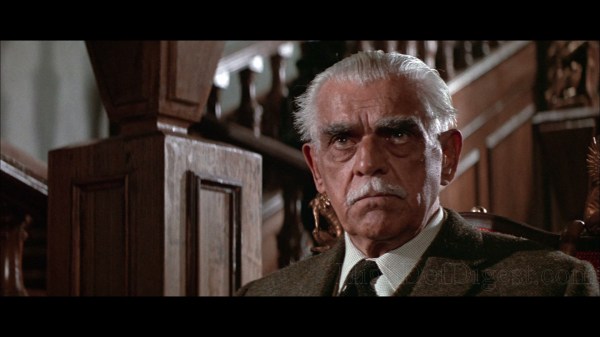
Die, Monster, Die follows the core idea of a meteorite that mutates the world around it…giant plants, mutant farm animals, people deteriorating monstrously. But it abandons the setting of a farm house for more of a gothic stately mansion.  The film is colorful, especially the greens.  The visuals still hold up and Karloff gives a nice menacing performance throughout the film, without being so far that he cannot also be sympathetic.

This is an entertaining adaption that is definitely a product of it’s time without not being to corny. Instead, it has a nice Hammer film feel to it.


World Washed Away (The Last Wave, 1977)

The_Last_Wave_posterWhen five Indigenous men in Sydney are accused of murder, a lawyer (with no experience in murder defenses) is called on to provide their defense.  But instead, he finds he may have always been a part of something larger.

Haunted by nightmares and visions, including of Chris Lee (one of the accused), he finds he may be on the verge of a world ending cataclysm.

The Last Wave is Peter Weir taking his time and looking at the possible end of the world on a very small scale.  This is effective, as Richard Chamberlain struggles to piece things together and learn from his indigenous clients what is truly happening.  It ends on a haunting and slightly ambiguous note, but so very effective visually.

The Last Wave is kind of a forgotten film, but it is a strong entry in the realm of apocalyptic horror.

Reboot, Restart (Jay and Silent Bob Reboot, 2020)

Jay_And_Silent_Bob_Reboot_PosterKevin Smith created a splash with Clerks in the early 90’s.  He had a string of hits, but somewhere around 2001 he started to fall out of favor.  Now, I actually like Smith’s general work and some cringe takes over the years, he comes off as a well meaning guy who wants to entertain through stories. He started doing national tours where he pretty much just chatted and told stories about his career (this has resulted in some rather entertaining DVD sets). His movies have not fared as well among critics and general audiences (though I liked Red State and Tusk).
I like Smith and feel like people are a little too hard on him. Maybe I have missed something unforgivable. But anyways… 2001 was the year that Smith put out Jay and Silent Bob Strike Back.  Unlike previous works, there was no real “message” or exploration of ideas about relationships and the like. The film was just a wacky hijinks filled raunchy comedy.

Jay and Silent Bob find out that Banky sold the film rights to a major studio to create a Bluntman and Chronic (the comic Holden and Banky created in Chasing Amy). Angry that they are not seeing any of the profits, they set out to sabotage the film.

I worked at a video store when it came out on DVD.  Every night when we closed up shop, we threw in that DVD and laughed our asses off as we did our closing duties. Jay and Silent Bob Reboot feels, well, inevitable.

Picking up around seventeen years later, Jay and Silent Bob discover that Bluntman and Chronic is getting rebooted and they are not being compensated.  So they set off to sabotage the film by going to Comic Con.  The hiccup is the discovery that Jay’s beloved from Strike Back- Justice- had a daughter with Jay that she never told him about named Millenium, or Milly. Justice is now married to a woman named Reggie Faulken. Yes, Smith is geeking out hard here.

After meeting, Milly forces Jay and Silent Bob to take her and her friends to Comic Con with them (without knowing who Jay is, as Justice makes him promise to not reveal he is her father). Hijinks ensue.

There are some good laughs, mainly falling into cute references, rather than joke based hilarity.  The cameos are ranging from fun to “because they could get them”…but what really stands out with the film?

Smith wanted to say something here.  Like, his desire to communicate overwhelms the film.  And not in a terrible way, I actually like what he is saying…it feels far more personal than some of his other attempts at sentimentality.  Family seems to have been the spirit here, and I truthfully like that.  Even when we revisit characters like Holden and Alyssa from Chasing Amy, it is to show them both at a better place in their lives and their relationship.  Smith pushes the notions that family is bigger than traditional ideas of a nuclear family. Family is what you make of it, don’t fear parenthood, no matter how scary it may seem.

This is not to say the film is not goofy, it is…and while some humor feels repetitive or just fell flat for me early on, by the end of the film, Smith won me over.

Now You See Me (The Invisible Man, 1933)

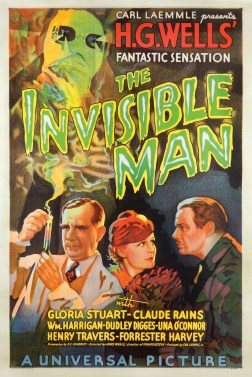
Invisible_Man_1933_PosterThe Invisible Man opens mid story.  A mysterious bandaged stranger arrives at a tavern and demands a room.

When he becomes abusive to the tavern owners the police come and the truth is revealed…beneath the bandages is emptiness. Meanwhile, associates of the invisible man are trying to locate him in the hopes of curing his condition.

It is revealed that while he is initially trying to heal his infliction, Jack Griffin is being driven mad with power through the invisibility. Through his beloved Flora and her father, we discover he was a better man, and they are hoping to return him to that.

The idea that invisibility would turn any man or woman deviant no matter how decent they are is not really quite explored here, as it is shown to be a side effect of the formula that is driving him mad.

The Invisible Man is short and moves quickly, and Claude Rains is quite entertaining.  The effects are still incredibly effective, making this a fun part of movie history.

The Art of Gaslighting (The Invisible Man, 2020)

Invisible_Man_2020_PosterWhen the Tom Cruise update of the Mummy crumbled, so did the planned Dark Universe that Universal was placing hopes on. Instead, Universal penned a deal with low budget horror production studio Blumhouse.  They brought in director Leigh Whannell to make a lower budget re-imagination of the character.
Whannell moves the focus to Cecilia Kass who is trying to escape an abusive relationship with a famous optics tech scientist.  She tries to hide from him until she is informed that he has committed suicide. At first, things start to look up and improve…but suddenly, mysterious occurrences begin to occur that slowly cause Cecilia to unravel…she is convinced that her ex Adrian is still alive (the film does not hide this, both the trailers and film make it clear that Adrian is messing with Cecilia).  However, she cannot convince anyone of this.  Adrian starts to escalate things, severing her relationships and interfering with all attempts to move forward.

Moving the focus from a mad scientist to the victim of an obsessed stalker is highly effective.  Whannell constructs an incredibly intense opening sequence, with no effects beyond the use of sound and the motion of the camera.

The whole film uses angles, shots and general camera movement that causes you to distrust your eyes.  And it is incredibly impactful for the viewer as we search the screen for what is…wrong.

Moss gives a terrific performance.  We know she is not crazy, but her descent into obsession with proving Adrian is still alive is visceral and shocking.

I also really liked Aldus Hodge who is a police detective friend allowing Cecilia a home in which to stay.

The Invisible Man is an excellent thriller and I highly recommend it.

Give It All Away (Brewster’s Millions, 1985)

Brewsters_Millions_PosterBack in 2008, Bill Gates retired from the day to day of Microsoft and had the plan to devote his fortune to charity. Twelve years of giving charitably, Bill Gates is now worth more than he was in 2008.

Monty Brewster is a down on his luck minor league baseball player who discovers he had a long lost rich uncle.  Monty is the last living relative and is set to receive $300 million on one condition.

Monty is required to spend $30 million in thirty days. At the end of thirty days, he can only have the clothes on his back.

Monty takes the challenge, but finds quickly discovers the odds are against him. The Law Firm dispensing the money will gain all of the estate if they fail, and so they set about trying to sabotage him. His friends enjoy spending the money with him, but Monty has the problem that people assume he does not want to go broke and he cannot tell them why he is spending like a madman.

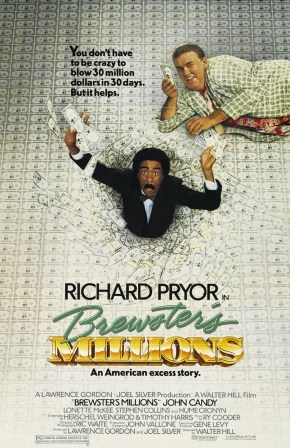
The seventh adaption of a book from 1902, this version is written by Timothy Harris (who wrote Trading Places, another “rich men put the poor through the ringer” story) and directed by Walter Hill (48 Hours and the Warriors), this version is a vehicle for the late Richard Pryor.  And it is a fun vehicle.  The antics as Monty tries to spend his way to being broke is supported by terrific cast.  John Candy is Spike, Monty’s best friend.  This is pure Candy charm at work, emphasizing a nice and goofy nature with just a hint of being a womanizer.  Lonetta McKee is the person assigned to keep track of Monty’s spending, but unaware of his full situation, she is repulsed by his squandering of money when it could be used for good.

Thirty five years later, Brewster’s Millions still holds up as a fun comedic farce.


The Rich Eat the Poor Eat the Rich (Parasite, 2019)

Parasite_PosterParasite opens with a family struggling to find access to someone’s wi-fi so they can use their phones. Comical and relatable it is also clear the Kim Family are constantly trying to find ways to make money and cut costs.

When a friend of son Ki-Woo asks him to take over a job tutoring a girl from a rich family for him while he is away at college, the Kim family gets an idea.  They plot to infiltrate the family via employment.  They find ways to get the current employees of the rich Park family fired and take their places.

Parasite is one of the more clever and nuanced looks at class and really the entire system of capitalism.  Bong Joon Ho weaves a tale without heroes. Instead, we follow the families and see how different the worlds they live in are and yet how interdependent those worlds really become. It is not a critique of the rich.  The rich in the film are not direct evil. We Americans tend to be more comfortable with clearly delineated good and evil.  But Parasite looks at the economic system of capitalism and suggests it makes us all parasites.

The cast is terrific, with all great performances.  The writing is wickedly funny and emotionally charged. Parasite earned it’s Oscars and is a film I highly recommend.

Fast Cars and Overheating Egos (Ford Vs Ferrari, 2019)

Ford_vs_Ferrari_PosterI confess…the subject of the film is not close to my heart. Cars are a utilitarian tool for me. So, I confess, the trailers did not excite me much. Damon and Bale are pretty proven variables…and Mangold has shown himself to be a skilled director.
Dramatizing the events of Ford’s attempts to beat Ferrari in racing and the team Ford assembled to pull it off, this got pitched as a dad movie.  Which, I mean, I guess dads will like it… but really it is a film that fans of creative innovations and risk will find appealing.

Forced to stop racing Carroll Shelby is recruited by Lee Iacocca (for Henry Ford II) to create a race car that can beat Ferrari in the 24 Hours of Le Mans. He reaches out to his friend, driver Ken Miles to help.  Reluctant at first, as he gave up racing to focuses on his life with his family, Miles becomes dedicated.  However, execs at Ford are not keen on having Ken as the driver, believing him too difficult.

The drama is terrific in the film, with the hard work, successes and disappointments as they fight to succeed against the odds. Damon and Bale have a very real connection as friends with a somewhat adversarial relationship.

There is some really solid cinematography on display here.  One of my favorite shots is Ken sits on the training track with his son as the night is falling. Just beautiful. I also thought the racing sequences were nicely played out.

Ford vs Ferrari is an engaging film worth watching, whether you are a dad or anyone else.

Quiet Regrets (The Irishman, 2019)

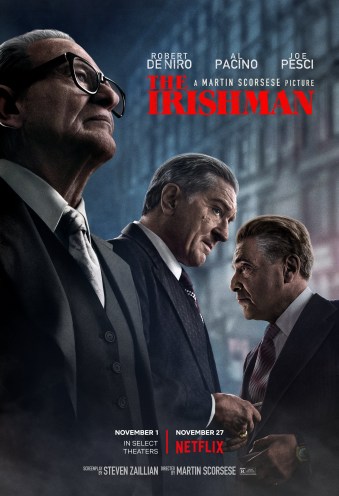
The_Irishman_PosterMartin Scorsese has given us countless cinematic classics. It stunned the world of film when it was announced his next film, the Irishman, would be a Netflix original.

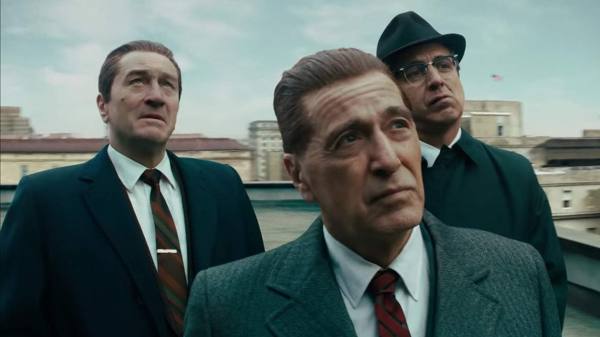
The Irishman follows the life of Frank Sheeran, a mid level mafia type who…well, when all is said and done, loses the important things in his dedication to the empty life being offered by the family.

Like Goodfellas or Casino, we see lives of toxic masculine bravado and the damage it does to families. But this time, Scorsese opts for a more quiet and lamenting approach. Less focused on the brutality, this film is about a man who tries hard to not acknowledge his faults. It ruins his relationship with his daughters, yet he is unwilling to truly take the steps to fix the situation. He has regrets, but not the will to become a truly responsible man.

With a three and half hour runtime, I suspect that it may not be as effective for casual viewers.  This is a good film, though not Scorsese’s best.  It boasts strong performances, with this being one of Joe Pesci’s finest moments of his career.

The film makes big use of de-aging technology.  When characters are sitting around? It is really good. Screen shots look fine. But when there is action and a lot of movement required…well, it may *look* like 35 year old De Niro…but he moves like 76 year old De Niro and that is hard to ignore.

As I said, this is good, but not a great Scorsese film.  I am glad he made it, I liked it.  But outside of Scorsese die hards, I am not sure this film will garner near the appreciation.

Create a free website or blog at WordPress.com.

Up ↑