The Beast of Love (Spring, 2014)

spring_posterEvan (Lou Taylor Pucci) is witnessing his life collapse…a friend suggest he pretty much run away, he runs off to Italy.  When he arrives in a small town, he fines himself drawn to Louise (Nadia Hilker), a beautiful resident.  She initially offers the promise of a fun night of sex, and keeps pushing Evan away when he asks for actual dates.  After a time she relents and they begin a fun relationship.  Louise has a dark and deep secret.

Spring is a romantic tale with horror elements.  When Evan discovers the dark reality of Louise, he is terrified, angry and yet still drawn to her.  As she tries to explain who and what she is, he is unwilling to hear it…but hen finds himself feeling the desire to continue on with her.  The film hinges on the time that follows changing Louis is one of two ways.  Either she will be made fully human…or she will become something new.  Will she truly love Evan?  Will she never love him and then place Evan in danger when she changes.

The film plays with the notion that she is something natural, rather than supernatural.  She is not any typical kind of monster, sometime she is reptilian, sometimes wolf like and so on.  It creates a unique mystery. The effects are primarily practical and look great.

Louise is alluring and mysterious. Hilker and Pucci have a real solid chemistry that draws the viewer in.  The visuals (filmed in Italy) are powerfully beautiful.  The settings that Louise and Evan traverse through are engaging on their own.

Directors Justin Benson (also the writer) and Aaron Moorhead are proving themselves skilled filmmakers who make strong films with genre touches that expand on the themes that are driving the film.  Their previous film is the critical but unseen Resolution.  Spring is a thoughtful romance that uses horror touches to explore the travails of growing love.

Finally, the film has a beautiful and simple score that is both hypnotic and emotional by Jimmy Lavalle.

Vengeance Is a Dish Best Served Cold (The Revenant, 2015)

the-revenant-movie-posterRevenant: Definition one, a person who returns.  Definition two, a person who returns as a spirit or ghost.  The film works on both those levels.  Going in, based on early word and promotions, this may have struck you as a revenge movie with Leonardo DiCaprio fighting a bear.

And those things are there.  The bear attack is intense and brutal.  It also leads to DiCaprio’s High Glass’ quest for revenge on Tom Hardy’s John Fitzgerald.  After their fur trapping group is attacked by a group of Native Americans.  They are seeking the Chief’s kidnapped daughter and believe Glass’s crew has her.  The survivors escape due to Glass’s knowledge of the wilderness.  His main goal is protecting his son.

While scouting ahead, Glass is attacked and has a fight with a large mother bear.  His group tries to patch him up, but ultimately, they agree to go ahead while Fitzgerald, Bridger (Will Poulter) and Glass’ son Hawk (Forrest Goodluck) stay with the incapacitated Glass.

Things go south as Fitzgerald becomes impatient, wishing Glass would just die.  As I said, the film is a revenge film.  But it is not a revenge film like we might get starring Liam Neeson or Mel Gibson.  Director Alejandro G. Iñárritu (2014’s Birdman) takes his time.  Much of the film simply follows Glass struggling to survive a harsh winter, mostly alone, when he can barely walk.  The actual seeking of revenge does not occur until near the end of the movie.

It is beautifully shot, capturing much of the beauty that can be found even in harsh winters.  Iñárritu skillfully will focus on a sunrise as seen through frozen bare tree branches.  And the performances are what one would expect from talent like DiCaprio and Hardy.  There are long quiet stretches, that get broken up by harsh and brutal violence.

I don’t know that the Revenant is truly a film that invites repeat watches, it is not a film where you need to mine it for themes buried deep.  Instead, it is laid bare on the table.  It is a film that sticks with you well after leaving the theater.

Being the Alien (The Martian, 2015)

The_Martian_posterFor being a comedy, (thanks People’s Choice Awards) The Martian feels pretty serious.

That does not mean it is devoid of humor.  Really, most any solid drama with have humor to break tension.  And considering the situation Mark Watley (Matt Damon) finds himself in?  Tension needs to break.  After an accident leaved Watley left behind on Mars, (believed dead) he finds himself struggling to find a way to last until the next mission to Mars can pick him up…in about four years.

The Martian is a thrilling account of survival that manages to be filled with concern and joy.  Ridley Scott likes his epics, but this is very low key in that regard.  Instead, it is a focus on character and endurance.  We get a window into Watley’s thoughts by way of his video recording everything he is doing as a journal.  On the one hand, this could have felt like weighty exposition, and some might wonder why the filmmakers did not opt for the near silence of the first half of Castaway.

Damon’s delivery is light and accessible, rather than clunky, and it is easy to connect with the character.  One of the film’s strengths is how it manages to give us insight to our characters very quickly, especially the crew.  We meet them mere moments before the storm that separates Watley.  And yet, you get a feel for the relationship of this crew and the dedication they have to each other in those few minutes.

The cast is very strong, everybody turning in enjoyable performances.  The visuals are solid, considering it is a lot of reddish sand and rock.  Scott really seems to like films set on barren planets.

The Martian is an engaging sci-fi drama well worth viewing.

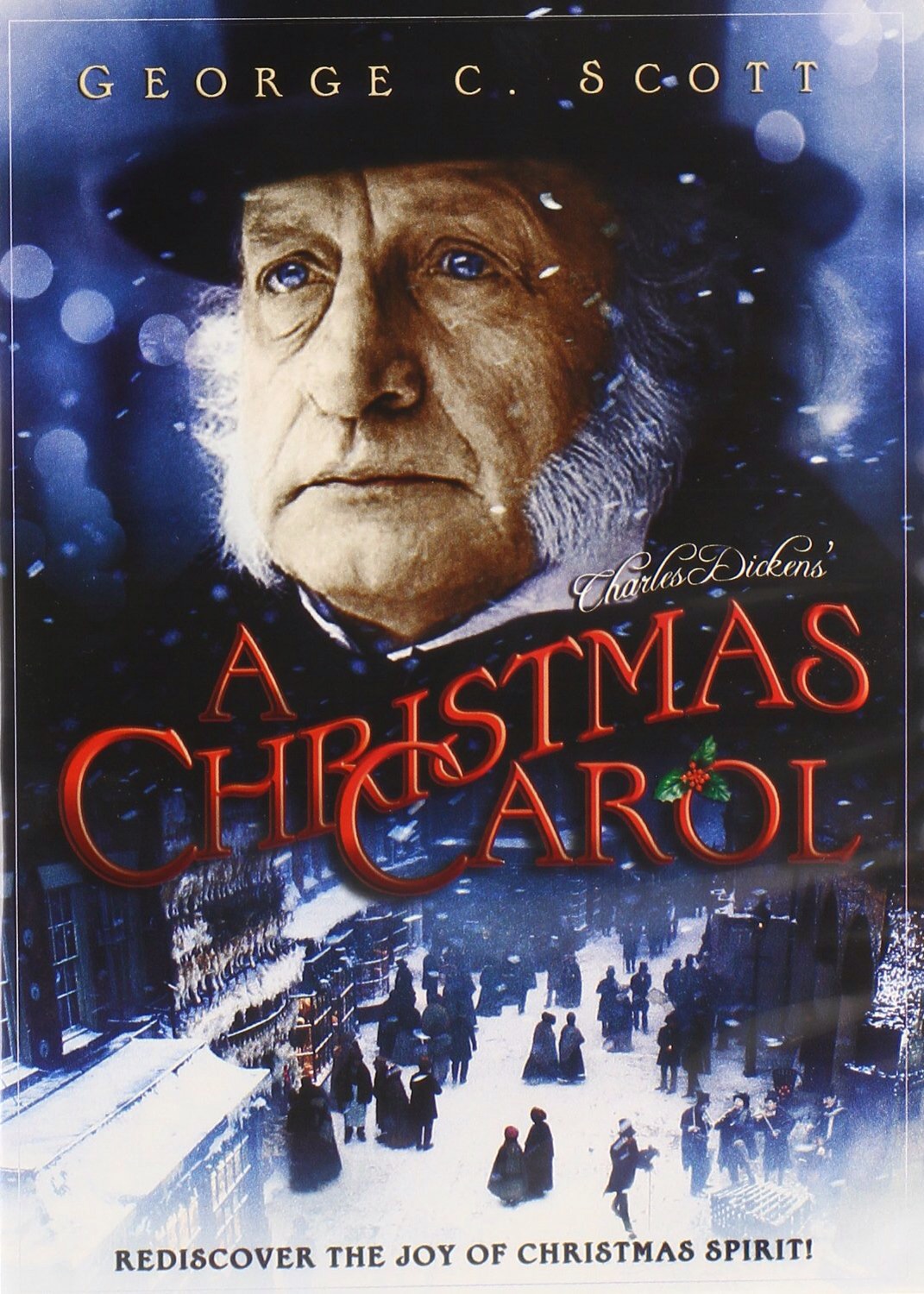
What a Scrooge Part 9 (A Christmas Carol, 1984)

 For some reason, the definitive version for me as a child was the 1984 George C. Scott version. Scott plays Scrooge as someone who seems to enjoy being mean to people. He likes dancing on other people’s joy and belittling their situations. Scott’s Scrooge is bitter and proud, and a bit spiteful. But I think what always made the movie for me was the Marley sequence. It was terrifying.

It still is. Scott sits in the corner, huddled by a small fire. Above the flames, Marley’s tormented visage starts to fade in and out. Then, the bells start to ring. And Scott turns towards a loud thump at the bedroom door. Slowly, the locks come undone and the door swings open. Marley (Frank Finlay) fades in as he marches into Scrooge’s room. He faces Scrooge, unties a bit of cloth around his head and his jaw falls to his chest. Marley is horrifying as he stands there, mouth agape and covered in chains. And his voice is loud and tortured. Every word seems labored. Marley is walking sorrow and regret. And he convinces you that this is no mere figment.

The first ghost is oddly youthful, yet ageless (Angela Pleasence). She takes Ebenezer from past Christmas to past Christmas. Scrooge is defensive at these moments. The Ghost even mocks him a bit cruelly. When she denounces Fezziwig as a silly man, Scrooge (who is caught up in fond memories) defends him to her. You begin to see the cracks in Scrooge’s armor as he goes through each moment. Finally, he can take no more and tries to snuff out the light of the Ghost’s truth. Scrooge is visited next by the host of Christmas Present (of course).

This incarnation (played by Edward Woodward) is boisterous, yet hides an ominous side. He seems to relish every opportunity to use Scrooge’s own words against him. At one point he angrily (yet with a hint of a smile) tells Scrooge that it may be that in Heaven’s eyes he is worth far less than the people who he has no time to help. His words sting both viewer and Ebenezer. Then he leaves Scrooge to wander a lonely part of town.

Then Ebenezer sees the final Ghost. What I find so interesting is that we only get little glimpses of the Ghost of Christmas Future. We see it at a distance (with waves of fine fog cascading across the ground.

The few close ups are from behind or of the Ghost’s almost crippled and deformed hand. Mostly, though, we see the long shadow it casts into the street and doorways. It’s all used to powerful effect. Scott again shows a new side of Scrooge, this time terror and desperation. And even though it never speaks, this ghost has its own moments of cruel mockery. When Scrooge demands to be shown some human emotion in regards to the death of a man (unwilling to accept the truth of who the dead man is), he is brought to a seedy part of town where people jovially mock the deceased why going over goods stolen from the deceased’s home. Even upon seeing his own watch, Scrooge refuses to accept the reality. Only when forced to look upon his own grave does he accept the inevitable. And that’s when Scott’s Scrooge loses it. There is no doubt that he fears all is lost, and the night is a waste. He finds himself at his bedside, praying out loud, begging in tears for another chance. And then morning comes to find Ebenezer still on his knees, but having fallen asleep from exhaustion. Scott is very convincing in his turn to a man of generosity.

He comes across as a man excited to repent of his past and to make up for lost time. His excitement is infectious. One interesting note is that Scott is a departure from the typical Scrooge. Often Scrooge is a frail looking slender man. Scott, on the other hand, is more stout and robust. It’s very effective with his gruff demeanor and slightly gravelly voice.

Throughout the film, Scott bounds between arrogant pride and a fear of the reality that beats back against his coldness.  It is a wonderful performance, and a large reason in the end why this remains my favorite and most recommended version of a Christmas Carol.

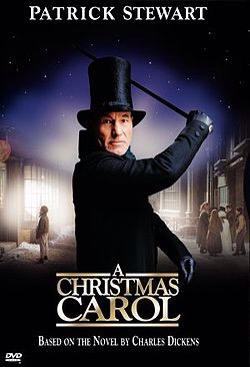
What a Scrooge Part 6 (A Christmas Carol, 1999)

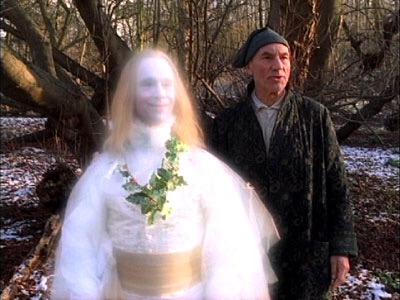
 Today, I am writing about the 1999 TNT television movie starring Captain Pickard, er Professor X…um…Patrick Stewart.

The film opens slightly differently than the others. It opens on the day of Marley’s death. Scrooge is rather dispassionate, simply signing off on Marley’s death in the Church ledger as the only guest. He then walks the foggy streets of London. He reaches his store front, enters and we see the passage of time as the sign is eaten away by the elements, devouring Marley’s name. When Bob Cratchit (Richard E. Grant) asks if Scrooge intends to remove Marley’s name, Scrooge merely grumbles. He doesn’t leave it there out of sentimental memory of a friend. Rather, he doesn’t want to spend the money on a new sign, and feels the elements will erase Marley’s name just fine.

Scrooge is visited by his nephew Fred (Dominic West). This Fred clearly loves his uncle, never mocking him, but clearly having some fun in the hopes of lightening his dour uncle’s mood. Ebenezer has no interest in accepting Fred invitation, even threatening to fire Cratchit after a fiery speech from Fred about the goodness of Christmas.

Scrooge is then visited by men seeking donations for charity. He mocks the men, asking if there are no prisons or work houses, after all, his money goes to the upkeep of those through taxes. Finally, when one of the men suggest people would rather die than face those options, Scrooge heartlessly suggests they should die and decrease the surplus population. And with that, he takes his leave. When he gets home, Ebenezer briefly sees Marley’s face upon the door knocker and once inside him home hears strange noises about his house. He tries to comfort himself by eating next to the fire, he is startled as he looks at the ornate designs of the fireplace. One shows a man clubbing another man…suddenly, the attacker turns and looks at Scrooge! It’s a brilliant and simple effect. Then the design forms the face of Marley. Scrooge shakes his head.

Then the bells start to ring, and Scrooge hears the sound of clanking metal coming up the stairs toward his room. Marley (Bernard Lloyd) walks through the door (I kind of missed the creepy unlocking of the locks and the door slamming open like the 1951 and 1984 versions had). Once inside, he unties a cloth around his head, dropping his jaw. Again, in a nice subtle use of digital technology, his mouth opens frightenly wide, like a cavern. This Marley is on par with the 1984 in fear. He is tired from dragging his chains, frustrated by his hell. Interestingly, Marley seems thrilled by his opportunity, since, for once, he is able to interfere in Ebenezer’s life, to spare Scrooge his own fate. And he promises a visit from three spirits. Scrooge attempts to be humorous, suggesting that time is precious, could they not just come at the same time. But Marley has no patience for his friend’s frivolity…he wants to save his soul.

And so the first ghost comes, the Spirit of Christmas Past (Joel Grey). At first, it’s hard to see the Spirit, as the light is so intense. Scrooge tries to stay confident sounding, though the Spirit is clearly outside of his comfort zone. This is an interesting take on the ghost, as it blends the variety of choices before. Joel appears much younger and more androgynous than the 1951 version, but has the long blonde hair, and certainly older than the 198 or Muppet version. Grey brings a certain undercurrent of mockery towards Scrooge, which is entirely appropriate for the Ghost.

And first he brings Ebenezer to his school, and Scrooge is overcome by his emotion at seeing young friends. Years pass and Scrooge is joyous upon seeing his young sister, until the Ghost reminds him of how fragile she was, and Scrooge becomes withdrawn. As if taking pity on Scrooge, the Ghost brings him to his youth at Fezziwig’s. There we are introduced to the short and round man, Albert Fezziwig (Ian McNeice). He a jovial and happy man, in love with his wife and family…loves a good celebration. He cannot close up the shop fast enough to start his party. Even here, Scrooge finds a moment of joy, taking offense when the Ghost chastises Fezziwig as a silly man. But his mood quickly turns as Belle (Laura Frazier) enters the room. This is the woman he loved, and the love starts to grow inside on sight. But the Ghost is cruel at times, and the next thing it shows Ebenezer is the day Belle set him free. Scrooge pleads with his younger self to go after her. But even as Belle pauses to look back a final time, young Scrooge does nothing. Scrooge demands to be taken home. The Ghost honors the request, but the harsh truths he has witnessed are too much. Scrooge grabs the cap carried by the host and uses it to cover and smother the Ghost’s light.

But it is hardly over. Scrooge awakens to a light under the door. He walks into the room where Marley met him to find a giant of a Ghost…the Ghost of Christmas Present (Desmond Barrit). He shrinks to Scrooge’s size and takes him into the city.

The Ghost walks from person to person, casting water on them as a mystical blessing. They go first to the Cratchit Household. Scrooge expresses surprise that Bob has a boy who is crippled, and the Spirit gruffly replies “You should have asked him.” The Spirit seems to have far less patience for Scrooge’s attempts to sound innocent of his attitudes and actions. Again, this Ghost has no tolerance for excuses from Scrooge, much as Woodward’s in the 1984 version. He is abrupt, brash and yet joyful and boisterous. After Scrooge asks if Tiny Tim will die, the Ghost sorrowfully states that if things remain unchanged, there will be an empty seat when he brother shows up next year. As Scrooge starts to feel sadness about the prospect, the Ghost casts his own words about the surplus population back in his face, stunning Scrooge.

The Ghost then brings Scrooge to his nephew’s house. There he watches as they sing and chat, only to hear them talking about him. And Fred defends him. When asked why, Fred’s wife explains that his mother loved Scrooge. And Fred elaborates that he believes there is something good in Scrooge for his mother to have loved him so much. The Ghost tells Scrooge it is time to leave, but as they leave, Fred starts a round of games, and we see Scrooge light up. He has not played games in so long; he requests that the Spirit and he stay awhile. The Spirit grants the request. Then the Spirit takes Scrooge on a whirlwind (literally!) tour of the earth, to see people in every nation and of every class celebrating Christmas. As they return to London, Scrooge notices the Spirit is getting older. Then he sees movement under the Spirit’s robe. The spirit reveals two emaciated and sickly looking children, Ignorance and Want. They terrify Scrooge to the point that he asks the Spirit to cover them. But when Scrooge looks back, they are gone. He now stands along on a cold street.

Scrooge starts to run down the street blindly as the bells chime. But he is stopped in his tracks as a large hooded figure. He instantly recognizes it as the Spirit of Christmas Yet to Come, who will show Ebenezer shadows of things that have not yet come to pass. By this time, Scrooge realizes time is at a premium for him, and he is on the edge of change. And he knows he is on the edge, no less. For the first time, Scrooge asks the Spirit to take the lead, no fighting or attempts at bravado. You can see the change taking over him.

And yet, as I have noted in the other reviews, the Spirits all have a somewhat wicked sense of humor. Bringing Scrooge first to the Stock Exchange, where they eves drop on some men laughing about the death of another man, Scrooge winces. He is troubled by the callousness. The Spirit whisks him to a dark and seedy looking pawnshop where they find people selling the dead man’s things, all laughing how they took things as the body was still growing cold. One of the women even stole the shirt off the dead man’s body, feeling it was a waste of money to bury him in it. This all troubles and even angers Scrooge. He suddenly finds himself before the body, which is covered by a sheet. The Spirit points to the body, and Scrooge realizes that he is being asked to pull the sheet back. He reaches for it, but cannot, instead asking the Spirit to show him someone showing emotion about the man’s death. And so it does…we see a young woman looking distraught, suddenly, her husband comes up to her. We learn they were not able to make a payment and feared losing their home…until the husband explains the person who held their debt has died. So now they will have time to get the money they needed to pay it. The couple embraces, and Scrooge is left frustrated, he wanted to see that someone cared and was saddened by the man’s death. But there is no one. So he asks to see some emotion connected to a death. The Spirit brings him to the Cratchit household. Sadly, Scrooge stand’s behind his clerk Bob Cratchit, who kneels by the body of Tiny Tim as Bob tries to offer comfort to his son’s soul.

And finally, Scrooge finds himself in a graveyard. The Spirit forcefully points to a specific grave marker. Ebenezer starts to plead with the Spirit, asking why he must see these things if there is no hope for change…or if there is hope, he already knows he will be a new man, why must he continue. The Spirit says nothing, instead continuing to point at the grave marker. And so he finally relents and kneels by the marker. He brushes away the snow to reveal his own name, Ebenezer Scrooge, carved in the stone. Scrooge stands and starts begging for the Spirit’s understanding. Suddenly, the earth shakes and the marker cracks open to reveal the cold dead body of Scrooge. The ground gives way at the feet of the living Scrooge and he finds himself face to face with his corpse. Suddenly, the ground gives way beneath the coffin and Scrooge (clutching his corpse) is hurtled downwards, screaming.

And suddenly, he nearly falls out of his bed. He pauses for a moment. And a grin crosses his face. He is safe! Scrooge starts to feel the curtains around his bed, and then looks at his hand. He pinches himself. He is real! Scrooge starts to choke, or so it seems. But the truth is, he has not laughed for so long, it starts out feeling unnatural. But soon he is laughing and excited. He cheerfully extols just how little he knows. Ebenezer hears the bells and runs to the window. He sees a young boy and asks what day it is. The boy seems a little shocked, but says that it is Christmas. This excites Scrooge all the more. He has not missed Christmas!!! He asks the boy about the butcher shop down the street, wondering if the prized Turkey is there still. The boy says yes, and Scrooge asks him to bring the butcher back with the turkey.

When they return, Scrooge asks that it be delivered to the Cratchit home-anonymously. Scrooge then gets into his best “going out” clothes. He greets everyone with a smile, startling many who never have seen the man smile, much less say Merry Christmas. He runs into the two men who had approached him about a donation and, to their shock, makes a generous offer. Scrooge even pauses briefly for a snowball fight with some children. A very nice touch, that underscores his new heart, is Scrooge stopping off at a Church. He steps politely into a pew and starts to belt out, in that booming voice of Stewart’s, a holiday standard with the rest of the congregation.

Stewart then goes to his nephew Fred’s place. While he hears the party going on inside, Scrooge become scared and apprehensive, the expression on his face suggesting maybe this is too much at once. Finally, he forces himself up the stairs to the door. Quietly, Scrooge opens the door, so quietly, no one notices until Scrooge clears his throat. Everyone looks to him. Like a frightened child apologizing to a parent, Ebenezer asks Fred if he is welcome to dinner still. Looking first stunned, then thrilled, Fred stands and cheerfully invites him in. But Scrooge is not quite done. He humbly walks up to Fred’s wife, Emily (Annabel Mullion) and asks her forgiveness for his cold ways, and will she welcome him? Emily shares Fred’s warm heart and welcomes Ebenezer to their table with a warm embrace. Later, Scrooge is in the office, waiting for Bob Cratchit. When Bob arrives a little late, Scrooge takes a moment to play with Bob, pretending to be stern and upset regarding such an infringement. But he cannot contain himself for long. He breaks down and tells Bob he is giving him a hefty raise and will help him with Tiny Tim…and then demands he put more coals on the fire.

Honestly, I love this version almost as much as the George C. Scott version from 1984. Patrick Stewart captures Scrooge as a complex character. His conversion is thoroughly convincing and his joy and excitement in the end are contagious. This deserves to become a classic, watched every year for years to come. And as Tiny Tim said…

What a Scrooge Part 5 (A Christmas Carol, 2009)

a-christmas-carol-poster-2009Truth be told, I was not anticipating much with this film.  It was motion capture and seemed like a vanity project for Carrey to show off.

And yet, the motion capture was not as distracting as I expected.  The character designs had an old storybook look.

And yes, it is an opportunity for Carrey to show off, but this film works in his favor.  Carrey provides the voice of Scrooge and all three Ghosts.  The film has some of the most imaginative takes on the ghosts, as only animation allows.

The Ghost of Christmas Present has a flame for a head, symbolic of the birth of hope (at least to me) to be mined from the past.  While the Ghost of Christmas Present appears very much like other incarnations in his wreath crown and red robe, Carrey plays him with a wicked glee.  This is a powerful component of the Ghost that can often be missed.  He enjoys sticking it to Scrooge by using his own words against him.  The best adaptions of the story remember this.

Marley is spot on.  He is downright horrifying, as is fitting to the story.  If your Marley is not fear inducing, you are getting it all wrong.  And here, Marley’s arrival is intense.

The performances are all effective.  Oldman’s Marley is grim, angry and desperate.  His Bob Cratchit kindly and gentle.  Colin Firth brings warmth and joy to Fred.  But Carrey?  He shines as Scrooge.  He brings the right amount of fear and bitterness to Scrooge.  His ghosts echo his voice ever so slightly, as if each ghost has a direct link to Scrooge.

Post conversion Scrooge hits all the right notes.  He is giddy, joyful and full of hope.  There is a glint of childish mischievousness in him as he plays off the expectations of those around him and then surprises them.

The one sore spot for me is that there two absurd and over the top effects sequences.  The first has Scrooge rocketing through the sky after extinguishing the ghost of Christmas Past.  The second is where Scrooge shrinks and grows while trying to outrun the horses of the Ghost of Christmas Future.

But overall, writer/director Robert Zemeckis and his cast seem to understand the story, and put together a pretty effective version of the tale.  They get the horror element, the scary aspect of the story, but also the hope and redemption.  I was pleasantly surprised with this one.

What a Scrooge Part 4 (A Christmas Carol, 1938)

a-christmas-carol-reginald-owen-posterThis version of a Christmas Carol stars Reginald Owen as Ebeneezer Scrooge.  It follows the story quite faithfully, and features fine performances.
In fact, the film has one of my favorite portrayals of Scrooge’s nephew Fred.  Barry MacKay portrays him with a wonderful exuberance.  His kindness is overflowing.

One of the more interesting aspects to me is that the Christmas spirits win Scrooge over quite early.  He is in love with Christmas by Christmas Present.

Yet it still works, and Owen has a true joy when he awakes on Christmas morning.  While the sequences with Fred and Bob Cratchit’s (Played by Gene Lockhart) family are brief, they capture the soul of the redemption of Scrooge.

Owen belongs in the list of memorable Scrooge performances and this is a terrific telling of Dicken’s immortal tale.

What a Scrooge Part 3 (A Christmas Carol, 1949)

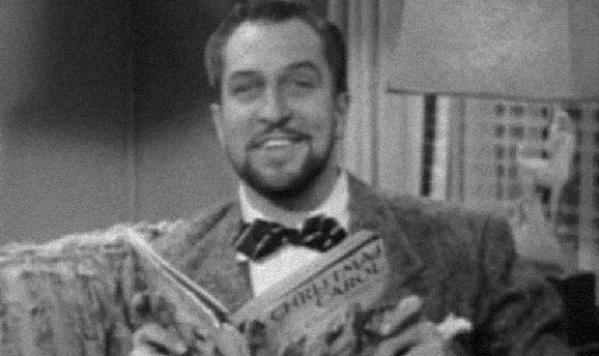
Christmas-Carol-1949_coverThis odd little telefilm from 1949 mainly has one interesting point.  It is hosted by Vincent Price.  But truthfully, clocking in at 25 minutes?  It causes the film to fail in pretty much every way.
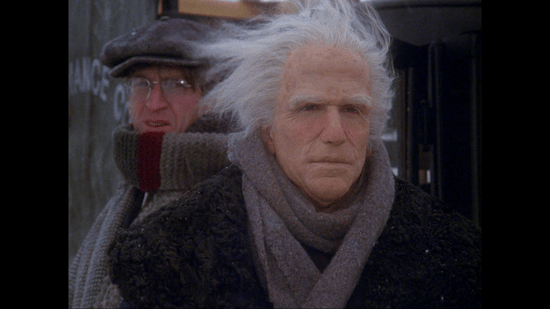
The ghosts are not remotely unnerving.  They only show Scrooge one aspect of his past, present and future (actually they show two for the Future) which makes it impossible to buy into Scrooge’s horror and his eventual turn around.  His change of heart does not ever feel earned.

This was just not an enjoyable or inspiring telling of a classic tale.

What a Scrooge Part 2 (an American Christmas Carol, 1979)

 In 1979 this TV movie was released starring Henry Winkler as Benedict Slade.  Set a few years into the Great Depression, Benedict Slade is running the savings and loan. He runs a hardship and the town has fallen on hard times. The early stories focusing on Benedict and his employees collecting from people who own debts to the savings and loan.

On Christmas eve, after taking many people’s things, his employee Thatcher tries to convince Slade to invest in reopening the local quarry. Slade repays Thatcher by firing him.  Alone in his warehouse, slate starts to read first addition of Charles Dickens a Christmas Carol. He scoffs at the book and tosses it aside.

He startled when the sudden storm brings his long dead partner Latham.  This is honestly one of the most uninspired introductions of the Marley role that I’ve seen in any of the versions of a Christmas Carol. The character lacks any urgency and would not inspire the terror he should.  He politely explains how to Slade. There are no chains and nothing seems to bind him at all, and he doesn’t even seem troubled by his situation.

And that seems to be the problem with much of this production. The ghosts are all kind of bland and personality free.  The ghosts are not unique individuals, but rather take the form of people from home he has repossessed items.

On the other hand, I can say that Slade is a very well realized version of the Scrooge character. He truly embodies a character who believes that the miserly way is the best way.  Early in the film, he gives orphans a gift… sheets of paper that tell them all about famous people who pulled themselves up by their bootstraps and me money without help from anyone. The irony of coarse, is that he has done no such thing.  He was given his opportunities by others.  He too was an orphan in need.

While well-meaning as an updated version of the Dickens tale, over all this film falls flat and is fairly forgettable.

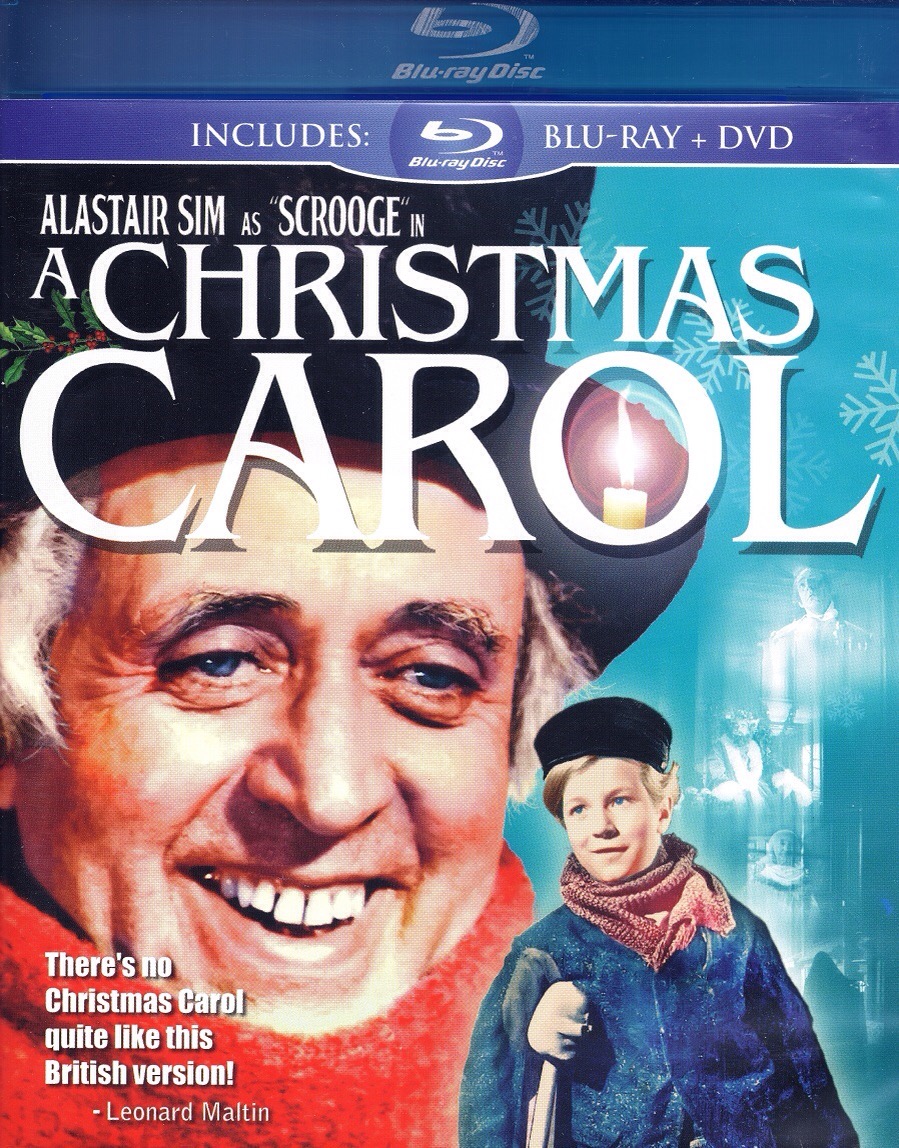
What a Scrooge Part 1 (Scrooge, 1951)

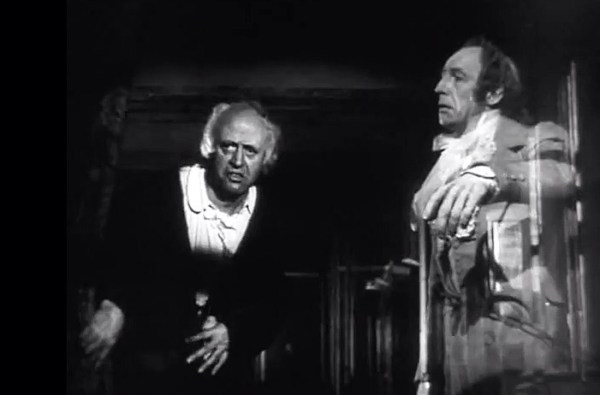
I am starting with the 1951 version starring Alistair Sim. The DVD menu says it is called a Christmas Carol, but the title cards of the film (and host Patrick Macnee) call it Scrooge. It starts out with the familiar voice-over telling the viewer that Marley has been dead for seven years. Sim’s Scrooge is accosted by a debtor outside the exchange. This is a departure from any film version I have seen. It moves quickly to introduce our important characters, such as Bob Cratchit and Scrooge’s nephew Fred. We also see Tiny Tim (who is not so tiny) and his mother walking past store fronts.

As Scrooge sits to eat his meal, he starts to hear bells ringing (the filmmakers take the time to show us the various bells, but they are not moving as they ring. I am unsure if this was intentional, to make it creepy or just lazy). But the door slams open and in walks Marley (Michael Hordern). Or rather, he fades in. I didn’t find this to haunting, although, the sequence ends nicely as Marley Opens a window to show Scrooge multitudes of torments spirits trying to help a poor homeless woman, yet unable to intervene. For the limited effects of the time, it is a powerful moment.

In a rather interesting choice, the Ghost of Christmas (Michael Dolan) is an older man. I note this because most portrayals are of a younger woman, or a young androgynous male. In the longest segment of the film, Scrooge visits his school briefly, only seeing himself on the day his family takes him home. The older Scrooge sees his sister Fan (Carol Marsh) and instantly is overwhelmed with joy-only to face disappointment as she passes through him. The Ghost then leaps to the Fezziwig Christmas Party. Unlike most versions of a Christmas Carol, the Ghost leads Scrooge through much of his past, including his first meeting with Marley. Young Scrooge (George Cole) is more generous and a romantic, especially under the leadership of Fezziwig. However, he is swayed by his desire to not be poor, soon accepting work with Fezziwig’s competition. This is where he meets Marley (Portrayed as a younger man by Patrick MacNee of the Avengers). The film follows Scrooge to the death of his sister Fan. There, the younger Scrooge is so bitter at her dying, he leaves the room, never hearing he dying request that he raise her newborn son, Fred. This causes Ebenezer to break down, weeping and begging Fan’s forgiveness. We also see Marley and Scrooge taking over Fezziwig’s business. Then we see Scrooge’s beloved, Alice (Rona Anderson) setting Scrooge free to pursue money.

The Ghost leads Scrooge to a point in his later years when he and Marley take advantage of the dishonesty of their boss (who has been embezzling the company into bankruptcy) to get control of the company. Finally, the Ghost brings him to Marley’s death bed. There, Marley tries to warn him, as he does again seven years after his death. It’s an interesting mirror as Marley tries to tell Scrooge to change his ways before he dies.

Scrooge is next called upon by the Ghost of Christmas Present (Francis De Wolfe). Unlike the previous Ghost, he is not transparent, and he seems younger. He is fairly jovial at the start, but once he starts to lead Scrooge around, he becomes more somber, lest bombastic. He leads Scrooge to Cratchit homestead, where he witnesses the joy within this family he has given little thought to. As Scrooge’s heart warms to the family, he asks about Tiny Tim. The Ghost confesses, rather somberly, that he sees an empty chair and an unused crutch next Christmas. As Scrooge laments this news, the Ghost quietly ridicules him, using word from Scrooge’s own mouth about allowing some to die-to decrease the surplus population. Scrooge is visibly stung by this. He is then taken to see his nephew Fred. Ebenezer is clearly seeing his nephew anew. Finally, the Ghost brings him to a shelter, apparently run by Alice, you see Scrooge light up as he sees her. Yet, Scrooge is uncertain…he is old…what good can he do now? The Ghost takes his leave. Ebenezer starts to run down the snowy streets, only to be stopped by a cloaked figure.

We see little of the Ghost of Christmas Future, besides a black cloak, that covers the spirit from head to toe. We see a human hand, but little else. The Ghost brings Ebenezer to a pawn shop, where he sees his housekeeper pawning off his valuables, along with the undertaker and another woman. All laugh and cheer the death of Ebenezer. When he is finally brought to his grave, he breaks down, unable to take anymore. He begs for mercy, asking how he can change, he is but an old man, it’s too late. And suddenly, he finds himself in his bed. Scrooge steps out of bed, as his house keeper enters the room. Scrooge asks the day, and is elated to discover its Christmas. In this sequence, Sim plays Scrooge as if a giddy drunk. He cannot contain his joy, and instantly gives his house keeper a raise. She, of course, is terrified he has lost his mind. But he assures her he is simply a new man. And he’s thrilled by it. He secretly sends a prize turkey to the Cratchit family. Young Tiny Tim, in this version deduces that it was Scrooge, which feels a little overly silly, because his reasoning is, “I don’t know how I know, I just feel it.” However, making up for that is the heartfelt moment when Scrooge apologizes to Fred’s wife (Olga Edwardes) for being so foolish towards her and Fred. It’s a very touching scene. Alistair Sim’s best performance in the film is at the end. He can’t contain himself, and it’s enormously contagious as the film closes.

It is interesting how much back story you get on Scrooge in this version, the majority of the film is spent with the Ghost of Christmas Past. The Ghosts are also quite gentle and non-threatening, even Marley is not fear or awe inducing. But the film still works on the strengths of it’s actors. Also worth noting is the music. It makes heavy use of traditional Christmas songs, especially “Hark the Herald Angels Sing” and “Silent Night”. Hark the Herald Angels Sing is even incorporated into the haunting score during the opening credits so that it flits from a choir singing the carol to a thundering symphony playing an original score.

Create a free website or blog at WordPress.com.

Up ↑