Fading Glories (Once Upon a Time… In Hollywood, 2019)

Once_Upon_A_Time_In_Hollywood_PosterAnd so here we are at Quentin Tarantino’s ninth film (Apparently Death Proof does not count?).  A pretty loving homage to the Hollywood of the 60’s, Tarantino weaves a tale of fading actor Rick Dalton and his best friend Cliff Booth and their place in it all.  Cliff is less bothered, content to help out his friend and then spend the evening sitting in front the TV with his dog. But after a meeting with producer Marvin Schwarz, Rick is realizing he is becoming…well obsolete…and it scares him.

I suspect Dalton’s crisis is not uncommon in Hollywood…but does it make for a great story?

Yeah.  It turns out that here? It sure does.

Now, of course, this is in part, due to the performances of both DiCaprio and Pitt as Dalton and Booth respectively. DeCaprio’s portrayal is both hilarious and endearing. Pitt gives Booth a real sense of casual cool.

Once_Upon_A_Time_In_Hollywood_Alt_PosterThe writing is both the cleverness we expect from Tarantino matched with compelling characters (there is a bit of a question if Cliff is maybe a darker guy, but the film leaves the door open on just how dark). I would say the weakest link in the main characters is Robbie’s Sharon Tate. Not because Robbie is a bad actress. She is charming and kind as Tate.  There is a sequence where we see Robbie express insecurity turning to joy as she watches a movie she is in with an audience. Robbie sells this moment. But she feels so incidental to the story for much of the time.

The cast is just full of great talent… Kurt Russell, Timothy Olyphant and a pretty endless group bringing their A-game.

Visually, the film feels it is of another time, truly like a creature of the 60’s. And the soundtrack is darn near perfect.

My only real criticism is a somewhat lazy time jump that glosses over six months. But, admittedly, had they shown all of it, the film would be, like five hours long. And I do like listening to the Kurt Russell narration.

I found Once Upon a Time… In Hollywood great fun.  Bear in mind, this is a Tarantino film…if you hate his previous work, I don’t think this will change your mind. But fans will appreciate this one for sure.
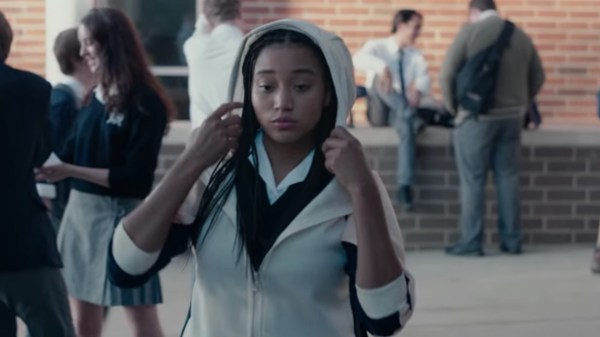
Duality (The Hate U Give, 2018)

the_hate_u_give_posterStarr and her family live in the poor part of town. But her mother pushed for sending Starr and her brother Seven to a prestigious (and mostly white) school. There Starr lives a very different life, downplaying any aspect of herself that might invite the accusation of being “ghetto”. She even has a (white) boyfriend named Chris. Chris is a goofy guy who wants to be a bigger part of her life, but Starr wants to keep he and her friends their separate from the world of her home life.

When one of her oldest friends, Khalil is gunned down by a cop  in front of her, Starr’s world rapidly starts to unravel. She tries to retain anonymity, but finds the weight of injustice harder to compartmentalize than the rest of her life has been. As she becomes more vocal, her friendships and family relationships are tested.

Based on the book by Angie Thomas, The Hate U Give is a painful and yet hopeful exploration of blackness in America. Starr’s family has faced a lot of adversity, including her father having been the right hand man to the local drug lord King.  After a stint in prison, Maverick Carter turned his life around, working hard to be an honest man with a local business. Her mother Lisa, on the other hand, would like to leave their community for a safer place.

The film might be a hard watch for some whites, especially those who are prone to “blue Lives Matter” ideas.  The film does not flinch from challenging the whole problem of such arguments. And the film very deftly offers those defenses first through a black man, Starr’s uncle Carlos. Played by Common, the police officer takes a more middle ground position. In one scene, he calmly explains the struggle police face in a routine traffic stop. And it really seems logical…until she asks what would happen in a white neighborhood.  In that moment, he confesses a white man would get a warning before being fired upon.

The film only has one truly sympathetic white character, and he is capable of cringey moments. After learning about Starr being the previously anonymous witness, he pleads that he does not see color. He does, however, prove himself an ally in his willingness to trust and help Starr when she needs his support. But Starr is not a fragile child.  Amandla Stenberg portrays her with sweetness, but also an edge.  And when she finds her voice, it is a powerful moment.

I think that this film is a very strong rebuke to a culture that likes to pretend racism is no longer an issue of prominence.  Emotionally engaging, heart breaking and inspiring, The Hate U Give is a message that cannot be heard too much.

A Million To One (Get On the Bus, 1996)

Get_On_the_Bus_PosterOrganized by Louis Farrakhan, the Million Man March was a march on Washington for black men. The purposed was a reclaiming of roles that some leaders felt had been taken from black men (both through institutional racism and by their own choices).  Farrakhan was always a rather controversial figure (mainly due to his tendency towards anti-semitism).  But back in the 1990’s he was still seen as a leader for many black Americans.
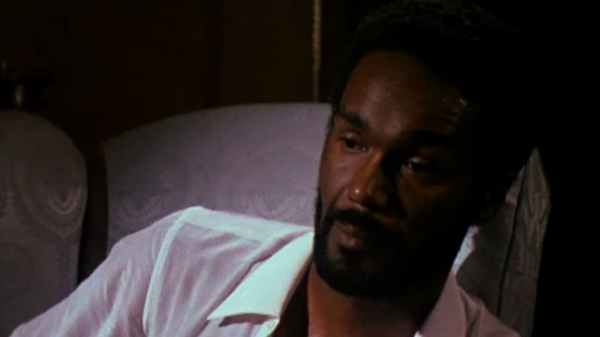
In 1996, Spike Lee directed a film that chose to explore what was behind the drive for the men who attended.  And what Get on the Bus tells us is…It’s Complicated.

Get on the Bus follows several men on a chartered bus ride to attend the Million Man March. The passengers include Evans Sr. and his son “Smooth”, who are (due to a court order) chained together (Lee and writer Reggie Rock Bythewood were not being subtle there). There is Flip, an ego driven and boisterous actor. Xavier is an aspiring director making a documentary. Jamal and Randall are a gay couple whose relationship is at an impasse. And Pops is the sixties radical who seeks to inspire the young men around him.

Spike explores some of the more obvious areas of white racism against the black community.  This is highlighted in a sequence with the lone white character in the film, a substitute driver played by Richard Belzer. It is a well done scene because you can both sympathize with Belzer’s Rick and yet cringe as he stumbles through a myriad of attempts to offer a defense. And Charles Dutton’s George (who works with Rick) takes some pity and steps in to defend him and get the others to back off.

But Lee also does not hesitate to turn the camera on issues specific to the black community. There are arguments regarding parenting, the treatment of black women, what it means to be black (one character, Roger, who had a white mother, has his “black cred” challenged).  And Lee takes on homophobia among black men pretty directly.

But really, the heart of the film is in both Evan Sr. and his son Smooth and then Pops.  Pops is that guy for whom the March is a chance to reclaim those days of past.  Days of revolution and the marches for Civil Rights. Offering words of wisdom, he quietly connects himself to these men, resulting in a moment where the men must put aside their differences, their egos and anger to unite. Evan Sr. is a man who knows he has let his son down and desperately wants to correct this.

Get on the Bus could have been unbearably preacher in lesser hands. And I do not mean just Lee here. The cast is excellent.  Charles S. Dutton is perfectly cast as the jovial George, who is exuberant in bringing these men together for something he hopes to be a life changing event. Dutton has a friendly authority throughout the film. Andre Braugher is irritating as the boastful Flip…but that is the point. You are never really meant to see his side. He is the selfish man, going to the March more for the image he thinks it will project than any more noble reasons.

Probably the weakest sequence is the over the top Republican character. This is not the fault of actor Wendell Pierce, but rather the fact that the character is less a character and a diversionary gag.

Get on the Bus feels as relevant and challenging today as it was back in 1996.

The Art of Addiction (Ganja & Hess, 1973)

Ganja_and_Hess_PosterDr. Hess is attacked by his assistant, who promptly commits suicide. When he awakens, Hess has no wounds and he has a compulsion to drink blood.  He stores his assistant’s body for safe keeping, but then is contacted by Ganja, the assistant’s wife.  Ganja discovers her dead husband,  but ultimately is both seductress and seduced by Hess.
It is hard to describe the film, because it is more of an art film than a horror film.  Playwright Bill Gunn was hired to make a blaxploitation horror film by the studio, but had little interest in making another knockoff. The end result is a vampire film that is a surreal exploration of addiction and seeking redemption. It never makes use of the word vampire, Hess is able to walk in the daylight.

The audience in theaters was not interested, wanting something more violent. But Gunn was not interested in this. The studio wanted an alternate cut, but Gunn, his editor Victor Kanefsky and Cinematographer James Hinton all refused, being very happy with the film they made. When the studio recut the film, Gunn walked out of a showing a few minutes in.  Ever confident in the work, he submitted his original edit to the Cannes Film festival where it received a standing ovation.  After decades of the recut and retitled film being the only version available for rental, the correct cut was created for DVD.

The movie ends on a fascinating note, as the film is full of religious imagery, with Christianity seeming to haunt Hess throughout the film.  It is interesting to see Night of the Living Dead’s Duane Jones in the role of Hess. He is more sedated in this role, often being pensive and observant of his surroundings.

For a lot of horror fans, this film may be a tough watch.  It moves at a very subdued pace, but it is such a fascinating watch.  Gunn’s vision is so unique, not just for black horror, but horror in general. I found myself wonderfully confounded and intrigued by the final decisions of Hess within the film.

Ganja & Hess is a fascinating exploration of vampires, addiction, religion and  redemption.

A Time For Grief, A Time for Theft (Widows, 2018)

Widows_PosterVeronica, Linda and Alice have lost their husbands in a tragedy. They discover their husbands were professional thieves. To add to their grief, they find their lives under siege, specifically from Jamal Manning.  While he is running for public office, Manning is also a local crime lord…and it so happen’s the women’s husbands died stealing from him.  He wants his money and gives them a month.
When she discovers her husband’s records of all her heists, Veronica brings the other widows together to try and complete the next heist that her husband had planned.

Widows is one of those movies that you don’t really get prepared for from the trailers.  Most Heist films are heavily focused on the planning and the heist. Widows is more interested in setting up its characters.  Everyone feels important.  We walk with them as their lives intersect. This is to the film’s benefit.  We get to really know everyone involved, both the heroes and villains of the tale.

Viola Davis gives a great performance as Veronica.  She is both vulnerable and tough as nails.  Colin Farrell and Robert Duvall play son and father of a political dynasty that are at each other throats.  Daniel Kaluuya is riveting and immensely terrifying as Manning’s right hand man.

Director Steve McQueen makes some bold choices in the film (one sequence takes place within a car, and we only hear the actors as the camera stays outside, as the focuses on the car itself). The end result is a very compelling character film that happens to feature a heist.  Managing some excellent surprises before it ends, I found Widows a very satisfying watch.

UnderkKkover Brother (BlacKkKlansman, 2018)

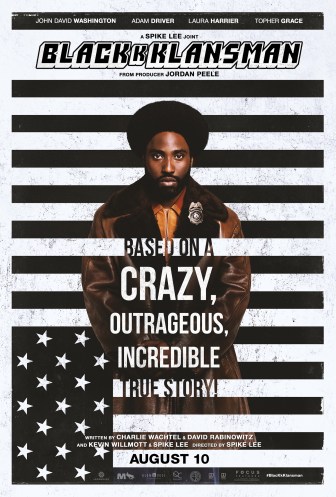
blackkklansman_posterAccording to Jordan Peele, it took a bit of work to convince Spike Lee to take on the role of director for this film. Well, not to much… He sent Lee a copy of the memoir of Ron Stallworth, the Black Klansman.
It really is one of those stories that seems so insanely weird it almost cannot be true.  But Ron Stallworth is a real guy, the first black police officer in the Colorado Springs Police department. And in the 70’s, itching to advance his career and take down bad guys, he struck up a relationship with the local chapter of the KKK., eventually, this crawled up the ladder to include ongoing conversations with David Duke over the phone.

Of course, there was the little snag that Stallworth is a black man…and that might have stood out a little.  And so the dDepartment decides there is a worthwhile investigation here. So, a white officer, Flip Zimmerman, is recruited to play White Ron.

Lee sees how absurd and humorous this appears on the surface.  And he plays that up a lot. But Lee also saw something deeper at play…a notion that today, we are seeing some of the same evils bubbling to the surface in the present. And the film is not subtle about it.

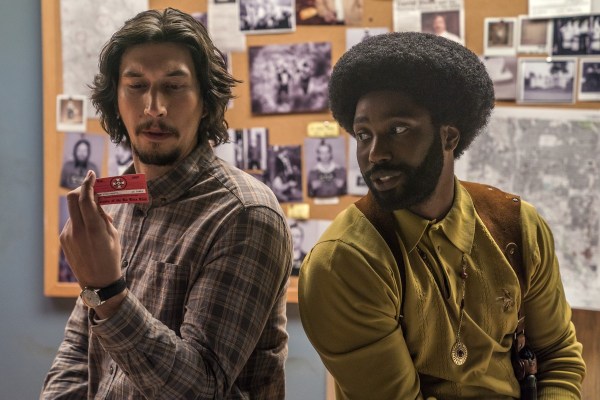
John David Washington is terrific.  He is both real and performers.  What I mean is that his performance can be very personable and real, yet turn on a faithless charm when Ron is playing the Klan for fools. Adam Driver is more muted…there is no real over the top behavior called for here. Washington and Driver have a good chemistry as men who begin as simple co-workers, but develop a strong bond due to needing to…in a manner…share a life.

The supporting cast is excellent.  From Laura Harrier to Topher Grace, we get a certain tongue in cheek, but not mere cartoon characters.

Lee uses some real visual flair in the film, adding a bit of a larger than life feel in some scenes.  But never at the expense of storytelling.

The film certainly takes some liberties (for example, David Duke did not find out that Ron Stallworth was black until around 2013) and yet, it did not detract from the story overall. Flipp is not a Jewish man in real life, but it added a certain effective story point within the film and gave a bigger story arc for Zimmerman.

Admittedly, the film does seem play it safe.  There is only one racist cop, the rest are, at worst, race agnostic. So, the racism functions outside the institution. This has a side effect of making the black activists represented by Harrier’s Patrice Dumas as being to unfair in their perceptions of the law. It is one bad cop, not the whole department.

However, BlacKkKlansman is a very entertaining and thoughtful film, and its shortcomings do not prevent the film from having a real impact.

A Bitter Harvest (Three Billboards Outside Ebbing, Missouri, 2017)

three_billboards_posterWhen grieving mother Mildred takes the drastic measure of renting three billboards asking the local Police Chief Willoughby why he has not arrested anyone in the rape and murder of her daughter, the town is thrown into strife. Many believe it is unfair to call out Willoughby. Officer Dixon (an abusive racist cop) is especially incensed, because he feels she has attacked a great man. Add to that, Willoughby is facing a death sentence with cancer.
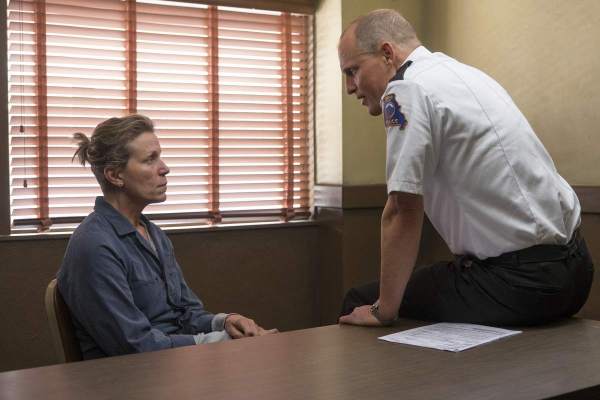
Three Billboards is a very good film. I want to get that out of the way.  The film is heartbreaking, angering and funny.  Frances McDormand’s Mildred is both sympathetic and a bit infuriating. In one scene, on a date, she is forced to face that she can be quite insensitive. You understand she is in a lot of pain, but she is remarkably out of touch with the world around her, even when people reach out in kindness.  And Woody Harrelson turns in a solid performance as the exasperated Willoughby, a man who seems to believe everyone in town is basically good, including racist Dixon.

And this is kind of the problem the movie has. See, Dixon is a violent racist, one scene plays it up for laughs. In another he violently attacks a the owner of the billboards and punches the man’s secretary in the face. And he just gets fired. Yet the film wants us to see this as a lead up to his redemption. And the film never earns that. There is no evidence he has seen the light for his racism. And even when he has a noble moment, in the end, he and Mildred go on a mission that…well…is morally dark.

I think this was best addressed by video essayist addressed it best in his video “How (Not) To Discuss Racism In Film.  I am including it here, but please note there are massive spoilers.

What a Scrooge Part 12 (It’s Christmas, Carol, 2012)

Its_Christmas_Carol_PosterIf you thought that this was a movie where a miser named Carol (played by Carrie Fisher) is visited by three ghosts… You are a little off.

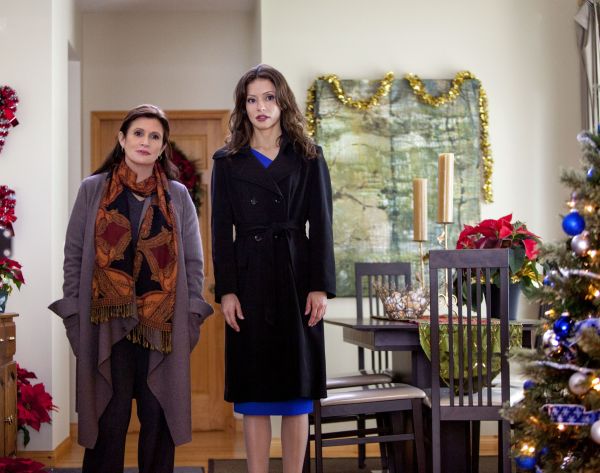
Carol is a powerful young publishing executive who treats her employees poorly and has favored her career above all other relationships. On Christmas Eve, Carol is visited by her former boss Eve (Fisher).  There is a little hitch…Eve has been dead for a few years.

Eve is Marley and the three ghosts all rolled into one. Times are tough in the Ghost Trade.  Eve shows Carol how she has lost all her great loves. Her love of life changing stories, the love of her life…even her own mother.

The story hits all the beats of a Christmas Carol, and Fisher is a lot of fun, giving the Ghosts a more direct and personal connection for the character of Carol.

It’s Christmas, Carol is not a remarkable take on the Dickens story. On the other hand? It is still kind of fun, and if you are missing Carrie Fisher? It is a fun watch.  Overall, this is a serviceable take on the tale, even if it is not particular memorable. I know that sounds harsh, but I did not hate the film.  I would even say that fans of a Christmas Carol will likely find it entertaining. And I thought the gag regarding the Ghost of Christams Future is quite good.

Have It All (Desperately Seeking Santa, 2011)

Desperately_Seeking_Santa_PosterMeet Jennifer. She is a hard working executive who oversees the mall that she has worked at since she was 17. She is trying for a promotion within the company.  She also only sees Christmas through the lens of profits for the mall. This year to bring people in, she devises the plan to have a Sexy Santa.
On her way to work one day, she jumps to the front of the line for her coffee, and runs into conflict with David. Of course, she finds out later that David is in the competition for the Sexy Santa.  Against her wishes, the committee settles on David. At the same time, he is trying to save his father’s restaurant from being destroyed for a condo development.

The two slowly start to become smitten with each other as they spar.

This is…well, a pretty standard rom com. Two people meet and do not get along, but you know from moment one that they are going to fall in love. But they follow the formula pretty well.  I mean, it is TV movie level largely light entertainment.

The film hangs heavily on Laura Vandervoot and Nick Zano. Zano’s David is pretty much the perfect guy…he is kind, helpful and remarkably selfless.  Zano brings the boyish charm that fans of Legends of Tomorrow are likely to recognize. Vandervoot is given the harder role…she is supposed to be both a bit cold but sympathetic. A lot of this is done through small moments showing her love for the employees and shop owners in the mall. They do make an attractive couple.

Overall, Desperately Seeking Santa is a cute film that does try and have a bit of heart with it’s conflicts. It is not a deep dive, but it did entertain for the most part.

Skating By (I, Tonya, 2017)

i_tonya_posterI will be honest…all I really remember about the Nancy Kerrigan story is that the talented skater and Olympic Hopeful was brutally assaulted, leaving her with a broken knee. What followed was pretty insane.  It became apparent that her attack was coordinated by people related to her competition…Tonya Harding. Harding, her husband, her bodyguard and two other individuals apparently colluded to commit the crime.

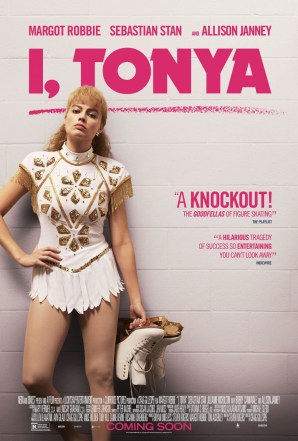
I, Tonya tells the story in a darkly comic fashion. Showing Hardings tough childhood, the film frames Tonya as a victim who struggles to break free.  The early film is actually quite heartbreaking as young Tonya, a talented skater at age four, manages to get the attention of a reluctant trainer. Her mother is cruel and absolutely horrific in her push for her daughter to succeed. The is a gut wrenching moment as her father drives away and Tonya is tearfully begging him to take her with him (McKenna Grace is wonderfully touching in her performance. You cannot help but feel broken for her).

She meets Jeff Galooley at age fifteen and begins a whirlwind remance that eventually becomes abusive.  But Jeff is absolutely certain that he needs to be with her, no matter how often she walks out.

Nancy Kerrigan plays only a small role, as the film is mainly focused on Harding’s life and the controversy on her end.

The film is based heavily on interviews with Harding, Jeff, there body guard Shawn and LaVona (Tonya’s mother).  The film has the framing device of on camera interviews with the primary players.  This allows for a unique narration.  We see Jeff hitting Tonya (the portrayal of the domestic violence is suitably unnerving) and Jeff interjects his denial of the events. Tonya pauses the film to quickly state that Kerrigan was no angel.

The performances here are top notch.  Both Margot Robbie and Sebastian Stan have a good chemistry that convinces the audience both of their initial connection and the dissolution of the relationship.  And Allison Janney as LaVona is inspired.  You cannot help but despise her.

The makeup and costuming here is impressive.  Janney is almost unrecognizable (only her voice made me recognize her). For much of the movie, both Robbie and Stan look positively average. Considering these are two very attractive people, the makeup people deserve kudos.

Now to the part of the film that might be troubling for many.  Some take issue with the notion of “reforming a monster”.  Tonya was part of a despicable crime. And the notion of the film rehabilitating her image did not sit well with people.

And, in a way, this is not entirely inaccurate. If the film is truthful? Harding was not in on the crime. She was only loosely associated.  Mainly, she appears to maybe have only found out about her husband and bodyguards involvement after the fact. The film also portrays Jeff as having tried to put a stop to the plan. He had hoped to send letters with threats to Kerrigan…psychological warfare. In the film, when he finds out what Shawn had done, he is enraged that they went so far.

Does it rehabilitate Harding’s image? Does it make her seem a victim of cruel circumstances that shaped her into a tough person who got a raw deal? Yeah, I guess it does.  But if the information in the film is accurate at all? Maybe she deserves it.


Create a free website or blog at WordPress.com.

Up ↑