Baked Goods Part 3 (American Wedding, 2003)

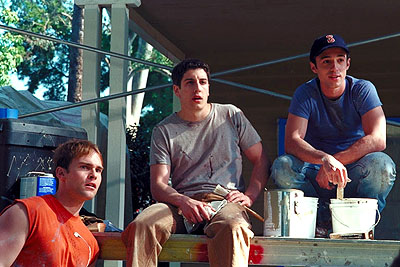
American_WeddingAmerican Wedding focuses heavily on the next step for Jim and Michelle, which was a wise move.  It’s secondary focus is on Stifler, which dominates the beginning of the film.  That is a very rough start.

The scenes with Jim and Michelle work well.  They are likable characters.  And to play Michelle’s parents, they got the terrific Fred Willard and Deborah Rush.  The early scenes where “Stifler Ruins Everything” are tiring.  But, somehow, they start to transform Stifler.  Oh, sure, he is a douche, but they really play up just how badly he wants to be liked.  This results in the homophobic character trying to prove to the patrons of a gay bar that they totally want him.  The dance off he starts is actually quite amusing.

Again, a lot of the heart is from Jim’s dad.  There is a genuinely heartwarming moment where Michelle is feeling uncertain, and she seeks the advice of Jim’s Dad.  When she mentions Jim told her he is the person he trusts most for life advice, Levy’s face lights up, like he always wished this was true, but never believed it.

This installment is notable as Shannon Elizabeth, Mena Suvari, Natasha Lyonne and Tara Reid are completely absent.  I suspect they had no idea how to fit them into the tale.

There are gross out jokes, embarrassing moments with Strippers at the bachelor party (Aspects of this scene work well, as everyone tries to cover up, when Jim unexpectedly brings Michelle’s parents back to the house).  Despite a rocky start, American Wedding is a surprise, and one of the best of the franchise.

Baked Goods Part 2 (American Pie 2, 2001)

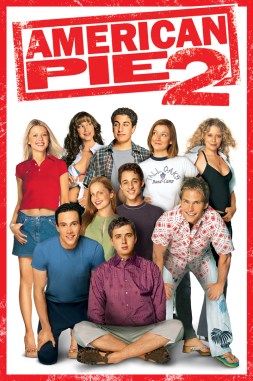
American_Pie_2The first film was a big enough hit that we got a sequel.  This time there is no pact, the guys are back from their first year of college and get a summer house so they can party hard.  Pretty much all the girls are gone.  They make appearances, but they are brief.  So it is focused on the boys.  Kevin is feeling apprehensive that Vicky is off having lots of sex, even though he is not her boyfriend…but he is concerned because he has not had much sex since the first film. Oz is bummed by his long distance relationship with Heather.  Finch continues to be obsessed with Stifler’s Mom.

Jim is hoping to have sex with Nadia who is coming to visit him, and seeks the help of Michelle.  This is the real heart of the movie.  Michelle grows as a character who is sweet but blunt.  These scenes work the best.  But other than this, women exist only as fantasy in the film.  They are there to entertain men.  And the portrayal of some of the women suggests the writers do not know any.

Seriously, if a couple women in their underwear discovers a bunch of guys hiding in their bedroom, do you really believe their response would be “Let’s play a “sexy” game?)  No, I think it is safe to say they would be running to get help.  On the other hand, I totally believe the gag where Jim accidentally super-glues his hand to…himself.  That a guy might be that stupid is plausible to me.  That scene also allows for a Patented “Jim’s Dad Speech”.  Dad tries to defend his son, but admittedly makes it a bit worse.

But overall, this sequel is a bust.  Only the Jim/Michelle story works or is sympathetic, it is hard to care at all about the other characters.


Baked Goods Part 1 (American Pie, 1999)

American_PieAmerican Pie was a movie released promising to bring back the spirit of films Like Porky’s, Hot Dog, Ski School and Revenge of the Nerds.  They were going to push the boundaries, starting with the plot.  The plot is real simple.  Four buddies make a pact to lose their virginity before graduation in their senior year.

And the film follows their fumbles as they race for that goal.  Sensitive Athlete Oz (Chris Klein) joins the Choir to woo cute and sweet Heather (Mena Suvari).  Kevin (Thomas Ian Nicholas) is trying to get his girlfriend Vicky (Tara Reid) to give up her virginity.  “Worldly” Finch (Eddie Kaye Thomas) ultimately tries by being cool and aloof.  Then there is Jim (Jason Biggs), the nerd of the group who pins his hopes on the sexy and sexually available foreign exchange student Nadia.  Jim is repeatedly humiliated in the film.

The thing that is surprising?  This film has a lot of heart.  A lot of that is between the well written and performed scenes between Jim and his Dad (Eugene Levy).  Jim’s dad is part bumbling dad stereotype, part wise sage.  He loves his son and wants his son to succeed in life.  He also tries to help his son navigate the world of relationships.  He stumbles through the attempts, but his kindness is a high point in the film.

The problem is, while the male leads are clearly defined, Jessica (Natasha Lyonne) and Michelle (Alyson Hannigan) are the only female character who seem to have lives when they are not onscreen.  Nadia gets the worst treatment as her character is literally only there to be someone Jim wants to have sex with.  And when she and Jim have an embarrassing situation involving a webcam?  She disappears from the story  completely.  And Jim, aside from humiliation, suffers no consequences.

The film’s gross out humor goes back and forth between disgusting and amusing.  While Jim’s experiences are funny, the character of Stifler (Seann William Scott) gets the crude and disgusting moments.  The character is pretty repulsive, constantly putting down the guys and making terrible sexual come ons  (bordering on harassment) to the women around him. He is a sexist homophobic guy, and an all around unpleasant character.

The film also has the characters come to the realization that the pact is absurd.  That sex is not the most important thing, and their pursuit of it was fruitless.   And then the film ends with all the guys getting laid.  So, way to undermine the revelation.  Admittedly, it plays an important role for Kevin and Vicky dramatically (their experience is awkward and uncomfortable, and is spelling the end of their relationship, not fulfilling it).  And Jim’s experience has a comedic payoff.

The film has it’s laughs and it’s heart does make it stand better against the test of time than films that tried to follow it’s success.  But it is at best a flawed but entertaining comedy.

Bustin’ Up


So, the Ghostbusters Trailer has hit.  And there were responses.  I initially saw plenty of “I’m in” responses.  Suddenly I started to see a lot of “blah” reactions.  Some were super aggressively angry that the trailer was a disappointment.

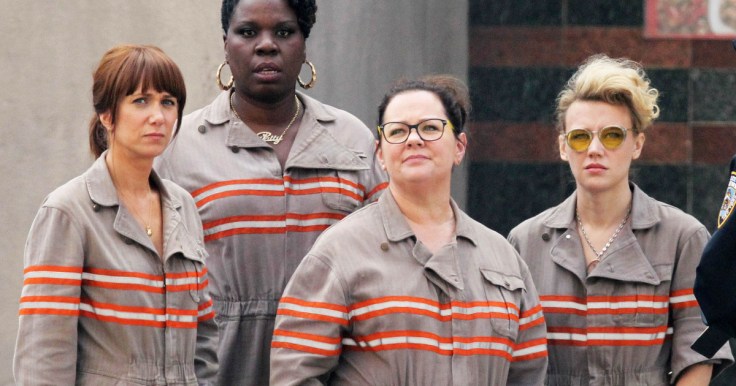
And, I agree to an extent that there was some stuff that is frustrating (Mentioning the original film as it does makes it seem like a sequel, and it is not).  But I loved the interaction between Wiig, McCarthy, Jones and McKinnon.  Plus Jones slapping McCarthy yelling “the Power of Pain compels you!” cracks me up.

But then there was a complaint that started a war of words.  See, Leslie Jones’ character Patty is a transit employee.  People questioned why she could not be a scientist.  And this question was lambasted for it’s being PC.

I am weary of this.  I am weary of how legit questions of story and character choices in regards to diversity are so quickly attempted to be shut down with cries of PC Culture.  Diversity in film is, of course, not important to these mostly white critics.  White people in America have no idea what it is like to watch movies after movie where there is only one or two folks who look like us.  It is easy when your face is all over the screens.  And my entire life, I have heard white people lament even one non-white character appearing in a story as being unrealistic, or they are token characters or they are forcing diversity.

Ghostbusters_2016

The question of why Patty could not have been one of the scientists (and having, say, McCarthy be the “every man”) is a valid one.  It is not like film and television have had a bunch of black nerds.  Now, they already finished the film.  Feig did not consult me.  And Leslie looks like she had fun with the role.  She is certainly protective of it.  I am holding back final judgement until I see the film.

Personally, I still wish it was within the original film’s storyline.  I think it would have made things fun if they returned in a sequel.  Let these ladies be aware of the originals, but nobody really knows where they went.  So, this film would focus on the new team, but in the background there is that mystery of where they went.  Then in a sequel, they could bring the still living cast in to team up with the new team.

Marvelous

So, I recently wrote about how some feared what the success of Deadpool meant for the future of comic book and superhero films.  And it looked like we were getting a glimpse of those fears being realized.  There was first the announcement that the Superman vs Batman Blu-Ray would have an ‘R-Rated’ edition.  Then they announced a go for the third Wolverine as an ‘R’.

There are reasons I think those were possible before Deadpool, but I think it did play at least a minor role.

However, proving that this may not be the trend it appeared to be, Marvel has announced they will not be making their Cinematic Universe a haven of ‘R-Rated’ super-hero films.  This is welcome news.  The Marvel Cinematic Universe has skewed comfortably PG-13.  They are not little kid safe…but older kids on up have been able to enjoy them.  Parents have been able to take older kids and teens and enjoy the films.  They were not to risqué (Guardians of the Galaxy pushed that envelope the most).

I am glad to see Marvel sticking to the plan, rather than being distracted by Deadpool dollars.

Diversify

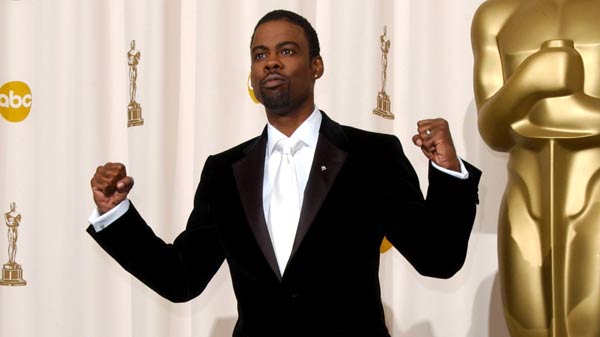
So, last Sunday’s Oscars happened.  There was much questioning in advance of how Chris Rock would address the #OscarsSoWhite controversies.  Some felt he should drop out.  Some felt he should use the the night to stick it to Hollywood racism.  And, he did pretty good.  Rock had some good jokes that called out the racism at play…Hollywood’s “Sorority style Racism” as Rock noted.  But Rock’s bits could have been better.

It started to become apparent that Rock’s calls to diversity were somewhat single dimensional.  In fact people on twitter started noting that Diversity is a bit bigger than Rock’s focus.  Aasif Mandvi tweeted:

hey , diversity is not just and .

He was met with a response that stated that because Chris Rock is black, he was focusing on black performers.  Which, to be frank, is a pretty bullshit excuse.  Rock was hosting the Oscars to a broader public.  Asians and Latinos (just to name two groups left out) had every right to be frustrated by Rock’s extraordinarily narrow observations.

In a bit of irony, Rock’s race themed bits all highlighted white versus black.  He only spoke of black actors vs white actors.  There was a distinct lack of diversity.  Heck, it even looked as if he  and his writers lifted the Martian Gag from the Nightly Show.*

All of Rock’s bits would have been funnier with an expanded racial scope.  Of course, pointing this out has gotten some hit with accusations of saying the same thing as “All Lives Matter”.  Which is absolutely false.  Let me cut folks off at the pass.  This is false.  Period.  There is no discussion to be had.  Pointing out that other races were not recognized by Rock is not the equivalent of saying all lives matter.  Why don’t we look at some facts  about Oscar Diversity.  It is not a pretty picture.

There has not been an Asian Best Actor nomination since Ben Kingsly in 2003.  There has not been an Asian Winner since 1982, which was also Ben Kingsly.  It was 26 years earlier that there was another Asian nominated.  That was Yul Brenner in 1956.  And he won.  You have two Asian winners in the Best Actor category.  There was one Asian woman nominated for Best Actress.  Merle Oberon in 1935. Not a single Asian Actress has been nominated since.  Not even from the Joy Luck Club, which got no nominations for it’s actors.

Surely it is better for the supporting roles, right?  Between 1957 and now?  Best Supporting actor has nominated Asian Actors six times.  Of those six?  Two are Ben Kingsly.  The only win was Haing S. Ngor for the Killing Fields in 1984.  The last nomination was Ken Watanabe in 2003.

Supporting Actress?  Since 1957? Again, six.  The last being Hailee Standfield in 2010’s True Grit.  Only one win, that was to Miyoshi Umeki in 1957.

So, what about Latinos?  Surely, they fared way better in acting nominations and wins, right?

Well, for best actor?  Five since 1950.  Last nomination was Demián Bichir in 2011.  Last win? 1950’s José Ferrer for Cyrano de Bergerac.  For supporting role, there six nominations. One was for José Ferrer in 1948.  Anthony Quinn was nominated and won twice.  Andy Garcia and the other two went to Benicio del Toro, who won in 2000 for Traffic.

Best Actress had three nominations between 1998 and 2004.  That is all, no wins.  Just three nominations in the history of the Oscars.  Supporting Actress?  Six nominations between 1954 and 2013.  And I bet that 2013 nomination would catch people off guard, because it is Lupita Nyong’o.  She and Rita Moreno are the only wins.

Native Americans have three nominations in the history of the Oscars.  Three.

While looking for that last one I found this article which sums all the information up nicely.

Chris Rock focused heavily on the lack of Black actors.  Since 1958, there has been 18 nominations.  This includes Will Smith (Twice), by the way.    Morgan Freeman was nominated three times.  Denzel Washington four times.  There have been four wins (Sidney Poitier, Washington, Jamie Fox and Forrest Whitaker).  Best actress has only had ten nominations since 1954 and only a single win (Halle Berry for Monster’s Ball in 2001).

Best supporting actor has seen sixteen nominations and four wins since 1969.  The wins were Louis Gossett Jr., Denzel Washington, Cuba Gooding Jr and Morgan Freeman.  Best supporting actress?  Eighteen nominations with six wins (Hattie McDaniel, Whoopie Goldberg, Jennifer Hudson, Mo’Nique, Octavia Spencer and Lupita Nyong’o) between 1939 and 2013.

Going by the actual numbers, those individuals who were telling Asians, Native Americans, Latinos and other minority groups to just accept that they were being ignored?  They have the bigger gripe.  Asians, Latinos, Native American performances are far less recognized.  In comparison, black performers are getting more of the opportunities.

Hollywood needs more diversity.  Hollywood needs to expand it’s recognition.  But Rock made his bits all about black actors, every single bit featured only black actors (or in one case Black “Man on the Street” interviewees), and Rock gave no recognition to the lack of diversity other races (who have had even less recognition in Oscar History).  But he did manage a racist Asian joke.  Way to go with the appeal to diversity.

*The Nightly show did the “What if Mark Watney Was Black” gag a few weeks back.  It is entirely possible that the Oscar version was recorded in “competition” and it was coincidence…but it was the exact same joke, just the Oscar version got the original white actors.

Boys and Ghouls At the Movies Part 3 (Ritual, 2006)

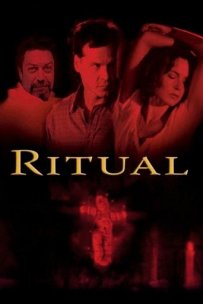
TFtC_RitualThe third and final (to date) Tales From the Crypt film is Ritual.  You would not realize it is a Tales From the Crypt film though.  The reception to Bordello of Blood resulted in the third film being released scrubbed of any Tales From the Crypt Connections.  The “Tales from the Crypt Presents” was added to the DVD Box when it was released in the U.S. as a direct to video release, but the film remained as it was in theaters.
This means that the film lacks anything connecting it to the series.  Unlike the first to films (which opened and closed with the Crypt Keeper voiced by John Kassir) There is no Crypt Keeper host. No actual references in the titles, no entering the Crypt Keeper’s house and no comic book cover.  The irony here is that while they removed those things to avoid the connection after the failure of Bordello of Blood, this generic Voodoo horror thriller desperately could use the flavor of Tales from the Crypt, or at least an actual alteration to the formula as Demon Knight had done.

Written by the Director of the first Fast and Furious film Rob Cohen and the film’s Director Avi Nesher it is loosely based on the 1943 film I Walked With a Zombie.

It tells the tale (get it???) of a disgraced Doctor named Alice (Played by Jennifer Grey) who takes a job in Jamaica tending to a young man with encephalitis.  He believes he is a zombie under a curse.  And someone seems to be using Jamaican Voodoo to attack Alice.

There is a bit of humor to see that as the films went on, they had less star power than the original show.  But the film tackles a topic the show already did, and the show did it in the so much better.  This film lacks the humor that was such a big part of the TV series.  Which results in a dull and boring film with low level effects.  It is not that the film lacks talent, it is that they have a guy like Tim Curry and just give him nothing to do.  Why would you want to do that?

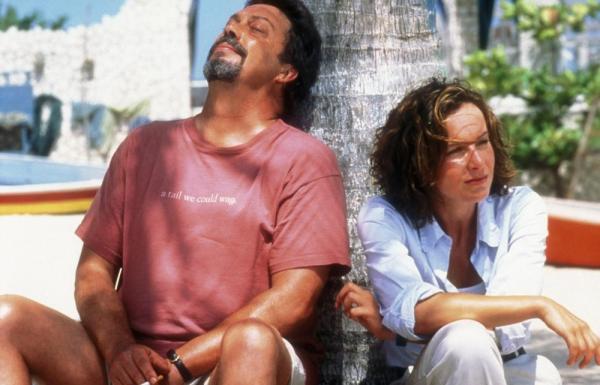
Of course, based on this image?  Maybe leaving the Dreadlocks sporting Crypt Keeper out of the film was a good idea…

Tales-From-the-Crypt-Presents-Ritual-tales-from-the-crypt-18665943-900-506


Boys and Ghouls Goes to the Movies Part 2 (Tales From the Crypt Presents Bordello of Blood, 1996)

TFtC_Bordello_PosterDemon Knight was received well enough to not deter the Tales From the Crypt Crew to keep on with their plan of a franchise with Bordello of Blood a year later.  The film had an all new story, though they included a tie to the last in that the magical macguffin is the “key” from the previous film.  But this time it is the only thing that can keep Lilith (Angie Everhart)  the Queen and Mother of All Vampires in check.
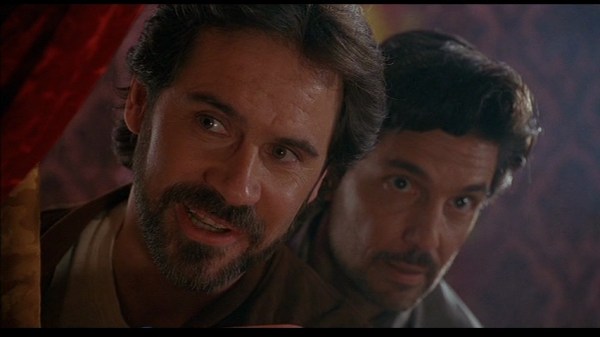
Bordello of Blood feels like a regular episode simply stretched to long and thin.  The little brother (Corey Feldman) of young Katherine Verdoux (Erika Eleniak) has disappeared.  She ends up enlisting skeevy P.I. Rafe Guttman (Dennis Miller in his first and really last leading role) to find her brother.  We viewers know he went to a new bordello (hint, it is the titular Bordello of Blood).  There we discovered that Lilith has apparently made a ton of attractive women into vampires who kill their customers.

Then there is a subplot involving Katherine’s employer.  She works for a megachurch televangelist named Reverend Current (he has an “electric” theme) played by Chris Sarandon.  He apparently employed man of adventure Vincent Prather (Phil Fondacaro in a role that is not all about his height, which is a nice surprise) to get Lilith for him.  So, the Preacher is controlling Lilith to be used in his battle against…Satan or…Something?

The film is more in line with the the TV series.  It has lots of slapstick type of jokes, gratuitous gore, and it has HBO’s trademarked “Tons O’ Nudity”.

According to one of the producers, Miller flat out stated he would not say any of the written dialog, instead making up his own, usually the day of.  If this is accurate at all, it only ended up hurting the film.  The jokes from everyone tend to fall flat. The plot makes little sense (What exactly does Reverend Current hope to accomplish with a vampire?!) and even by “Dumb Horror Film” standards, it is not entertaining even in a terrible way.

The characters are not particularly likable.  They are sleazy jerks, or in the case of Katherine, uptight and overly prudish.  Miller has his trademark snark in full display, but it works against him, because his character (technically our hero) is a real douche.

All the roles for women are based on being sexually desirable, which is frustrating, especially when you consider that in Demon Knight, character was more important and the roles for women were more substantial.

It is no surprise that the film franchise took a hit, and enough that the third movie was released with all hints of the franchise cut out.

Boys and Ghouls Go to the Movies Part 1 (Tales From the Crypt Presents Demon Knight, 1995)

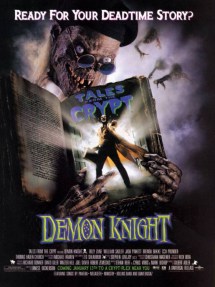
TFtC_Demon_Knight_PosterHBO’s Tales From the Crypt was in it’s sixth Season when they started a bold plan to break out into movies. There had been a Tales from the Crypt film in the seventies, but this would be different. Instead of being an anthology film, the Tales from the Crypt movies would tell a theatrical length tale.  They assembled a series of scripts, none of which were specifically written for the franchise.  This resulted in three films of varying success.

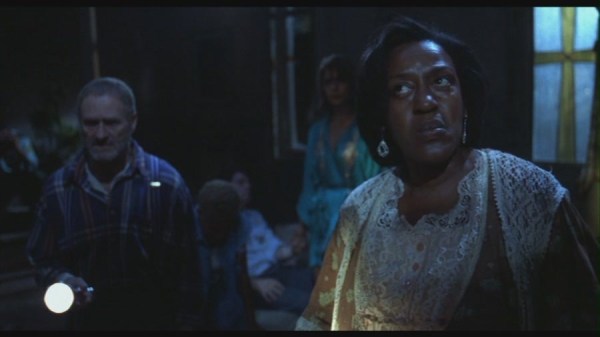
The first up was Demon Knight.  It introduces us to Brayker (William Sadler) a man running from a conflict.  He arrives at a remote hotel which houses a motley crew of broken people.  Brayker is frantic and  mysterious, so nobody takes him seriously before Hell literally arrives in the form of Billy Zane…the Collector.  Brayker has something he wants.

The Collector is actually a demon who needs a “key” that Brayker is trying to protect.  This key will allow Hell to overrun the world.  So Brayker tries to keep him out of the hotel.  Except, the barriers he erects also depend on the personal strengths of the people in the hotel.  If they let the Collector in to themselves, he can use them as fresh demons.

And that is where Billy Zane gets to shine.  This is really his movie.  The Collector appeals to your hopes or desires.  He promises one person love and respect, the two things she does not get in her life.  And then he tempts another character as a friendly bartender.  Zane has fun with these moments and is highly effective, you understand why characters cave.

The effects are low budget, but effective.  The demons are creepy, and the practical effects work really deliver for the story.  The characters are easy to root for, most of them having decent qualities, even if rough around the edges.  And the film has CCH Pounder.  Every film should have her in it.

In spite of the film being outside the typical stories in the Tales catalog (they are usually tales of bad people getting a comeuppance.  Demon Knight is a Heroes Journey), it is an effective tale.  It is fun, exciting and well told.  The film has a strong cast that really sell the situation.  This is the best of the three Tales From the Crypt films, and the one truly worth watching.

The Danger of Deadpool’s Victory

So, since the last time I talked about Deadpool, I was proven very wrong.  Deadpool was a hit with critics and audiences, receiving a lot of praise.  There are people who did not care for it, but the movie broke records nobody expected.

I am happy to be wrong here.  I am glad it has succeeded.  And I think there is room for both family friendly super hero films and ‘R-Rated’ super-hero films.

On Twitter a week or so back, I got involved briefly in a discussion that was inspired by a tweet that stated that “Nothing Good Can Come From Deadpool’s Success.”  I took the opposite side, arguing I do not think it means all super-hero films are suddenly going to go hard ‘R’.

Then in a couple days time, we saw announcements of the next Wolverine film will be ‘R’ and there will be an ‘R’ rated “super cut” of Superman vs Batman.  And I do get the concern, though I am not ready to admit defeat.  The Wolverine is not surprising, and they have skirted the violence of the character for over a decade.

Going back to X-2 we were being given pitches that we were about to see the Wolverine the last film did not deliver.  We got a more violent cut of the second Wolverine film.  At best, the success of Deadpool let them know that the ‘R’ is not the kiss of death.

In regards to Superman and Batman…Warner Brothers has always seen dark and gritty as the key to success.  When Superman Returns did not succeed quite as big as the WB had hoped?  They cited that it was not Dark Enough.  When the Dark Knight succeeded they felt vindicated and even suggested that this is how they would fix Superman.  When Green Lantern failed Warner Brothers blamed the film for not being dark enough.

Yet Man of Steel was dark and grim.  And it seems the DC Universe was already on this path, well before Deadpool.

What is sad, is there is a lesson to be learned from Deadpool’s success.  Deadpool was not a dark and grim take on super-heroes.  It was a fun and bizarre ride.  It had dark humor, and lot of it.  But it was funny and intentionally so.  The creators (from the writers to the director to the stars on) got the character.  They knew and were faithful to their source.

Deadpool proves taking a big risk is worth doing.  Films that know who they are? They are what studios should take a chance on.  Truth their creatives, don’t micro manage.  Letting the creators be free often produces positive results.  Micro-Managing everything gives us studio vision and less interesting films.

Blog at WordPress.com.

Up ↑