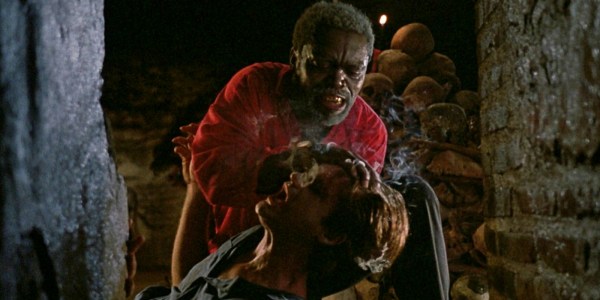
Taking inspiration from author Wade Davis’ book of the same name, Wes Craven explores spirituality and politics. This is not a direct adaption of the book, with Bill Pullman playing Dr. Dennis Alan. Alan is sent by his employer (a pharmaceutical company) too Haiti to investigate the stories of Christophe, a man who died in 1978, but has reappeared from the dead.
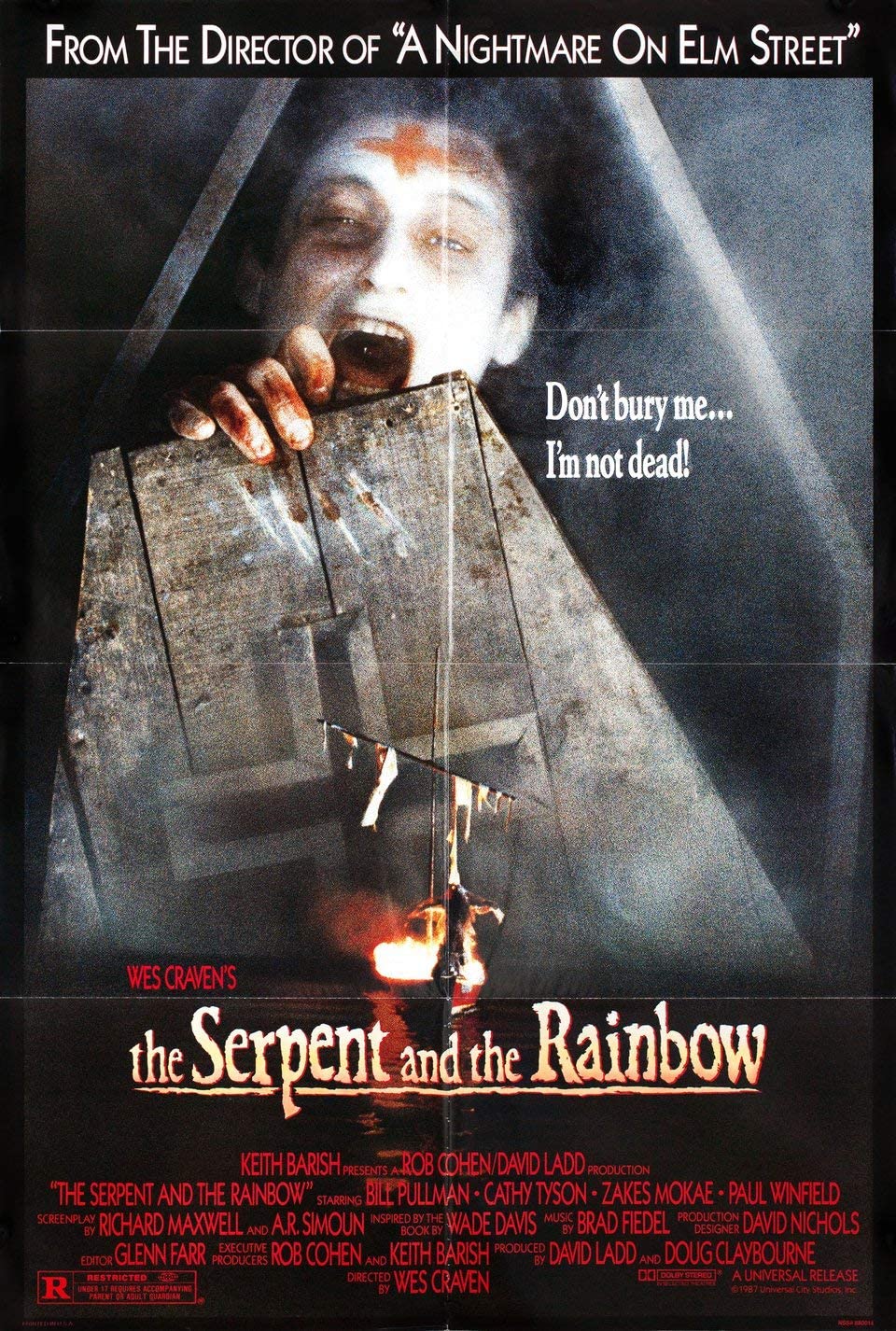
While there, Alan starts to work with Dr. Marielle Duchamp, who is treating Christophe. With her help, he is introduced to practitioners of Voodoo who are open to teaching him how to make the toxins that produce the zombie state. Dennis is convinced there are medicinal uses that would revolutionize medical care.
However, Haiti is in a state of revolution, and runs afoul of the local corrupt constable Dargent Peytraud (played with ominous relish by Zakes Mokae). After a threat to his life Alan realizes he cannot escape Peytraud’s grasp and returns to Haiti to help the friends he has made and confront Peytraud.
For the two thirds of the story, Craven plays things a bit coy. Any horror moments could simply be happening in his head, under the influence of hallucinogens. Up until the moment he returns to the United States, Voodoo is treated pretty respectfully. But then the film swerves into horror fantasy with a spiritual showdown between Alan and Peytraud.
The effects in the film are really solid with all sorts of creepy imagery. But what really stands out is the beautifully shot scenery. Filmed largely on location in Haiti, the cinematographer John Lindley takes full advantage of the environments.
Wade Davis has expressed some disappointment with the film for how it sensationalizes Voodoo, while the whole point of his book was to present it as a valid religion alongside the more popular and accepted religions of the world. He does not seem to lay this at Craven’s feet, whom he has suggested was trying to make something less in the horror vein (Davis had hoped for something more like the Year of Living Dangerously). He feels the studio kept the pressure on to provide them with a Wes Craven thriller.
While the film has some tonal flaws, it is still a very strong return to form for Craven, especially after Deadly Friend. This is Craven managing to bring his more intellectual ideas alongside his thriller instincts. And it works. This is an engaging film worth a watch.
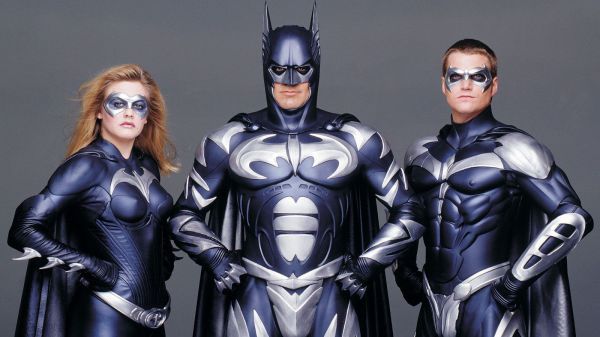
 Remember how I said Schumacher hoped to make Batman Year one by giving the studio what they wanted? Well, Batman Forever was actually a hit. It made a ton of money. And guess what the studio wanted? If you said, “A gritty look at Batman’s first year”? Slap yourself. They said “Give us more toys and product placement. Which led to a seen where Batman uses his BatCredit Card.
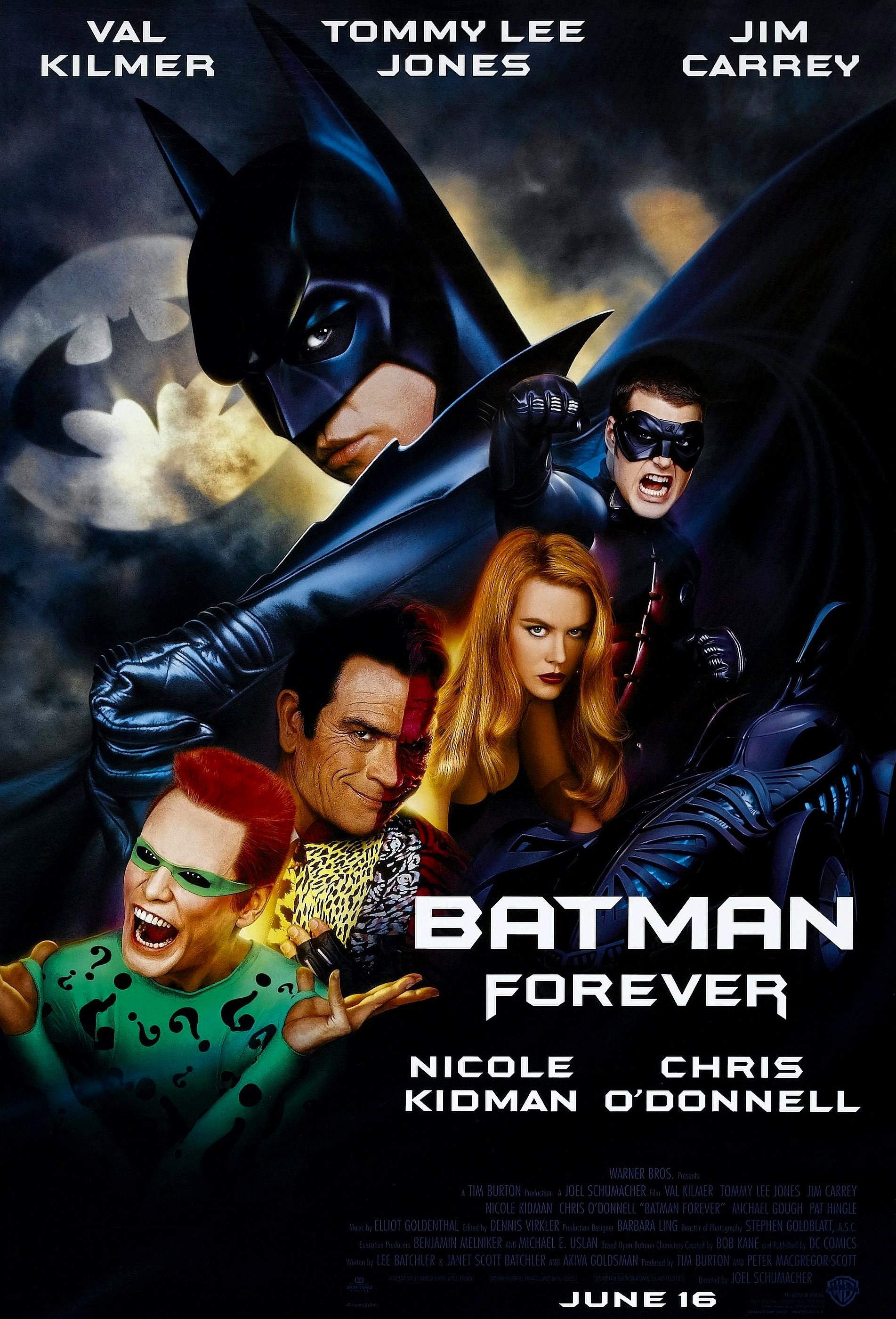 Batman Forever had some big shakeups. Tim Burton and Michael Keaton were out. Joel Schumacher and Val Kilmer were in. But the real shakeup was…Warner Brothers wanted to sell more toys. Schumacher had read Batman: Year One. He really wanted to tell that story. The studio was not interested. Schumacher thought that if he gave them the movie they wanted, he might be able to persuade them on the next film to do the film he really wanted to do.
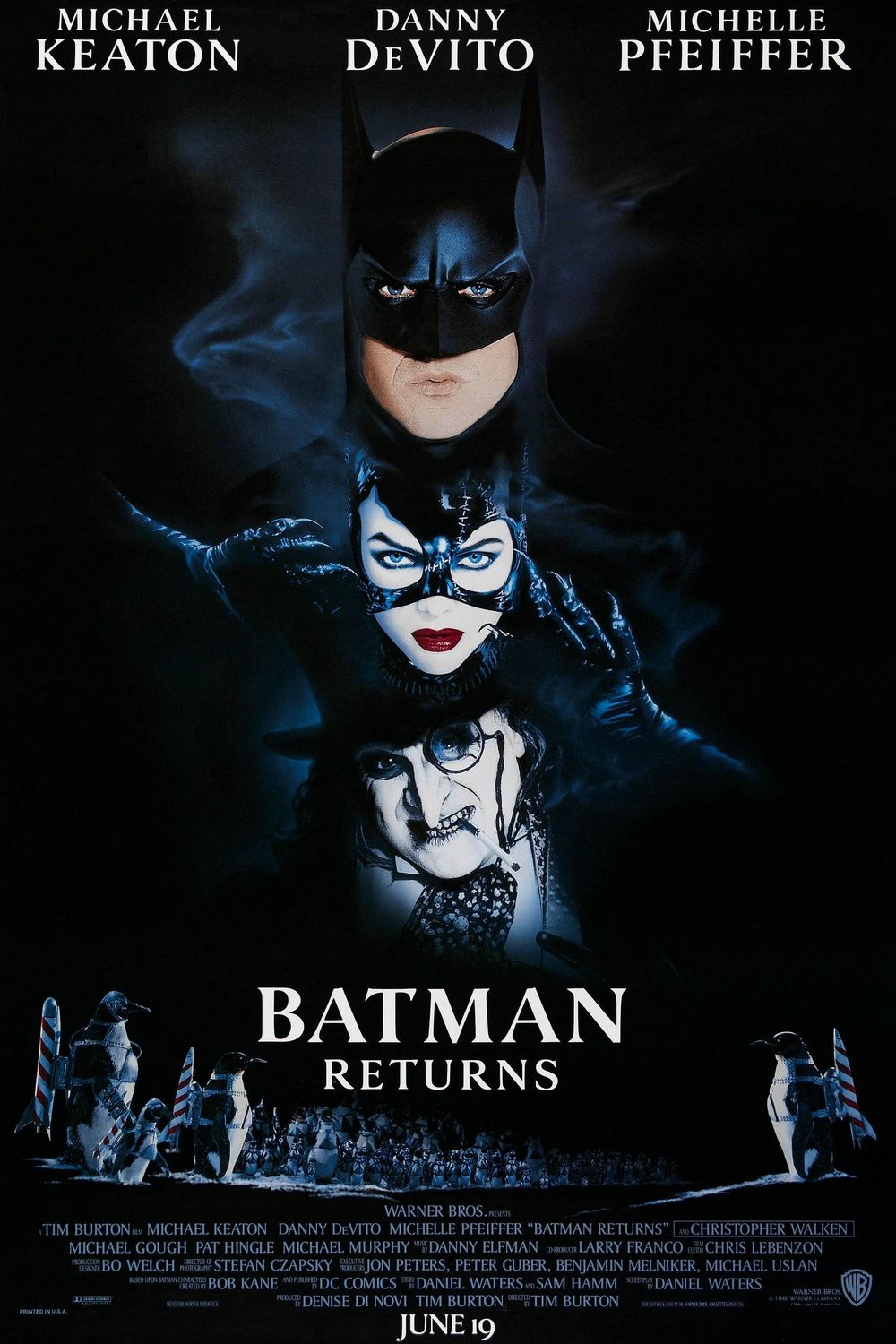 Jack Nicholson kind of established the villains would always be played by big names. Danny DiVito was brought in to play the Penguin. But this was not the traditional Penguin from the comics. Not merely a short round guy is a top hat, Burton envisioned an origin in which Oswald Cobblepot is born to an affluent family who are repulsed by his grotesque appearance. His father (played by Paul Reubens, who would play Penguin’s father on Gotham decades later) and mother (Diane Salinger) dump him over a bridge where he is found by penguins.
 1989 saw the release of the most controversial Batman casting until Batfleck. Michael Keaton, known almost entirely for comedies such as Mr. Mom, Johnny Dangerously and Gung Ho was cast as Batman…oh the horror and oh the wailing. A long tradition of freaking out over casting began right here. People were a bit more open to Jack Nicholson playing the Joker.
 Tripping Through Gateways