
 When a new Judge Dredd film was announced, there was no real fanfare. What people did not realize is that the film was being written outside of the Hollywood scene. Alex Garland (writer of 28 Days Later and writer/director of Ex Machina)…Garland is a fan of 2000AD and Judge Dredd.
Keeping the story very simple, Judge Dredd is taking a trainee with him, a hopeful Judge named Anderson. She has some limited psychic ability. Dredd is tasked with evaluating her. When three skinned bodies fall from the sky, Judges Dredd and Anderson arrive at a 200 story building that is pretty much a city unto itself. Dredd and Anderson capture a drug dealer who works for notorious gangster Ma-Ma. To prevent him from being taken out, Ma-Ma has the building in lockdown and then announces to the entire complex that she wants the two judges killed.
This simple setup makes for a very effective story of survival. Our leads must work their way to Ma-Ma to bring an end to their situation. They are cut off from the outside world and must rely on their skills and wit.
The look of the city is grimy and lived in. Full of pollution and decay, the sets of the film are effective. The effects, specifically the sequences depicting the effects of the drug Slo-Mo (it makes the user feel that time has slowed down) are very well thought out. The viewer sees everything in slow motion, with a shimmering effect.
Garland understands what makes Dredd work. Keeping the story simple is such a benefit here. There are no over the top conspiracies. Karl Urban never shows his face without the helmet in this film. And he wears a permanent scowl. Never does Dredd break down. Even when he seems to be relenting on his firm stances, it is in a fashion that he is in line with his attitude throughout the film. Urban really embraced the character and does Judge Dredd real justice here. Anderson is very sympathetic as a rookie and owns up to her mistakes. At one point, she knows she has failed the evaluation but refuses to back down from the challenge of Ma-Ma and her gang. And Ma-Ma? This is no glamor role for Lena Headey (Game of Thrones). She is a drug addict and psychopath…cruel and vicious with scars to show for it.
Dredd has gained a cult following over the past five years, with people hoping for a sequel. A few years ago an April fools announcement declared Netflix was doing a Dredd series with Karl Urban and Thirlby returning. Fans were bitterly disappointed it was untrue. But every so often, we get word of the filmmakers trying to press ahead. And Urban has welcomed the possibility of returning to the role. Most recently, there is the word that a series may be on the way after all, possibly with Urban back as Dredd.
Dredd is a very effective cop survival story, gritty and violent with strong performances. The creators get the characters and manage to remain true to what made the character work in comics, without being alienating to those unfamiliar with the source material.
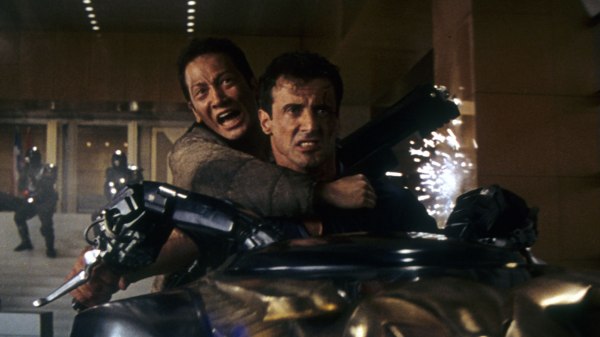

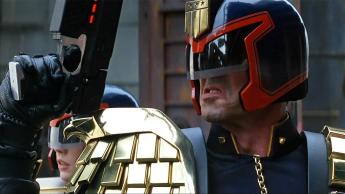
 Anyhow, looking for a story, the filmmakers thought the best approach was to tell it through the eyes of SNL alum Rob Schneider. He is an ex-convict returning home who gets caught in the crossfire between thugs and Judges. A little background here. After a nuclear event society is rebuilt in heavily concentrated cities. In these cities are massive buildings, communities unto themselves. They are known as Megacities. Outside of the sprawling cities is a desert wasteland populated by outlaws and mutants called the Scorched Earth. The Society has combined Police Officers with Judges. You do not go to court, a Judge simply tells you your sentence and that is that.
 For Americans, the character they probably most recognized from the British comic book series 2000AD is Judge Dredd. But 2000AD actually had a whole host of characters spawned from its weekly pages. Almost all of them every bit as violent and over the top as Dredd. There was Rogue Trooper, the ABC Warriors, Nemesis the Warlock, Bad Company, the Ballad of Halo Jones, D.R. & Quinch and Zenith to name a few.

 Tripping Through Gateways