Martin is one of the more interesting vampire films of the 70’s. Martin believes himself to be a vampire. It does not help that his family feeds this belief. He has faced exorcisms and now is being sent to live with his cousin Cuda. Cuda calls Martin Nosferatu and has filled his house garlic and crosses. Cuda’s daughter is less impressed with the family’s old world beliefs.
As he approaches his first victim in the film, he gets flashes in black and white that show his perception. He envisions entering a room and being welcomed by a beautiful woman in lingerie. The reality is she is wearing face cream and in a mundane robe. And rather than reach out to him, she is understandably horrified. There are flashbacks to his past as well (also in black and white). These are very effective ways of bringing the viewer into the mind of Martin.
Martin is also haunted by the voice of a relative who was believed by the family to be a vampire as well, and had committed suicide. Presenting a evidence for the viewer that Martin is not a supernatural being is his lack of fangs. He attains his blood not through entrancing his victims, but drugging them. He has no fangs, rather uses a razor blade to draw blood. Martin claims he is 84 years old, but there is no evidence to back this up. He has no physical reaction to the traditional weapons of garlic or crucifixes.
Cuda represents the old school, classic vampire film, but he is trapped in a modern and faithless world of vampires. The final act of the film is Martin discussing his vampirism with a talk radio host using the name “The Count”. This is juxtaposed with Martin’s mundane life, as he laments how hard it is to choose a victim.
The film ends both tragically and ambiguously, with voices on the radio asking what has happened to the Count. Martin is a strong entry into the world of Vampire Cinema. Romero explores the vampire myth through skeptical eyes, which really works in the film’s favor,
The Freeling family have a good life. Steve and Diane have three children. One evening they are awakened by their youngest, Carol Anne, who is talking to the TV.
As days go by they notice unusual phenomena and not just Carol Anne watching static on the television. The dog responds to something nobody can see, the son is sure the tree outside his window is alive.
After a traumatic night which results in Carol Anne being taken by the spirits she has been communicating with. When paranormal researches come in, they are floored by what they find. It is decided they need the help of an exorcist to try and get Carol Anne back.
There are two things people likely recall most vividly. Cute little Carol Anne turning to the camera to say (eerily) “They’re Heeeeere” and Zelda Rubinstein as Exorcist Tangina. Her most famous line has been quoted in many films and TV shows…”This house is clean.”
Rubinstein is memorable in both appearance and performance. A small older woman, she brings an otherworldly vibe, and at times, her purposes almost seem at odds with the Freelings.
The effects still stand up, with only a few exceptions. The most obvious being a sequence with a character clawing his face off and it is obviously a dummy head. But otherwise, the ghost effects still work very well.
There is a longstanding belief that Spielberg is the director of Poltergeist, and it appears he was on set, though so was Hooper. He was filming E.T. the Extra-Terrestrial at the same time (a movie he offered to Hooper to direct). Hooper is the only credited director, but according to at least some individuals who were there, it was primarily Spielberg. It sounds like this was not one of those situations where Hooper was being replaced, and he had some creative input. It would appear they got along fine and Hooper was providing Spielberg cover in regards to contractual rules with E.T.
Regardless of who directed it, Poltergeist is an entertaining and somewhat unique horror film with a terrific cast.
Not unlike Night of the Living Dead, the Crazies presents a situation in which our loved ones may be the biggest threat. Unlike his first film, of course, the threat is solely from the living.
The film opens up in the middle of things. Two kids are playing in their house, only to be chased by their father. What is quickly revealed is that the military has already arrived and started to close off the town to deal with an apparent viral outbreak. When contracted, the virus slowly begins to turn you violent. The military begins to bring the town to a central location while arguing with the local government.
A small group of locals escape the military and start hiding in the town while trying to get out entirely.
The Crazies goes back and forth between these two groups, with a surprisingly heavy focus on the military side. It becomes increasingly clear as the story goes forward, the military was ill-prepared for this situation and are rapidly losing their grasp on it.
The film has some really disturbing moments, including the violent threat to children, people self-immolating and a scene in which a young woman’s father attempts to rape her. Within the context of the story, these scenes show the breakdown and destructive nature of the virus, but they are uncomfortable none the less.
Romero and fellow writer Paul McCollough clearly gave a lot of thought to how the government might try and handle an outbreak of this nature…so much that the characters who feel like they ought to be the leads seem entirely secondary to the soldiers and scientists.
The Crazies has a pretty bleak ending which fits in with much of Romero’s work. This was a vast improvement over Season of the Witch and other than being slightly long is a good film.
Originally made as “Hungry Wives” (which sounds more like some sexploitation film), the title of Season of the Witch was chosen to tie in to the Donavon song of the same name (which is used in the film). It is also a much more apt title.
Joan Mitchell’s husband is going out of town on business, and while he is gone, she falls under the influence of suburban witches.
Some see this as a feminist work, truthfully, it felt more like a well meaning work that understood cartoonish versions of feminism. It really is the “Men are Evil, Marriage is Prison” styled feminism you sometime see in right wing parody.
The film does a lot of disorienting “dream vision” which just feels odd. And the problem is, really…the film is remarkably dull. Romero has stated it is the one film of his he would have liked to remake. And I do wonder what an older Romero would have done with it..
Hooper’s first Stephen King adaption, Salem’s Lot is a pretty straightforward vampire story. Popular writer Ben Mears has returned home to Salem’s Lot. But Mears is not the only person arriving in town. The mysterious Mr. Barlow and his employee Mr. Straker have arrived. Nobody has met Barlow, but he is taking up residence in the old Marsten House.
Mears actually has a theory that the house is evil and attracts evil men. And in this case, he will discover he is very right.
Townspeople start to get anemic and die, causing Ben to wonder if it is a vampire, but he needs proof. At the same time, he is falling in love with local teacher Susan Norton.
It becomes a race against time for Ben to find proof and defeat Barlow.
Salem’s Lot was a two-part mini-series, allowing it to explore the story more. Initially, we start witnessing the dark secrets of the town, such as the affair between Larry Crockett and Bonnie Sawyer.
There are some great visuals in the film, for example, a young boy is visited at his window by a friend who is floating outside. Hooper makes use of the atmosphere of his local very effectively.
I really like the choice of the vampire looking like Count Orlok from 1922’s Nosferatu.
While it can be a bit slow in it’s build up, it is a pretty decent vampire tale with good spooky atmosphere and sets. Salem’s Lot shows a real measure of improvement over Eaten Alive for Hooper as a director.
Tobe Hooper followed up his classic horror the Texas Chainsaw Massacre by traversing similar ground but in a different way. Set in rural Texas, Judd runs the local Starlight Hotel. It is a remote location, with its own swamp. And in that swamp? Judd keeps a giant crocodile. And guess what he feeds it?
Judd is your standard movie religious psychotic redneck. He kills prostitutes, he kills johns, he kills people who might expose him for killing prostitutes and so on.
Everything about this film feels like a sub-par take on the Texas Chainsaw Massacre. Both were made with obvious low budgets, yet here it just makes the film look cheap. In place of any tension, the film feels sleazy and generally unpleasant.
Probably the most interesting thing about the film is the cast. It features a young Robert Englund, and several familiar faces, such as Mel Ferrer and Neville Brand. And yes, the woman running the brothel is Morticia Addams, Carolyn Jones.
This was ultimately a disappointing follow-up to a classic.
1968 was a time of real social upheaval in the United States of America. Out of this turmoil was born a tale of people desperate to survive in a situation they cannot hope to make sense of.
George Romero and his friend John Russo put together a film that would challenge the norms of film-making in America. Horror monsters had always been distinct creatures. Vampires, werewolves and so on. But Night of the Living Dead introduced something different.
The concept of the zombie was not a new one. But Romero and Russo introduced a lot of what we consider standard zombie lore. Head shots to kill, undead and eaters of flesh. These monsters were scary not because of their personalty…but because they were our loved ones, but without soul…the dead are a horde without emotion and only seeking to devour.
We are introduced to Barbara and her brother Johnny. They have come to a remote cemetery to place flowers on their father’s grave. When they are attacked by a man, Barbara is forced to flee. She discovers a farmhouse and along with another stranger, Ben, start to try and hide from the attackers. Soon they discover they are not alone in the house and the small band of survivors work to try and survive and determine a way to escape.
The group finds itself strained by the tensions that develop as some desire to stay hidden, while others hope to get away from the farm. They are able to find news reports giving bits of information, but leaving them with few answers.
In some ways, Night of the Living Dead is ahead of the curve for films of that time. Ben (Duane Jones) is a black man who finds himself assuming the role of leader for many of the group. On the other hand, Barbara is pretty much comatose the entire film, paralyzed by her fears. Romero does not burden himself with to complex of a story, and although there are hints of a cause, the film is vague about it. There is talk of a satellite and radiation, but ultimately, there is no definitive answer.
Night of the Living Dead is an effective thriller that is, in the end, responsible for what we now know to be zombies. It’s significance cannot be overlooked, as it defined the zombie as a monster that still stands today.
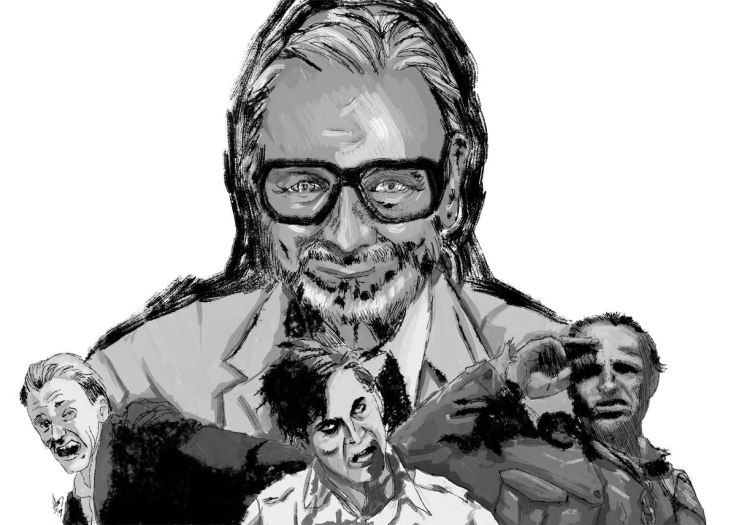
Welcome to the month of October. As with every year, it will be scary movies all month. Themes for this month include the films of George A. Romero and Tobe Hooper.
I had started doing a zombie theme for the month, but the death of Romero in July prompted an exploration of his films, as I really had only seen a few. And I had not seen some key parts of his older work, so it was interesting to take a look at films like Martin and Season of the Witch (one I find myself generally thrilled with and the other…well…).
Only a month later, Hooper passed. Now, I have covered a few Tobe Hooper films in the past so I will not be creating new entries for those. For Lifeforce, the Texas Chainsaw Massacre, the Texas Chainsaw Massacre 2 and the Funhouse…click the links). I confess Hooper’s films start to take a sharp turn after the Mangler (which is more a crazy mess than a classic). I am going to also include his Masters of Horror episodes Dance of the Dead (which seems like it would be a Romero title for a zombie movie set at a rave, oh wait, that was one of the Return of the Living Dead films) and the Damned Thing.
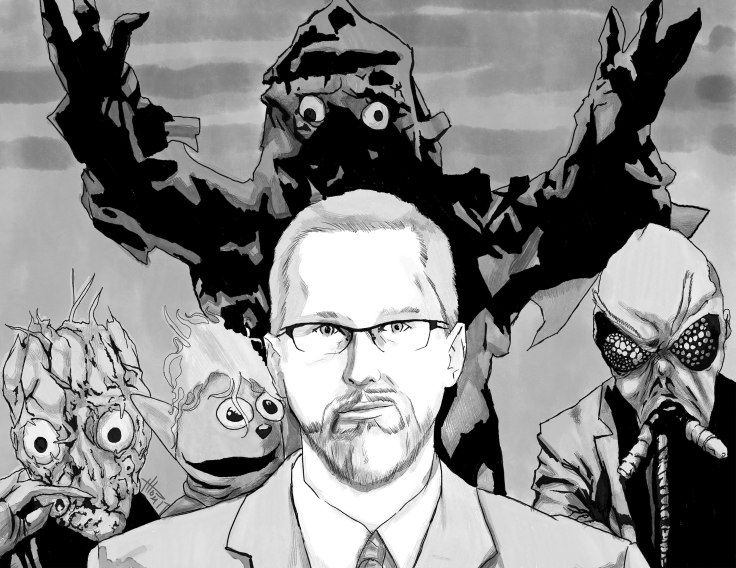
Also, later this month, I will be going through the entire filmography of Christopher R. Mihm, a local Minnesota filmmaker. He has a new movie coming out this month, the Demon with the Atomic Brain. His films are loving odes to the horror and sci-fi films of the fifties and sixties. His Mihmicerse is populated with ghosts, mutant animals, and Nazi Killing Weresquitos. I will expound more as we get to the films later this month.
Hope you have as much fun reading these as I have had writing them.
So, about a year ago, a semi-popular geek movie critic named Devin Faraci was accused of some pretty serious sexual harassment. He had some deep ties in the Austin Film Community and was a pretty big part of the Alamo Drafthouse. This stung for a lot of people, as Faraci did tend to express progressive ideals. He disassociated from his duties with the Alamo Drafthouse and stepped away from the film community. While he stated he had no memory of the incident, he did not deny it could be true and did not call his accuser a liar. It seemed like the resolution would be peaceable.
A couple months ago, it was revealed that Faraci had actually started quietly working for the Alamo Drafthouse again. Tim League spoke a lot about second chances, but this was all coming a bit late and frankly felt a bit dishonest. It appeared that he had started back rather soon after his public departure. And then this week?
The Austin Film Scene and Geek Movies lovers were given another shock. Indiewire uploaded this article detailing sexual harassment and assault by Harry Knowles by Kate Erbland and Dana Harris. If you are wondering exactly who Knowles is…well, for that we need to go a little farther back.
picture by Gage Skidmore
Harry started Ain’t It Cool News back in the late 90’s. It was a geek website focused mainly on movies. They trafficked in rumors, news and reviews. They got so big, Knowles was courted by studios for approval (even getting cameos in movies) and even appeared on Roger Ebert’s shows. His writers went on to be popular in their own right. Harry had a film festival called Buttnumb-a-thon which was a weekend people would pay to get to sit and watch a bunch of highly anticipated films. Harry was seen as a guy who could help or hinder your career. You can see where this might be leading right?
Throughout this time, young women have quietly told friends of experiences with Harry. He could be, to be generous, “handsy”. And often, he would get a benefit of the doubt, maybe it was an accident. I suspect most women can tell an accidental brushing of their butt or a breast, women will often give it a benefit of the doubt. And there are guys more than willing to take advantage of this. And in the geek community, there is a heavy reliance on the idea of the “Socially Awkward Geek.” He just does not know any better. He is awkward with women. He means well. Film writer The Blair Bitch shared this text she received from Harry:
Look at the time stamp. That was this year. Harry is 46 years old and should be more than old enough to have learned that this is not “proper” interaction. That is not socially awkward. It is creepy.
Now, to be honest, I knew who Harry was…but I never read much of the AICN site. I tried…but I found it painfully hard on the eyes. I thought the design was just terrible. So I rarely read a lot of it. If I did go, I was looking for something specific, not to wander the site. One thing I really had never done? Read Harry’s reviews. Film blogger and critic Scott Weinberg took a pretty firm stand with the women Knowles assaulted and harassed. He has started looking back at Harry’s reviews. And they are…well…telling.
There were more creepy reviews. How did this guy get on people’s radar? His writing is terrible. Someone claimed that at least it is not boring. But his work is actually really dull. Contemplating why mutant Hillbillies don’t rape the pretty actress is not interesting writing!
Between the multiple women, the creepy reviews and the creepy texts, it all paints a pretty disturbing picture. The reviews alone should have kept him from the mainstream.
My main hope here is that the the fallout is women not feeling they have to accept mistreatment to get ahead. That harassment and assault are not things they must just put on a brave face for if they want to advance in the film geek world. But judging from some folks rush to stand behind people like Harry (and Victor Salva, a child rapist whose latest film is about to hit theaters) this is still something a ways off.
Pretty sure this sequel was greenlit before the previous film hit theaters, hoping to have a franchise. For Chamberlain and Stone, this was the end of the road.
Everything that plagues King Solomon’s Mines? Is still here. There are no improvements. Poor effects, awkward performances… the sexism, Jesse still does not really do a thing other than getting in trouble and get saved by Quartermain.
For racism, the natives do not fare any better this time around. They are either primitives or mysterious primitives.Their search is for the titular Lost City of Gold…a city of myth inhabited by white Africans. The white people they find are (of course) not primitive. Oh, and they are ruled by Elvira, Mistress of the Dark.
This sequel is no improvement over the first film. Granted, it is not really any worse. Just equally terrible.

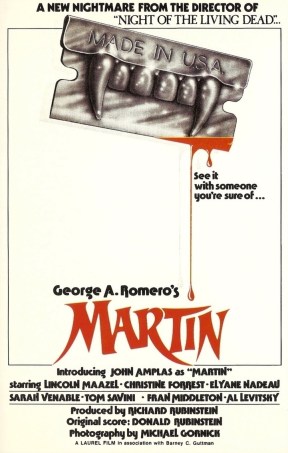 Martin is one of the more interesting vampire films of the 70’s. Martin believes himself to be a vampire. It does not help that his family feeds this belief. He has faced exorcisms and now is being sent to live with his cousin Cuda. Cuda calls Martin Nosferatu and has filled his house garlic and crosses. Cuda’s daughter is less impressed with the family’s old world beliefs.
 The Freeling family have a good life. Steve and Diane have three children. One evening they are awakened by their youngest, Carol Anne, who is talking to the TV.
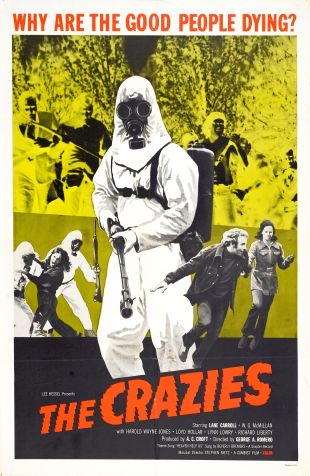 Not unlike Night of the Living Dead, the Crazies presents a situation in which our loved ones may be the biggest threat. Unlike his first film, of course, the threat is solely from the living.
 Originally made as “Hungry Wives” (which sounds more like some sexploitation film), the title of Season of the Witch was chosen to tie in to the Donavon song of the same name (which is used in the film). It is also a much more apt title.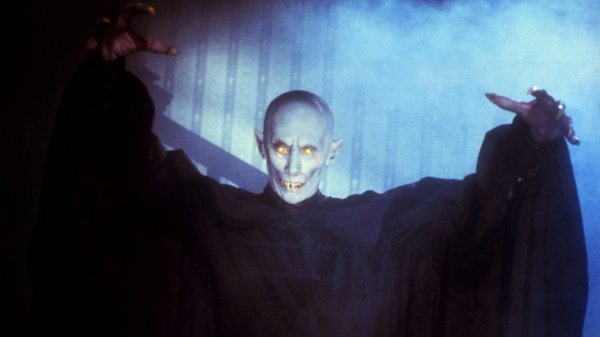
 Hooper’s first Stephen King adaption, Salem’s Lot is a pretty straightforward vampire story. Popular writer Ben Mears has returned home to Salem’s Lot. But Mears is not the only person arriving in town. The mysterious Mr. Barlow and his employee Mr. Straker have arrived. Nobody has met Barlow, but he is taking up residence in the old Marsten House.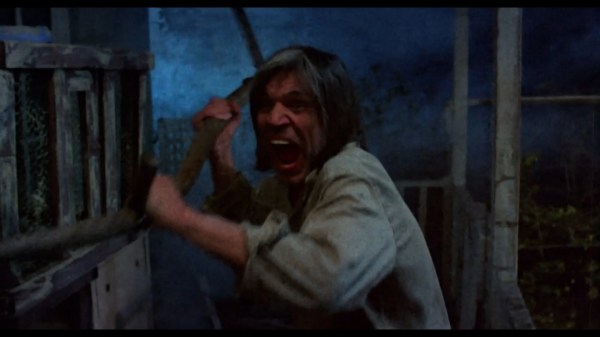
 Tobe Hooper followed up his classic horror the Texas Chainsaw Massacre by traversing similar ground but in a different way. Set in rural Texas, Judd runs the local Starlight Hotel. It is a remote location, with its own swamp. And in that swamp? Judd keeps a giant crocodile. And guess what he feeds it?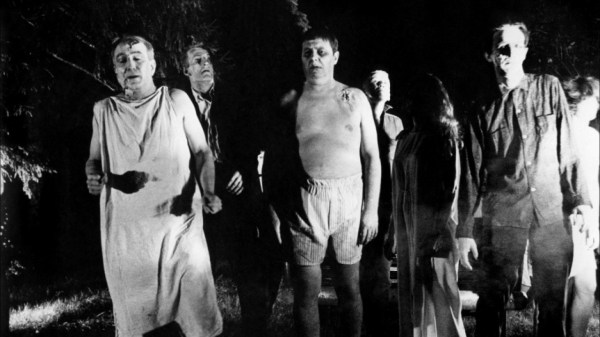
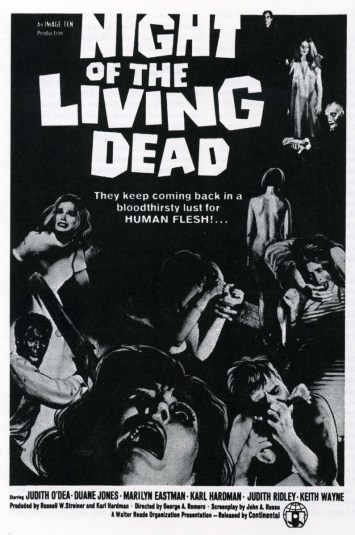 1968 was a time of real social upheaval in the United States of America. Out of this turmoil was born a tale of people desperate to survive in a situation they cannot hope to make sense of.



 Pretty sure this sequel was greenlit before the previous film hit theaters, hoping to have a franchise. For Chamberlain and Stone, this was the end of the road.
 Tripping Through Gateways