On the Run Pt 1 (The Maze Runner, 2014)

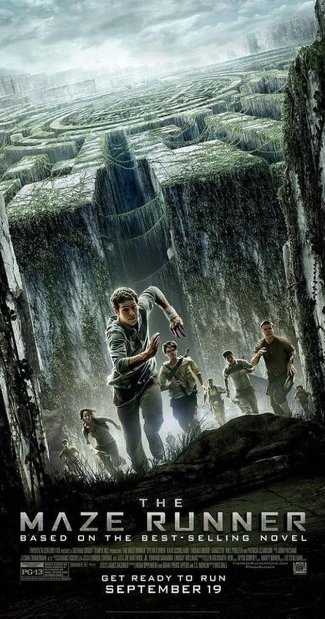
Maze_Runner_PosterWelcome to a dystopian future where Katniss is chosen to be part of a competition to the…oh wait…sorry, welcome to a Dystopian future where society has been restructured into five groups based on certain ski-wait, wait…that was something else…

So, in a dystopian future, ravaged by disease and a scorched earth, a young man awakens to find himself in an elevator with no idea how he got there. He soon finds himself in a Lord of the Flies type of situation.  A culture built by young teens.  At the top of the hierarchy are the Runners.

Runners enter the maze each day in an attempt to map it out to find a way to freedom. The young man, Thomas, risks his life one day to help two runners and gets stuck in the maze overnight.  They manage to be the first to ever survive a night in the maze.

Once made a Runner, Thomas pushes for the group to try and find the way out more aggressively.  This results in divisions among the group.

Part of the slew of films that adapted young adult novels to have the next Hunger Games, the Maze Runner exploits the ever popular “Teens in a Terrible Future” plot that fuels an entire subset of young adult books. But while it has strong similarities, it also sets itself apart a bit.  Built in with a larger mystery (why are the kids in the maze? What is WCKD?) the film smartly keeps the viewer in Thomas’ shoes.  He has no memory of why he is there or what he did before and we learn everything as he does.

The effects are pretty good, with an interesting monster design for the Grievers (creatures that hunt in the maze). The Maze design is intriguing and the action sequences are exciting.

The performances are quite good (Will Poulter, who played Eustace in the Voyage of the Dawn Treader, continues to impress me).

Is the Maze Runner awesome? No.  But it makes for a fairly entertaining sci-fi actioner.


Look Out In the Snow! (Tremors: A Cold Day In Hell, 2018)

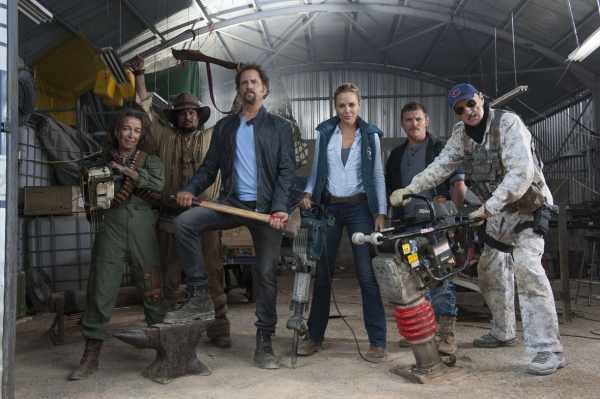
tremors_cold_day_in_hell_cover.jpgBurt Gummer is back in the desolate town of Perfection. He is having tax problems, so when he is contacted by the daughter of Val and Rhonda (Kevin Bacon and Finn Carter’s characters from the first film) because their remote Alaskan research base is under Graboid attack, he and his Son Travis run off.

It all has everyone perplexed, as there seems to be no explanation for the Graboids to be so far north. Gummer starts to piece it all together when they discover a nearby Area 51 style base. But the Graboids start gobbling people up and the two groups have to team up to try and survive.

I have noted in the past I found it kind of interesting how the films migrated across time to focus on survivalist Burt Gummer as the hero.  The fifth film introduced his previously unknown son Travis and beefed up the graboids in size and appearance.  They also became more agile.

Gross seems to enjoy  the role, though it may simply be that at this point he has the core of the character down.  Kennedy’s Travis can grate on the nerves a bit, but there are several like-able characters, making it easy to avoid just rooting for the graboids to eat everyone.

The move in the fifth film to make more use of digital graboids (though, there are still practical monsters for some scenes) is less jarring than it could be.  For the most part, the digital monster look pretty decent.

As someone who enjoys the Tremors series, I found this to be a passable, even fun sequel.

All Stand Together Pt 7 (Battle Beyond the Stars, 1980)

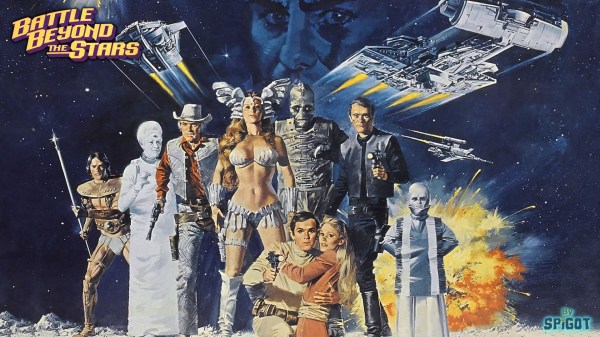
Battle_Beyond_the_Stars_PosterA peaceful planet called Akira is visited by the conqueror Sador.  He promises to return with an armada that will overrun the planet if they do not willingly submit to them.  A young man named Shad goes on a mission to get weapons and warriors to fight off Sador and his forces.

He assembles six unique individuals, including a vengeance seeking lizard man, a young scientist, a clone race, a haunted assassin, a beautiful warrior seeking glory, and a fun loving earth man. They all return to help the citizens of the planet.

If this sounds vaguely familiar, this Roger Corman film is a perfect example of Corman’s formula. Star Wars was a hit and had a sequel on it’s way.  Corman wanted a Star Wars style film.  He commission a script from John Sayles (who also wrote Corman’s Piranha).  They opted to take the story from Seven Samurai and set it in space, just as the Magnificent Seven moved it to the old American West.

And the movie is not shy about this.  The planet is named Akira, after Seven Samurai director Akira Kurosawa.  The advertising for the film included phrases like “Seven Magnificent Warriors”. Robert Vaughn even plays a character much like his dark Lee, from the Magnificent Seven.

This film, while being a knockoff meant to cash in onStar Wars hype, actually stands pretty well on it’s own.  A lot of this goes back to the strong cast.  George Peppard is a more laid back Han Solo type as the space faring earth man Cowboy.  The alien race the Nestors are an alien race of clones who are psychically linked.  This allows for a lot of intended humor, such as when they are offered a hotdog and while only one of them eats it, all the Nestor’s can taste is, and one observes, “There is no dog in this”.  After they recite the ingredients of a hot dog (determined by taste), Peppered cheerfully responds, “That’s what we call meat on Earth.”

Sybil Danning’s Saint Exmin the Valkerie is from a race that live only to fight in wars.  And wear swimming suits (what, you think a Roger Corman film is not going to feature at least one buxom woman in a tiny outfit?!).  Initially, Shad is annoyed and tries to chase her off, but she hangs on, proving herself in battle and winning Shad’s respect.

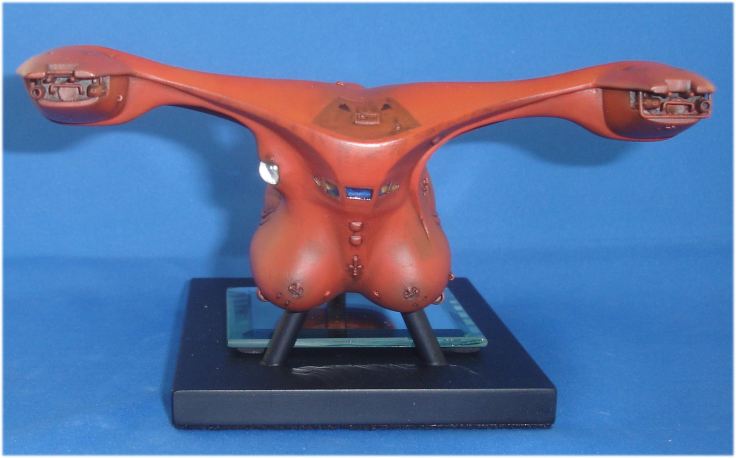
The film features work by James Cameron (as art director) and the designs go from very serious, such as Sador’s rather impressive ship to somewhat tongue in cheek.  Shad’s ship has a smart talking female voiced AI.  And the ship has breasts.  I am not joking.

Battle_Beyond_the_Stars_Ship

Seriously, Cameron…

And James Horner’s musical score is downright great.  Battle Beyond the Stars is entertaining and downright fun as low budget Sci-Fi goes.

Loveless Fascination (Annihilation, 2018)

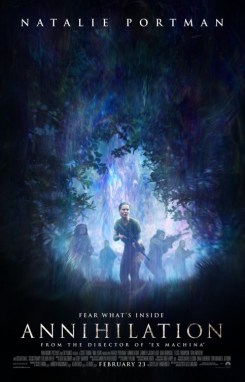
annihilation_posterLena is a professor who has been trying to come to terms with her husband Kane’s disappearance a year back.  He went on a mission for the Army and seemed to disappear completely.  As she tries to move on, one evening he just walks into the room. Kane is tight lipped, even absent minded.  Suddenly, he starts to vomit blood.  On the way to the hospital, the ambulance is accosted by government agents.

Lena learns where her husband has been, a strange part of an American swamp that is encircled by a strange barrier.  To try and get answers as to what is wrong with Kane, Lena volunteers to join four other scientists into what they call “The Shimmer”. They realize it may be one way, as other than Kane, no other group has returned.

What they find within the shimmer is evolution on overdrive.  Biological life is being melded into new lifeforms. The four scientists begin to question their sanity and even their physical forms.

Annihilation is a patient and quiet film.  It plays out and reveals itself in a deliberately calm fashion.  This is not a sci-fi spectacle.  Instead it is a world of frightening beauty. The film is full of haunted, eerie visuals.  At one point, they discover shrubbery that has grown to look like people. It is both creep and remarkably beautiful.

Much of the film rests on Natalie Portman’s shoulders, and luckily, she is in sync with the film’s tone. She has a quiet intensity throughout the film. Jennifer Jason Leigh offers us an uncertain leader.  Dr. Ventriss appears to have ulterior motives, but the audience gets no more real access than Lena.

Tessa Thompson plays scientist Josie in a role so uncommon for Thompson so far, that it took me awhile to realize it was Tessa Thompson.  Josie is quiet and mousey, but has a tremendous intellect. This allows her to start to understand the Shimmer in a way the other women cannot.  Gina Rodriguez is the well meaning conflict for the women within the film. Oscar Isaac’s role is small, but his performance as Kane is unnerving.

The film is visually stunning, every frame of the Shimmer full of horrific beauty. Alex Garland (director of Ex Machina) is proving himself a force to be reckoned with in thoughtful science fiction film.

It’s Good to Be King (Black Panther, 2017)

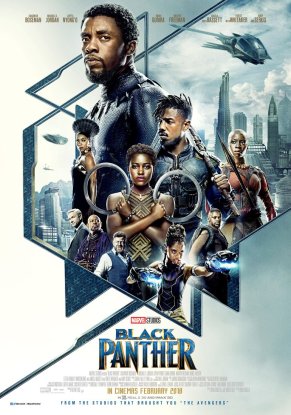
Black_Panther_PosterCreated by comic book icons Jack ‘the King’ Kirby and Stan Lee, Black Panther has seemed like a character Marvel wants to really make active…but struggles to figure out how to make him work best.  Initially being a guest star in the pages of the Fantastic Four and the Avengers, T’Challa (the titular Black Panther) got solo stories starting with 1973’s Jungle Action # 5. The series was not a top seller, and Marvel cancelled it. They tried to continue the Black Panther in his own series, which lasted until 1979.  They tried again in 1988, with a mini-series. This was followed by an appearance in Marvel’s anthology series Marvel Comics Presents in 1989.  1990 saw another series.  But it was 1998 where Black Panther found some footing.  Christopher Priest began his run and truthfully, he cracked the code with an incredibly engaging series. It lasted 62 issues (Priest wrote 60 of those issues). They worked on a new series in 2005 with Reginald Hudlin. 2016 brought back the Panther in his own series led by Ta-Nehisi Coates. This, for me, has come the closest to rivaling Priest’s terrific run.

While the Black Panther film was announced a few years ago, we did not get to see the Marvel Cinematic Universe take on the character until Captain America: Civil War.  I really enjoyed his introduction.  The film only hinted at a larger Wakandan culture, and so now is the opportunity to explore it deeper. This is a spoiler free review (so story references remain vague).

Opening with a young boy asking him to tell the story of home (Wakanda) before bedtime. This works rather nicely, filling us in on how Wakanda was built on Vibranium, how five tribes were united under a single king who was granted powers via plant life altered by the vibranium. Wakanda grew more technologically advanced than any other nation.  They sought to hide from the world.

The film quickly establishes that while the world believes that Wakanda is a low tech third world country, it is a vibrant high tech society. T’Challa and his family are still reeling from the events of Civil War, and it is time to T’Challa to take the mantle of King.

Of course, there are those who oppose him.  The weapons supplier Ulysses Klaue (pronounced “Claw” and first introduced to audiences in Avengers: Age of Ultron) and a mysterious young man called Killmonger are collecting Wakandan tech.

T’Challa struggles with his role as king. Heartbroken over his father’s death (again, in Civil War) and struggling with the role of Wakanda in the world.  His ex-girlfriend Nakia believes that Wakanda should be sharing it’s riches with the world…to be a beacon for the world, not tucked away. She loves him, but cannot see a place for herself in Wakanda when she has seen such suffering in the outside world.

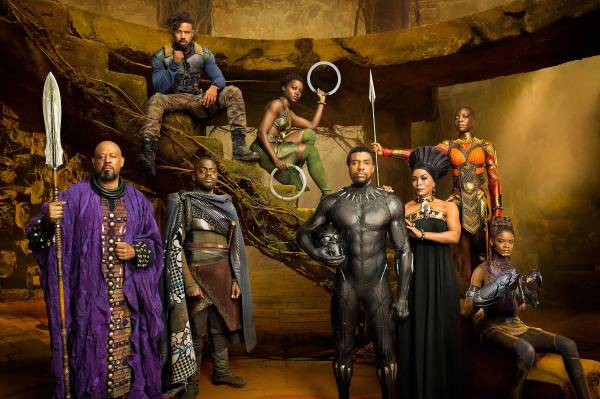
The film shows us a society which has a richness of history and culture. The costume design is beautiful.  The king’s personal guards are all striking in appearance with lush reds and gold.  They are all warrior women with shaved heads (in one entertaining moment T’Challa, Nakia and general Okoye are undercover and she complains about having to wear a wig).

The Wakandan tech is exciting sci-fi tech that would make Bond jealous.  The Wakandan landscape is a combination a immense futuristic cities and beautiful forests and mountains. There are some fight scenes set amongst giant waterfalls that Director Coogler and his cinematographer use lighting and sunsets to amplify the sequences with intensity and beauty.

I really liked the characters in this film.  For T’Challa, it carries over his lessons learned from Captain America: Civil War.  T’Challa is merciful and a good man.  Heavy is the head that wears the crown…this film shows T’Challa struggling to be a King and Protector and not being blind to the world around him.

The women really steal the show in this film.  Okoye is a formidable warrior and guardian.  Nakia is intensely stubborn in her dedication.  But she also is in love with T’Challa (who is also very in love with her).  His mother is a woman of pride and wisdom (Angela Basset is just regal and beautiful).  And then there is his sister Shuri.  She is a fun character who lovingly spars with her brother.  She is a brilliant scientist, but her youth presents a more brash attitude. She is like a super competent “Q”.

Everett Ross (created by Christopher Priest in his 1998 series) appeared in Civil War, but we did not get a real feel for the character.  Here we find him seeming over-confident at first, but he rises to the challenge of helping the Black Panther and his family. While he begins seeming a bit like he might be the comedy relief, he becomes a character who shows himself as heroic and willing to risk himself for his friends.

Killmonger is a villain with a good back story.  He wants to rule the world, but not in some cheesy maniacal ruler fashion. He wants to rise his people up to subjugate the colonizers. Klaue is just after money, and shows no arc…but Andy Serkis seemed to have a lot of fun in the role.

Full of action, heart and punctuated with some great humor, Black Panther was worth the wait.  I would easily categorize this as one of Marvel’s best.

Life Without a Soul (Blade Runner 2049, 2017)

blade_runner_2049_PosterIt is 35 years since the first Blade Runner. Agent K is a blade Runner and also a modern replicant.  He is given a mission after the bones of a replicant are found that indicate she died in childbirth. Replicants should be unable to conceive, let alone carry a child to term.
K’s human boss wants him to find the child and kill it.  But things become complicated when he finds evidence that his false implant memories may be real, leading to the question of whether K is the mysterious child of Deckard and Rachel (Sean Young’s Replicant from the original film).

Further problems arise when we find that Niander Wallace, who has profited off the failure of the Tyrell Corporation and become the leading force of Replicant and digital A.I. technology, is also looking for the child.  The one thing that has eluded him has been the ability for replicants to reproduce.  He sees this as a key component in their evolution (well, most everyone does).

The films is visually stunning.  The neon dreams that fill the city, the holographic girlfriend Joi (showing both K’s isolation as a Blade Runner and Replicant and his desire to connect), the desolate Las Vegas…every shot in this film feels like independent artworks.

The ending gives the audience just enough to be satisfying without wrapping everything up in a neat little package.

Not playing coy about K’s identity as a replicant is something that gives the film strength.  In one scene, K expresses a concern about killing something “born” to his superior Lieutenant Joshi.  He notes that being born implies there is a soul there. Joshi sends him off with the cold note that he has gotten along fine without a soul. I am trying to determine if it is a problem for me that Joi is probably one of the most sympathetic beings in the entire film. But I suspect director Denis Villeneuve would like to hear that. By and large, the Replicants are the center of the show here.  Luv, Wallace’s right hand, is downright terrifying.

Villeneuve has given the audience a beautiful and captivating film.

Inner Conflict (The Hidden, 1987)

Hidden_PosterDetective Tom Beck has a head scratcher of a case.  He is investigating a man who, up until a week prior had been a law abiding citizen.  One day Jack DeVries just up started killing people, stealing cars, robbing banks and listening to heavy metal.

After taking the guy down, an FBI Agent named Lloyd Gallagher shows up to work with Beck. Gallagher seems to have other motives, suggesting there is something bigger at work…or at least that having DeVries in the hospital is not the end of the case.

The audience quickly learns the cause of DeVries’ behavior is an alien bug that can move from body to body. When he is in a body, it can withstand a barrage of bullets before having to find a new host.  And this is where the problem lies, Gallagher can only destroy the alien when it is moving between bodies.  His weapon cannot penetrate human flesh.

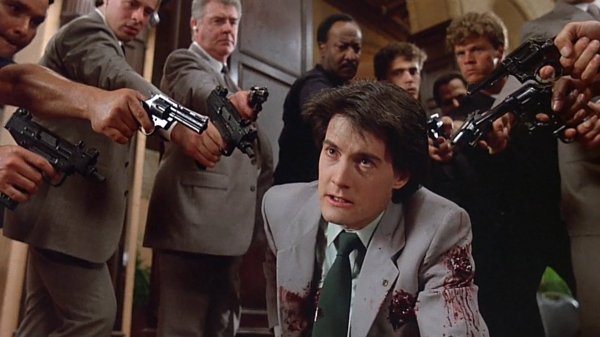
The two cops try and catch the alien, constantly a step behind.  The film revels in it’s crazy concept, with car chases and bloody gun fights. The evil alien is a selfish and hedonistic teenager.  He takes whatever he wants, and mainly what he wants is money, cars and power.

MacLachlan plays his role completely straight.  He is the awkwardly out of place alien trying to fit in.  There is a touching scene where he meets Beck’s daughter, and she seems to realize there is something different about him.

The Hidden is not a sci-fi classic, but it is a pretty good bit of fun trashy eighties excess.

Out Of Time Part III (Back To the Future Part III, 1990)

Back_To_The_Future_3_Poster“The Future is whatever you make it, so make it a good one!” These are the words of wisdom Doc Brown chooses to give Marty after three films bouncing around time. Spoilers occur throughout…

Made back to back with Part Two, the third film takes Doc and Marty to a time most appealing to Doc Brown.  Why the old West is so appealing to Brown, a scientist, always seems weird to me. But anyways, Marty goes to 1955 Doc Brown for help.  Future Doc Brown hid the Delorean away, so Marty and 1955 Doc dig it out so they can fix it and Marty can return to 1985.  However, in spite of Doc’s comfort with remaining in the old west, Marty realizes there is a danger when they discover a tombstone for Brown from the 1800s.  And so he goes back to get Doc.

In the old West, Marty finds himself meeting the relatives of both his family and Biff Tannen.  Biff apparently comes from a long line of bullies. The film brings back the gag of Marty giving a false name, this time around he calls himself Clint Eastwood (which is met by laughter from locals for being a non-masculine name). Marty and Doc must figure out how to get back to 1985 before Doc is killed.

Things are complicated by the arrival of Clara, a schoolteacher.  Doc saves her from falling off a horse.  As Doc falls for her, they realize that she should have died, and Marty and Doc have altered history.

Back to the Future Part III avoids the complications of the previous film, keeping everything in a single time for most of the film.  It repeats the motifs of the original film, and it takes three films for Marty to learn not to be set of by being called chicken. But while it is less creative than Part II, it is more tonally consistant and therefore more satisfying for the audience, I suspect.

I do find the “moral” imparted by Doc odd.  We have spent three movies with Doc declaring how dangerous time travel is and how they need to stop jumping through time…only for Doc to decide to run around the time continuum with his family.

But still, this is a pretty enjoyable close to the series, and really, feels like a decent high note to end on.

Out of Time Part II (Back to the Future Part II, 1989)

back_to_the_future_2_poster-e1514977762521.pngSpoilers occur throughout…Back to the Future had one of those endings that worked both as a setup for future films, as well as just a cute way to end a time travel movie.  Marty’s life looks awesome and then Doc Brown shows up saying they need to fix the future. I suspect that the reality is, it was just meant to be a cute little throw away ending.  But then, Back to the Future was a big hit…and both the film makers and audiences wanted to see more. And so they set forward with plans for two sequels.

Back to the future begins right where the first film left off, Doc Brown urgently telling Marty they have to go into the future to do something about Marty’s kid. They bring along Jennifer for the trip to the future, but she becomes so excited by the notion of being able to see her future, the Doc opts to knock her out, telling Marty she will just think it is a dream.  Doc tells Marty to go to a local hang out, meet Griff (grandson of Biff) and simply tell him “no”.  It turns out that if Marty Jr. goes along with Griff’s peer pressure, he will end up in jail.

But after fixing that potential future, other things go awry.  The police find Jennifer and bring her to her future home. Meanwhile, Marty gets the idea to buy a sports almanac so he can go back to the present and make bets based on future knowledge.  Doc puts the idea to bed, but someone overheard the idea…and while Doc and Marty go to get Jennifer? Old Man Biff seeks to reverse his fortune.

They return to the present and leave the unconscious Jennifer on her porch. Marty slips in through his bedroom window, only to discover a whole new family is living in the house.  After being chased off by an angry father, Marty comes across a newspaper.  Certain they came back to the wrong time, Marty discovers that, indeed, they returned to 1985…but everything is off.

Marty is knocked out, and when he awakens (in a scene mimicking the sequence from the first film where he awakens to find his teen mother watching over him) he is startled by a mother who looks very different from before.  He is horrified to discover that Biff is his step-father…and Biff is the richest man in America. Biff tries to kill Marty based on a warning from the man who gave him the sports almanac.  Doc Brown intervenes and explains to Marty that an alternate timeline has been created.

To fix the timeline, they must go back to 1955 and steal the almanac from young Biff.  Then, hijinks ensue.  Marty has to get the almanac from Biff, while avoiding Biff’s thugs, yet also save his other self from those thugs.  It is a crazy last act, filled with alternative views of sequences from the original film.

The most memorable part of the film for audiences was the future of 2015, where Marty rides a hover board, is wearing self drying clothes and everything is super technologically advanced. And apparently Gale and Zemeckis believed the height of future technology would be TV screen communications, swiping credits cards and…fax machines all over the house, built into walls.

It is a fun sequence though, for my money alternate 1985 is an interesting idea.  Biff’s rich and famous routine is absurdly entertaining in it’s obvious allusions to the Donald Trump of the 80’s.  And the notion of 80’s nostalgia is certainly not inaccurate.

The film ends on a cliff hanger, with it seeming that they solved the problem of the Dark 1985 timeline, but the Delorean is hit by lightning, causing it to appear as if Doc Brown was incinerated…but it is all a set up for the third chapter.  A Western Union guy arrives with a letter addressed to Marty from 70 years earlier.

They introduce a a variation on the photo gimmick from the first film, instead using newspaper clippings. As they make changes, the paper headlines and photos change.

This is a flawed film, mainly because halfway through it just starts to seem endlessly complicated. But, in some ways, I really like it for daring to mess around with it’s formula.

Out of Time (Back To The Future, 1985)

Back_To_The_Future_PosterSpoilers occur throughout…Marty McFly has big dreams but lacks any of the confidence to reach for them.  His high school principal is convinced every generation of the McFly family are losers. And it is not hard to see why Marty may struggle with that.  His parents are meek.  His father is pushed around by his boss Biff. Biff has George McFly writing up his reports as well as supplying him with his car. His mother is uncomfortable with the notion of a girl calling a boy. His sister and brother are unemployed layabouts.  And his uncle pretty much lives in prison, failing to get parole at the beginning of the film.

Marty’s only bright spot is his girlfriend Jennifer.  She is confident Marty should be successful, especially as a musician.  One evening, Marty is asked by his friend, eclectic inventor Doc Brown, to help him with a top secret project.  The project turns out to be a Delorean car that Doc converted to… A TIME MACHINE. After an attack from rogue Libyans (it makes sense, trust me) forces Marty to jump into the Delorean and race off, triggering the time travel.  Marty finds himself in 1955. Marty runs into his father, who turns out to be just as as weak willed as his grown up self.

But it is when he saves his father from being hit by a car that everything goes wrong. He discovers the act prevents his father and mother from starting their relationship, instead, young Loraine falls for Marty. Marty Tracks down Doc Brown for help and they set out to fix Marty’s parental relationship (discovering that he and his siblings will be erased from the timeline if his parents fail to fall in love).

As bizarre and outlandish as the plot may seem (and even creepy, what with the subplot that Marty’s mom has a crush on him), everything fits together nicely. The film establishes all the town’s important monuments in about two minutes.  Each character is quickly defined in brief dialog.  And the film presents the science of time travel in ways that seem complex, but easy to suspend disbelief for.  Zemeckis and writer Bob Gale also have a simple gimmick for communicating to the audience the severity of the situation.  Marty has a photograph of he and his siblings, each of whom fade from the photograph through the course of the movie.

Back to the Future was Michael J. Foxes first big starring feature film role.  A role that almost never happened, the film began shooting with Eric Stoltz, but after awhile, it was felt he was just not right in the role.  Up until this point Fox had been a rising television star.  But Back to the Future pushed him into the next level.

Crispin Glover brings a likable and sweet nerdiness to the role of George McFly. This is important, both for George and Marty.  While Marty is a “cooler” kid, a lot of his insecurities are mirrored in his father.  When George makes his third act turnaround, Glover does so with a great performance.  Lea Thompson is sweet, with a hint of rebellion, as Marty’s mom.  A lot of the fun for her character is the juxtaposition of the woman she is in the future and the teen she was.

As Doc Brown, Christopher Lloyd brings his signature manic style, making for an entertaining performance Thomas F. Wilson will probably be forever tied to Biff Tannen, but he is extremely memorable in the role.

While the old age makeup for all the actors certainly looks like “Old People” makeup, it is not so distracting as to damage the enjoyment of the film. A lot of the effects still hold up for the film.

The tone of the film is light, with plenty of humor. And the jokes, for the most part, have withstood the test of time. There is one gag that has not held up so well, because, looking back, it is an image issue.  The gag on it’s face is not remotely malicious, and the filmmakers probably never once had it occur to them that they were basically attributing a form of music created by black musicians to a white kid from the future.

Decades later, Back to the Future is every bit as entertaining as it was in 1985.


Create a free website or blog at WordPress.com.

Up ↑