Out of Time Part II (Back to the Future Part II, 1989)

back_to_the_future_2_poster-e1514977762521.pngSpoilers occur throughout…Back to the Future had one of those endings that worked both as a setup for future films, as well as just a cute way to end a time travel movie.  Marty’s life looks awesome and then Doc Brown shows up saying they need to fix the future. I suspect that the reality is, it was just meant to be a cute little throw away ending.  But then, Back to the Future was a big hit…and both the film makers and audiences wanted to see more. And so they set forward with plans for two sequels.

Back to the future begins right where the first film left off, Doc Brown urgently telling Marty they have to go into the future to do something about Marty’s kid. They bring along Jennifer for the trip to the future, but she becomes so excited by the notion of being able to see her future, the Doc opts to knock her out, telling Marty she will just think it is a dream.  Doc tells Marty to go to a local hang out, meet Griff (grandson of Biff) and simply tell him “no”.  It turns out that if Marty Jr. goes along with Griff’s peer pressure, he will end up in jail.

But after fixing that potential future, other things go awry.  The police find Jennifer and bring her to her future home. Meanwhile, Marty gets the idea to buy a sports almanac so he can go back to the present and make bets based on future knowledge.  Doc puts the idea to bed, but someone overheard the idea…and while Doc and Marty go to get Jennifer? Old Man Biff seeks to reverse his fortune.

They return to the present and leave the unconscious Jennifer on her porch. Marty slips in through his bedroom window, only to discover a whole new family is living in the house.  After being chased off by an angry father, Marty comes across a newspaper.  Certain they came back to the wrong time, Marty discovers that, indeed, they returned to 1985…but everything is off.

Marty is knocked out, and when he awakens (in a scene mimicking the sequence from the first film where he awakens to find his teen mother watching over him) he is startled by a mother who looks very different from before.  He is horrified to discover that Biff is his step-father…and Biff is the richest man in America. Biff tries to kill Marty based on a warning from the man who gave him the sports almanac.  Doc Brown intervenes and explains to Marty that an alternate timeline has been created.

To fix the timeline, they must go back to 1955 and steal the almanac from young Biff.  Then, hijinks ensue.  Marty has to get the almanac from Biff, while avoiding Biff’s thugs, yet also save his other self from those thugs.  It is a crazy last act, filled with alternative views of sequences from the original film.

The most memorable part of the film for audiences was the future of 2015, where Marty rides a hover board, is wearing self drying clothes and everything is super technologically advanced. And apparently Gale and Zemeckis believed the height of future technology would be TV screen communications, swiping credits cards and…fax machines all over the house, built into walls.

It is a fun sequence though, for my money alternate 1985 is an interesting idea.  Biff’s rich and famous routine is absurdly entertaining in it’s obvious allusions to the Donald Trump of the 80’s.  And the notion of 80’s nostalgia is certainly not inaccurate.

The film ends on a cliff hanger, with it seeming that they solved the problem of the Dark 1985 timeline, but the Delorean is hit by lightning, causing it to appear as if Doc Brown was incinerated…but it is all a set up for the third chapter.  A Western Union guy arrives with a letter addressed to Marty from 70 years earlier.

They introduce a a variation on the photo gimmick from the first film, instead using newspaper clippings. As they make changes, the paper headlines and photos change.

This is a flawed film, mainly because halfway through it just starts to seem endlessly complicated. But, in some ways, I really like it for daring to mess around with it’s formula.

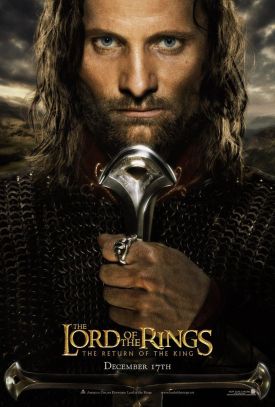
To Rule Them All Thrice (The Lord of the Rings: The Return of the King, 2003)

LOTR_Return_PosterAll stories must conclude.  Some just take longer than others.  A lot longer. But more on that later. Sauroman is defeated, Aragorn and the people of Rohan have defended Helms Deep and Frodo, Sam and Gollum are at the door of Mordor.
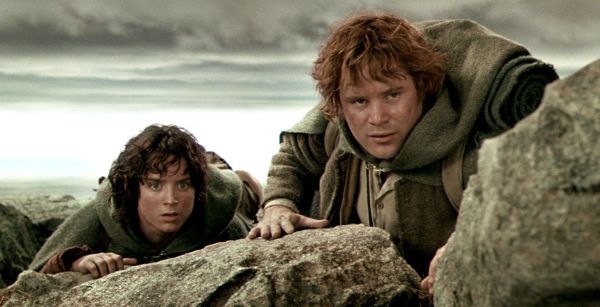
Te film actually opens by jumping back several hundred years before the story we have been watching where we see hobbits Sméagol and Déagol fishing in a small boat.  After being pulled into the water, Déagol finds… The Ring. Both are gripped by obsession for the ring, resulting in murder.

Aragon and the others make their way to Gondor to unite the armies of men against Mordor and it’s seemingly endless forces.  We see most of our characters reunited.  Sam and Frodo’s relationship is tested by the duplicitous nature of Gollum.

Without question, the visual effects, costume and set design are top notch.  There really is not much to say here that I have not recognized in my previous reviews.  Sure, there are minor slip-ups (hobbits that are clearly height doubles wearing masks of the actors) and a few of the “Legolas being amazing” sequences in battles are surely CGI.

Faramir and the hobbits all get better deals here. Both Merry and Pippin get to be more than comic relief, with downright heroic moments and emotional moments.  There is a scene between Pippin and Gandalf where they say nothing, but share a look of great heart break from across the room, as if Gandalf knows Pippin is about to face some truly unfair tests.

Gimli, unfortunately, has never recovered from the Two Towers and remains embarrassingly frustrating comic relief.

Elijah Wood tells the story of how Jack Nicholson told him he left after the first ending. And this film has, like the book, several endings.  Though, most lamented is the scouring of the Shire, which the extended edition and theatrical cuts never included (the first film paid tribute to it in a vision with Galadriel). Here, the extended cut moves the unceremonious end of Sauroman from the scourging to earlier in the story.

But the frustrating part is that each “ending” feels somewhat necessary. Each gives a certain sense of closure to the tale. For all their flaws, the trilogy comes together and has far more to love than hate.  The strengths of the performances, the overall writing, the effects, the set design, the costumes…brings together one great epic.

Two Rule Them All (The Lord of the Rings: The Two Towers, 2002)

LOTR_Two_Towers_PosterPicking up in the aftermath that split the fellowship apart, the Two Towers has a lot on it’s shoulders. Frodo and Sam are now on their own, making their way for Mount Doom to destroy the ring.  Aragorn, Legolas and Gimli are trying to rescue Merry and Pippin, who are believed to have been kidnapped by Orcs.
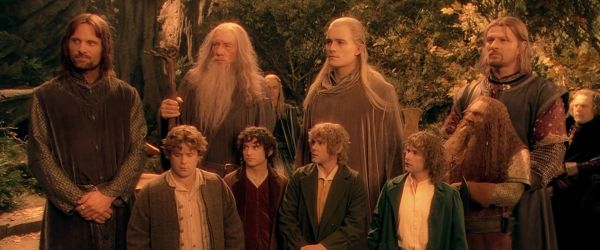
We quickly learn that Merry and Pippin found escape from the orcs on their own.  Aragorn, Legolas and Gimli are diverted by Gandalf who directs them to Rohan.  Gandalf realizes the time has come to prepare the armies of men for an epic battle against Sauron and his forces.

Rohan is under the influence of the Wizard Sauroman.  Their king is in a sickly trance, poisoned by Wormtongue, the agent of Sauroman.  Upon arrival, Gandalf excises the presence of Sauroman and chase out Wormtongue.  They warn the people there of the coming danger, and all agree they must make their way to an old fortress to protect everyone.

Meanwhile, Merry and Pippin discover the ancient race of Ents.  The Ents are ancient and sentient trees.  Pippin becomes determined to convince Treebeard and his fellow Ents to fight against the advancement of Sauroman and his orc army before it can join Sauron’s army.

And of course, there is Frodo and Sam.  Theirs is a somewhat less exciting route, as they are trying to avoid being seen.  Frodo confronts Gollum, who has been shadowing he and Sam in his attempt to get the ring back. Frodo takes pity Gollum, and chooses to take him along as a guide.

In the first film, we only had glimpses of Gollum.  This character presented a huge challenge and still stands as a monumental achievement in CGI effects.  Coupled with a terrific performance by Andy Serkis, Gollum comes to tragic and frightening life.  Serkis takes on a voice that can seem almost painfully childish and monstrous…sometimes at the same moment.  The film has a great moment using reflections and camera angles in which Gollum argues with himself over serving Frodo faithfully versus betraying him and stealing the ring back.

In the book, the stories are separated into two parts.  The first half follows Frodo and Sam and the second half follows the other characters. In one way, this does allow some interesting storytelling moments.  Frodo and Sam’s story will reference them seeing stuff we only see played out in the second half of the book.  But it also can make the Two Towers a tough read.  It does not break up the story enough.

Gimli continues his slide into little more than comic relief and Legolas even ends up having plenty of his swashbuckling antics coming off as comedic and cheesy (using a shield as a surfboard).

The film also undermines the character of Farimir, brother of Boromir.  In the book he is not tempted by the ring in any way.  He is a strong and confident man in ways his older brother was not.  Unlike Tom Bombadil, this not being tempted is an effective statement of Farimir’s character.  The film makes him much less sure of himself.  He is haunted by the ghost of his brother and his father’s greater love for Boromir. He does, of course, make the choice he makes in the book, but the overly wrought drama of giving him severe daddy issues works against the character in frustrating ways.  Yes, it allows Sam to be a dramatic voice of reason…but it really is an unnecessary detour that also makes Farimir come off as needlessly cruel at times.

The Two Towers does start to feel a bit meandering at times.  The extended cut suffers from this even more, though some of the additional scenes are quite entertaining.  While not quite an Empire Strikes Back (which is a bit leaner storytelling) it still is a pretty impressive film.

To Rule Them All (The Lord of the Rings: The Fellowship of the Ring, 2001)

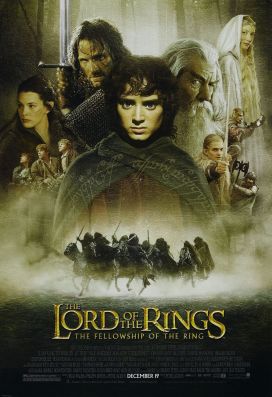
LOTR_Fellowship_PosterJohn Rogers, one of the writers of the abysmal Catwoman film once also wrote “There are two novels that can change a bookish fourteen-year old’s life: The Lord of the Rings and Atlas Shrugged. One is a childish fantasy that often engenders a lifelong obsession with its unbelievable heroes, leading to an emotionally stunted, socially crippled adulthood, unable to deal with the real world. The other, of course, involves orcs.”
And the Lord of the Rings is definitely one of those book series that had legions of admirers.  Ralph Bakshi has adapted the three books into two animated films in 1978 and 1980. And there were a lot of false starts until the late 90’s.  The first plan was to try and make one film…then they thought they could convince a studio to do two…but somehow, Peter Jackson convinced New Line the only proper way to do the film was to adapt each novel and film them back to back.  They then took it a step further and released the special edition DVDs.  These sets were expanded to include many scenes not used in the theatrical releases.  My reviews will be of the Expanded Editions.

The story of the Lord of the Rings is that long ago the evil Lord Sauron tricked the leaders of the Elves, the Dwarves, and Man, creating powerful rings for them all…secretly creating the one ring that would rule them all.  In a battle between Sauron and the final alliance of men, dwarves, and elves, Sauron was defeated.  Instead of destroying the ring, Isildur keeps it for himself. He is eventually killed.  The ring was then lost to time.  It was found by a creature who hid with it in the mountains.  It eventually fell into the hands of the Hobbit Bilbo Baggins. He has had it ever since.  The Fellowship of the Ring is the beginning of the final push to destroy the ring.

The wizard Gandalf the Gray calls upon Frodo, nephew of Bilbo for this task. He sends Frodo on, promising to meet in a small town.  Frodo is accompanied by his friend Samwise (or more simply, Sam).  Soon after leaving, they are joined by fellow Hobbits Merry and Pippin.  As they go on their journey, they pick up help from the mysterious ranger Strider (Revealed to be Aragorn, a descendant of Isildur).

When Frodo is wounded by a Ringwraith (the souls of the original nine kings of men who were enslaved to Sauron), he is whisked away to the Elvish city of Rivendell. There they meet up with what are to be the final members of the Fellowship of the ring, the Elf Legolas, the Dwarf Gimli and Boromir, son of the Steward of Gondor.

They find themselves constantly under attack, primarily from Sauroman, a wizard like Gandalf, but having chosen to serve Sauron. Using magic and a new generation of Super Orcs he tries to stop them at every turn.

Filmed in New Zealand, almost every shot of this film is awe-inspiringly beautiful. The Hobbit Shire has been carefully created bringing the environments of the book to life in a vibrant way.

Along with the sets, the film’s costumes are incredible.  Everything has power and weight.  The craftsmanship of the weapons and costumes immerses you into this world.

The visual effects have withstood the test of time.  A lot of Weta Workshop’s work is a combination of digital and practical.  But unlike far too many movies, the digital is groundbreaking and almost never distracting (except in it’s dedication to looking natural).  The Fellowship of the Ring broke new ground in its digital work to create massive armies that seemed to move without being duplicated.

The film also uses a lot of practical tricks to create the illusion of different heights.  Both Hobbits and Dwarves are supposed to be significantly smaller than the rest of the cast, and in spite of actors who are as tall as anyone else in the cast, using perspective tricks, smaller actors as stand-ins they manage to create a nearly seamless illusion.

And then there is the cast.  Some scoffed when Elijah Wood was cast as Frodo.  The books describe Hobbits in a fashion that insinuates, they are naturally a bit hairy and pudgy.  But Wood (and really the other hobbit actors) are rather attractive.  But They all do quite well.  And Wood and Sean Astin really sell the deep and heartfelt friendship between Frodo and Sam.  Frankly, I love the fact that the films capture this love.  Films featuring male relationships can often be quite superficial.

Ian McKellen, so compelling as Magneto in the X-Men films carries great weight here as the wizard Gandalf.  He is warm, yet can seem stern and menacing when necessary.  And he brings a sense of grandeur so necessary for such a character.  Viggo Mortenson brings a quiet nobility to Aragorn.  And Cate Blanchett’s Galadriel as an unearthly and elegant beauty.

This is not to suggest there are no flaws.  While not as large of an issue here, Gimli can often be reduced to comic relief (the same with Pippin and Merry). On the other hand, the storytelling is more expedient than the books. Often, Tolkien can seem a bit obsessive in his world-building, with sudden diversions into poetry and legends and language of Middle Earth.  The filmmakers wisely cut the Tom Bombadil sequence.  While this is a fairly loved section of the book, the screenwriters are correct that it undercuts the narrative of the Ring to suddenly have a character who is not impacted at all by it.  Especially so early in the story.  Personally speaking? I don’t care for that section of the book, and so I did not miss it within the film.

The Fellowship of the Ring is s very strong adaption of the book, full of epic adventure. It was a risky venture that paid off quite well for the filmmakers and the studio.


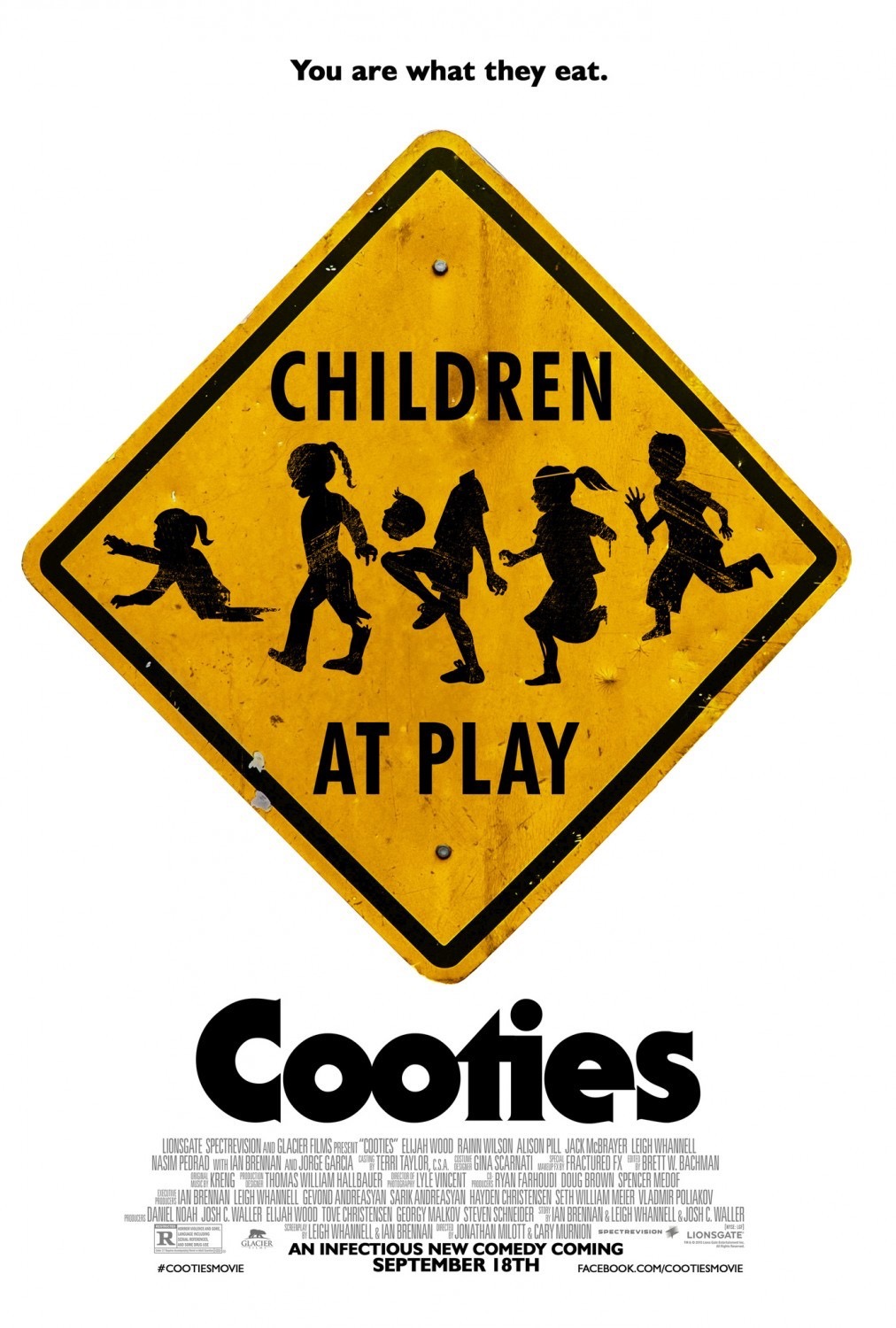
You Can’t Eat the Teachers, Man! (Cooties, 2015)

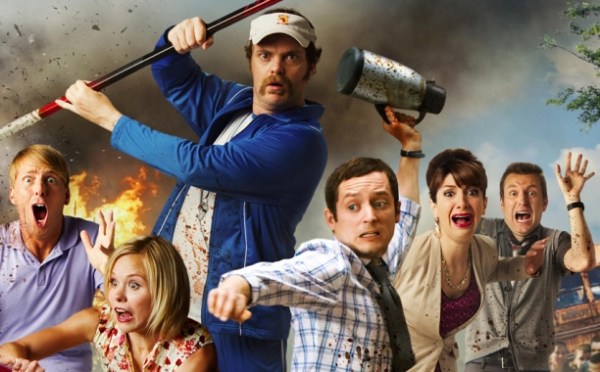
cooties_posterKids are mean.  We all know that.  Cooties just takes that to the next level.  Cooties opens with the most gruesome images possible.  Chickens being ground into chicken nuggets. Because tainted chicken nuggets will cause stuff.

Then we meet Clint (Elijah Wood), an aspiring writer making ends meet as a substitute teacher.  He has no real heart for it…he uses his class to get notes on his horror novel.  In the midst of a reading, the class bully is attacked by by a girl he was teasing, getting a severe bite.

Soon, the teachers find themselves trying to survive in a school of zombie children.  They hope to hold out in a room, but this is a horror film.  Mayhem cannot be avoided.

And a hilarious massacre it is.  The film’s zombie still behave like kids, they run, they jump, they play with grown ups by ripping them to pieces.  Just like my nephews.  But seriously, the film takes an absurd premise and has a lot of fun with it.

While there is nothing truly original in the setups, the writing makes great use of cliched things like love triangles, absurdly overbearing gym teachers, clueless adults, etc.  The film has fun with it’s cliches, rather than hiding behind it to pretend to have a plot.

Along with clever writing, the film is populated with terrific comedic character actors such as Rainn Wilson, Nasim Pedrad and Jack McBrayer.  Elijah Wood and Alison Pill are terrific fun as well.  And Leigh Wannell (one of the few actor’s known for his straight up horror roles) is entertaining as an oddball science teacher.  Oh yeah, and Jorge Garcia from Lost is quite entertaining as a stoner school crossing guard.

Much like Tucker and Dale Versus Evil, the film is quite gory, yet somehow manages to not overpower the comedy.  The effects are solid and help sell the horror side of the film.  Simply put, I was laughing throughout the film, and was engaged by the characters through the entire film.

Blog at WordPress.com.

Up ↑