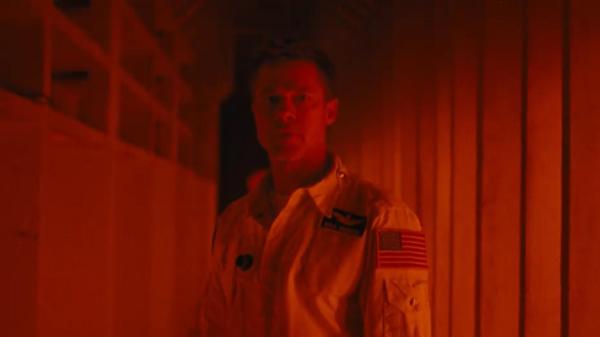
 Fifteen years ago, Clifford McBride left earth to find intelligent life in the universe, leaving a wife and son behind. At some point, the mission was lost. McBride’s son has followed in his fathers footsteps and now works as part of a space station/satellite. After he survives a massive accident Roy McBride discovers that his father may yet be alive and that his experiments may be what caused the accident. See, the accident was due to a massive surge from space that has impacted the planet.
Roy is recruited to go on a mission to see if he can convince his father to stop the experiments. Much of the film is focused on Pitt’s Roy McBride’s trip and emotional journey. It is established early on that Roy is in a rather remarkable sense of self control. He is aware that this is detrimental to his relationships and that he is pretty distant from his own life. He even comments that he might be lying to everyone, even himself.
This tends to work really well, as Pitt keeps his performance largely detached and emotionless until you near the end of the film. Only as he sees possible closure do his emotions start to creep to the surface.
The film really rides almost completely on Pitt’s performance, as most characters pass in and out of the story very quickly. But Pitt is up to the task. The film is not terribly deep, it is about fathers and sons and letting go of personal pain. And the film is very much surface level. But I appreciated that the film does not get so lost in meandering philosophy (and it could have) that it feels like a solid resolution and hope for Roy by the closing minutes of the film.
The other thing I appreciated a lot in this film is the atmosphere and the world building. Set in the vague “near future” we have space stations on the moon and Mars, but nothing feels implausible. The tech feels like logical extensions from current tech. The moon is established as a borderless zone, full of tourists and threats. In the safety of America’s Moon-base you have fast food restaurants, families taking their pictures with mascots and hotel chains. but leaving there, you run into human threats.
Ad Astra is thoughtful sci-fi without being too esoteric for mainstream viewers. It is amazing to look at and Pitt gives a simple but interesting performance.

 And so here we are at Quentin Tarantino’s ninth film (Apparently Death Proof does not count?). A pretty loving homage to the Hollywood of the 60’s, Tarantino weaves a tale of fading actor Rick Dalton and his best friend Cliff Booth and their place in it all. Cliff is less bothered, content to help out his friend and then spend the evening sitting in front the TV with his dog. But after a meeting with producer Marvin Schwarz, Rick is realizing he is becoming…well obsolete…and it scares him.
 The writing is both the cleverness we expect from Tarantino matched with compelling characters (there is a bit of a question if Cliff is maybe a darker guy, but the film leaves the door open on just how dark). I would say the weakest link in the main characters is Robbie’s Sharon Tate. Not because Robbie is a bad actress. She is charming and kind as Tate. There is a sequence where we see Robbie express insecurity turning to joy as she watches a movie she is in with an audience. Robbie sells this moment. But she feels so incidental to the story for much of the time.
 Tripping Through Gateways