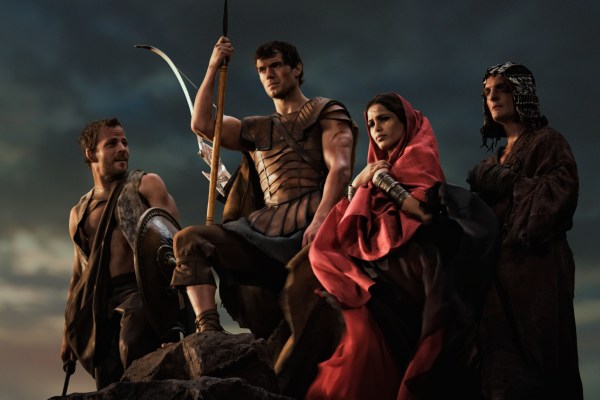
 Immortals begins with an ominous dream in which a man uses a mythic bow to free the Titans who were locked away by the gods. We are told how the gods defeated the titans, and in the midst of their battle the powerful Epirus Bow was lost. Now, eons later, the vicious King Hyperion seeks to find the bow and set free the Titans, allowing him to reign destruction across the earth.
A seaside village is under threat from Hyperion’s armies, hastened when a soldier betrays them. This results in Hyperion killing the mother of peasant Theseus. Unknown to anyone, including Theseus himself, he was trained as a warrior by Zeus himself (in the guise of an elderly man). Theseus is hopeless and enslaved, until Phaedra, the virgin oracle, seeks his help in escaping the grasp of Hyperion. Their mission becomes that of stopping Hyperion from freeing the Titans.
The gods of Olympus are not playing games here, and in a way the film kind of inverts the Clash of the Titans remake. Instead of the gods demanding the faith of men, here, Zeus implores the other gods to follow his lead and have faith in mankind. They have a rule against direct interference (Zeus’ loophole for helping Theseus was that he did not use his god state, but rather did his work in the form of a human). The other gods are more impatient, wanting to intervene directly.
The film does not hold very tightly to the myths of Theseus (the mythical founder of Athens). This is not to say those stories go unacknowledged. But they occur more as brief incidentals, or serve other purposes than the original tales.
Immortals is quite a visually stunning film. This is no surprise, coming from director Tarsem Singh, known for films like the Fall and the Cell. An aesthetic of beauty stands above practicality with wild armor and flowing robes filling the screen.
And while it uses a similar style to films like Zak Snyder’s 300, it feels very much like it is truly the vision of it’s director, rather than following in a popular style. The gods move in a unique way, with their golden armor creating motion trails, and while they are moving through fights quickly, their blows strike the targets in slow motion (simultaneously). And yet, the film ends up feeling more like eye-candy than a real story. Everything is so pretty to look at and yet, feels incredibly empty.

 Romero’s career as a director came with this final installment to his Dead franchise. A more traditional story structure than the previous film, this film features characters we only briefly met in Diary of the Dead. The National Guardsman are still trying to get somewhere safe. They meet a kid who tells them about an island. When they arrive at the island, they run into a rivalry between people who want to kill the zombies and those who want to protect them.
 Tripping Through Gateways