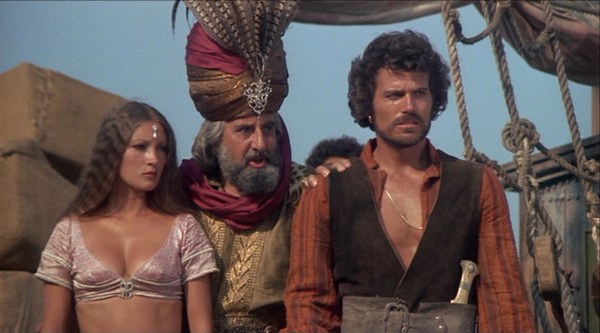
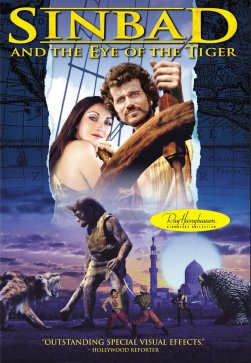
 Prince Kassim has been transformed by his stepmother into a Baboon. She wants her own son, Rafi, to inherit the throne. For help, his sister, the Princess Farah calls on her beloved Sinbad for help. They go on a quest to save Kassim from his cruel fate.
After finding out that the only cure can be found in a magical region of the Arctic, Sinbad races against the evil Zenobia and Rafi, who use magic to try and sabotage Sinbad’s chances.
Harryhausen, as usual, delivers amazing and whimsical monsters, ranging from a giant walrus to a giant Troglydite. Margaret Whiting makes a deliciously over the top villain and Patrick Wayne is pretty good as the swashbuckling Sinbad.
This film, of course, suffers the same cultural problem of casting white people in non-white roles. This was certainly treated as less of an issue as recently as the 70’s, but that simply does not make it less problematic.
In spite of this, I have always had fond memories of this film. It is both exciting and whimsical. It is worth noting that this film is written by Beverly Cross, who wrote Jason and the Argonauts and would go on to write the original Clash of the Titans. Sinbad and the Eye of the Tiger is an enjoyable adventure in that same vein.

 While at sea, Sinbad happens upon a golden tablet that he decides to wear as an amulet. During the night, his ship is hit with a storm and Sinbad has a dream of a man dressed in black and a beautiful woman. He and his crew find themselves near Marabia. There he is met by a man who wants the amulet. After a chase, Sinbad meets the Grand Vizier who wears a Golden Mask to conceal his deformed face. He tells Sinbad about the tablet, that it is only part of a larger puzzle that will reveal a map to the Foutain of Destiny.
 Tripping Through Gateways