I Always Feel Like (Someone’s Watching Me!, 1978)

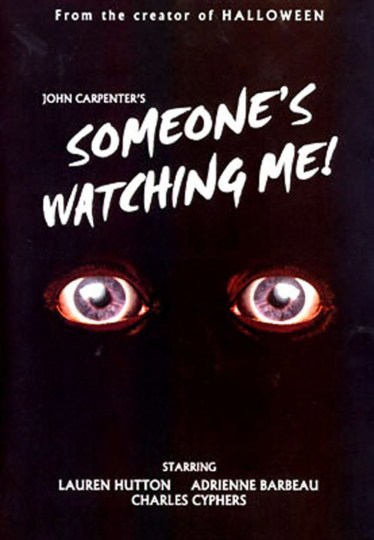
Someones_Watching_Me_PosterThe same year Carpenter unleashed Halloween, he wrote and directed this television thriller.  Lauren Hutton is Leigh Michaels, a television  producer, new to Los Angeles.  She moves into a high-rise apartment and then starts to receive ominous calls from a creepy voiced stranger who seems to know a lot about her.  She has an ex who won’t give up and is trying to start a relationship up with a new man.

As the calls escalate (even after changing her number) and she is receiving mystery gifts, the Police let her know there is nothing they can do.  Leigh retorts “Well, if he kills me, you will be the first to know!”  As plots go, Someone is Watching Me is pretty pedestrian.  And considering there are many true crime shows dedicated to stalking now, well, this probably seemed a bit freakier in a time when people were not really talking about stalking.  It also becomes a bit like a reverse Rear Window.

It has a strong core cast with Hutton, Adrienne Barbeau and David Birney.  Barbeau plays Hutton’s lesbian co-worker.  I only note this because the film plays it off as merely another aspect of who she is.  It is neither played as a joke or a sign of her being a suspicious individual.

Not unlike Halloween, Carpenter spends much of his time establishing the characters and building tension until the final twenty minutes or so when her stalker gets murderous and she struggles to convince her boyfriend and the authorities she is not making this all up.

Overall, you can see the spark of Carpenter’s film-making gifts.  He takes a standard TV movie plot and manages to give his characters personality and build tension, throughout the film.


Closing Time (Assault on Precinct 13, 1976)

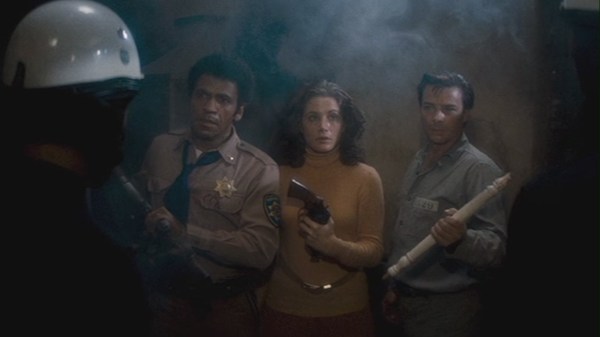
assault_on_precinct_13_posterAfter Dark Star, Carpenter made one of his few films outside his standard horror and Sci-Fi genres.  Assault on Precinct 13 is a gritty action film about a group of cops holed up in a Precinct that is about to be closed.  A gang has attacks with the express purpose of killing someone that is locked in the precinct.  Cops and criminals must unite to survive the night.

The odds are against them, but they are not willing to give in either.

The cast, led by Austin Stoker (Battle for the Planet of the Apes) is a quality combination of both solid character actors and unknowns.  These are good performances and Stoker’s Ethan Bishop is instantly likeable.  He is a strong and determined officer who lays his life on the line to protect the people trapped with him.

The tale is unrelenting with an uneasy resolution.  Unlike a lot of Carpenter’s other works, the threat comes from within humanity, rather than outside of it.  That is part of what makes the heroes of the tale so compelling.  They are forced to work together to deal with the brutal attacker bent on their complete destruction.  Carpenter makes a successful action thriller worth watching.

In the Beginning (Dark Star, 1974)

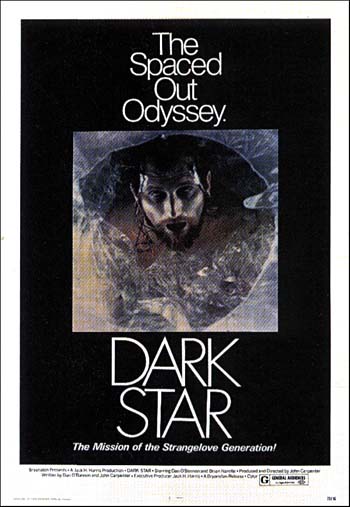
John_Carpenter_Dark_StarJohn Carpenter’s feature length debut was an odd comedy about four astronauts doing space work or something.  They blow up planets as prep for colonization of other planets in that solar system.  Aside from Carpenter, probably the most notable thing about Dark Star is that it was written by Dan O’Bannon, who went on to write Alien, as well as Return of the Living Dead and the Arnold version of Total Recall.  O’Bannon also plays a character named Pinback in the film.

It is a very low budget film, even by the standards of Carpenter.  He has always been a guy who can stretch a buck…but this film reeeeaaaally Stretches the dollar.  The film feels like a student film, and the cast outside of Carpenter and O’Bannon have slight to no film resumes beyond Dark Star.  The alien in the film looks like a beach ball.  Because it is.

You can see hints of O’Bannon’s future work, such as having the female voiced computer called Mother or trying to stop a self destruct countdown. But to be honest, it is hard to see the talent at work.  I mean, I know what both became.  Carpenter has directed some of my favorites.  The music, by Carpenter does not hint at all of his future classic soundtracks, such as Halloween or Escape From New York. Instead there is a bizarre country song that plays over the credits.

This is most definitely not the place to start with Carpenter, and is more of an odd footnote.

Carving a Niche

As part of my October Horror Movie Madness, I am going to explore the films of John Carpenter.  I will start at the beginning with Carpenter’s Student Film and work my way up.

Noticeably absent will be Halloween, as I covered the entire Franchise last year.  Also, I am leaving the TV movie Elvis aside for another time.  Although, at the same time, though not horror films, I will be covering Assault on Precinct 13 and Memoirs of an Invisible Man.   I have long admired Carpenter’s work.  Not just as a  director, but also as a writer and songwriter.  He has recently released two fabulous albums of music called Lost Themes and Lost Themes II.

Carpenter has written and directed more than one classic film, and I look forward to exploring his work in the days to come.

John_Carpenter_BW

The Ultimate Halloween

There have been a lot of box sets of film franchises. Often, the series is owned by one studio. This gets tougher for many horror franchises. Child’s Play is owned by MGM, the other films are owned by Universal. Paramount owned the first eight films in the Friday the 13th series, New Line had the later films. Halloween was owned by multiple studios, with the first five films settling in under Anchor Bay and the sixth film on belonging to Dimension Films.

Earlier in 2014, Shout Factory’s horror line Scream Factory announced a pretty big deal. They got Dimension, Universal and Anchor Bay to agree to allow a box set with every single Halloween film. All ten films. And you get the television versions of Halloween and Halloween 2. I watch the television version of Halloween every year. But the real big shocker? The never before released in America Producer’s Cut of Halloween 6: the Curse of Michael Myers. It has been long rumored to be vastly superior to the (admittedly abysmal) theatrical version of the film.  I addressed that earlier this week.  They also include the unrated versions of both Rob Zombie films.

2014-10-12 21.35.112014-10-12 21.35.59

The packaging is terrific.  A nice box houses ten individual cases, black instead of the traditional blue.  The cover art is the classic cover art.  The box has some really good and atmospheric painted art.

2014-10-12 21.36.38 2014-10-12 21.36.53

Every disc includes special features related to the individual film.  These are made with care and the producers  manage to get a lot of the original teams to return and discuss their experiences on the film.  If you love to dive into special features (as I do), this is a very rich set.  The set includes a bonus disc with new special features (mostly relating to Halloween’s 3-5).

Some of the special features were on previous releases (Considering Anchor Bay has released a 20th Anniversary Set, 25th Anniversary Set and 35th Anniversary set, there was a lot to use).  Considering the Halloween:H20 DVD years ago claimed to have special features that  were not actually on the disc, it is nice to finally get to see interviews and behind the scenes stuff that was promised.  In the end, I think the only thing missing from the deluxe set was the Halloween 25 Years of Terror DVD set.  And they include some of the special features from that.  Keep in mind, the non-deluxe version of the set does not have the Halloween II Television Version or the Producer’s Cut of Halloween 6.

The picture quality is great, keeping some of the grain, but the blu-ray transfers are never muddy, allowing us to never miss some of those great out of the shadow reveals.  This is how a box set should be.  I truly wish the Shout Factory had been in on the Friday the 13th and Chucky box sets…because we would more than likely have gotten a pretty sweet deal out of it.  The Shout Factory has set a standard here.  This is not that surprising, they have spent years making themselves stand out as kind of the Criterion Collection for pop culture.

(Still) The Night He Came Home (Halloween II,1981)

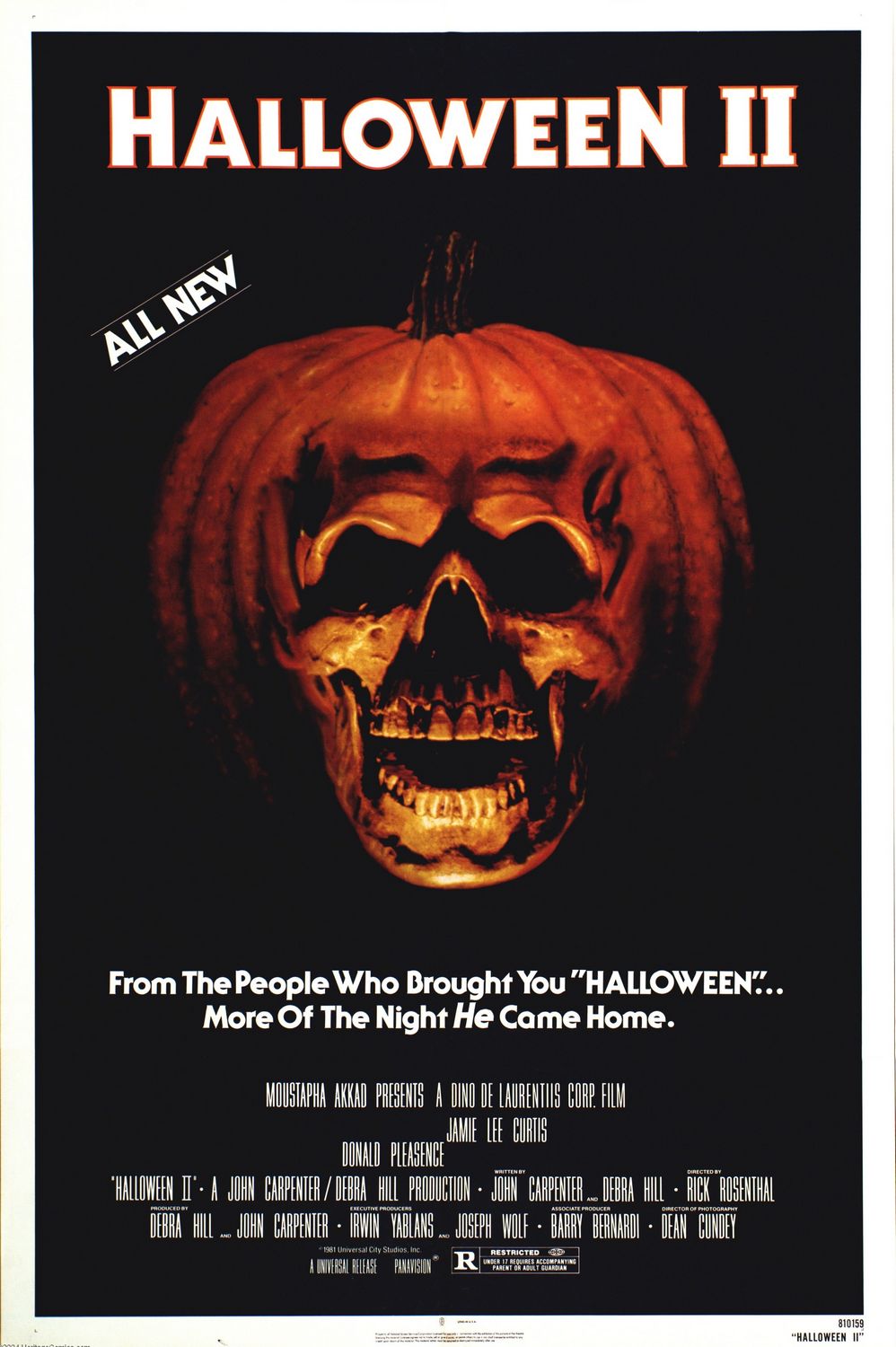
halloween_2Halloween 2 is guilty of kicking off a lot of horror sequel trends. You remember that kid Randy from the Scream movies? The one who explained all the rules of the slasher genre? Halloween 2 pretty much nailed every one of the rules of a sequel that Randy talks about in Scream 2.

Halloween 2 does not suck. On the other hand, it is not quite as good as the first film. Carpenter and Hill are producers and helped with the script, but the film was directed by first time film director Rick Rosenthal (who has gone on to direct a lot of television, especially in the horror/fantasy genre such as Buffy the Vampire Slayer and Smallville) who returned to the last film before Rob Zombie’s reboot. So, as with many sequels, this was someone cutting their teeth.

Spoilers are cutting up next.  Ouch. Sorry about the pun.

The part of this film that works is we have our main cast returning and it continues on the same night as the original film.  This one picks up as Dr. Loomis believes he shot Michael dead, only, of course to look over the edge and see Michael is gone.

The story continues Michael’s unrelenting attack, though it becomes more refined.  People often forget,  it was Halloween 2 that introduced the idea that Michael and Laurie were siblings (It was also the second film that first used the song Mr. Sandman to creepy effect).  Nearly the entire second film takes place in a hospital, with the majority of film’s victims being hospital employees.

As the film starts, Laurie Strode is taken to the local hospital, which is pretty sparcely populated at the time, we see no patients (other than some newborns in the nursery at one point), only a skeletal staff of nurses and ambulance drivers.  Of the two drivers, we have the kind hearted Jimmy Lloyd (played by Last Starfighter Lance Guest) and the sex obsessed, crass Graham (played by Jeffrey Kramer).  Graham is constantly trying to get some alone time with his girlfriend, Nurse Bailey (Pamela Susan Shoop).  Jimmy on the other hand keeps trying to sneak in to talk to Laurie, though head nurse Mrs. Alves (Gloria Gifford) keeps interfering, insisting Jimmy let Laurie rest.

Dr. Loomis is still working with police to try and catch Michael, but that relationship becomes increasingly strained as the sheriff discovers that one of the dead teens is his own daughter.  It is when Marion Chambers (who we saw in the first film) comes to tell Loomis he must leave with her under state orders that they discover a truth that was hidden from even Loomis.  Michael had another sister, little Laurie Strode.  Loomis, being the determined guy he is, will not go down without a fight and demands to be taken to the hospital.

Of course, in the meantime, hospital staff have dropped like flies.  Laurie has been sedated, but she refuses to give up and stumbles through the hospital trying to escape the ever present Michael Myers.  If it sounds familiar, this is because many films have duplicated this cat and mouse since in the slasher and horror genre.  But Halloween 2 pulls it off well, it is one of the film’s strong points.

Loomis arrives at the hospital for a final showdown with Michael.  In one of the less plausible moments, Laurie manages to shoot both Michael’s eyes out with a gun…which only blinds him.   Holding a scalpel, he swings wildly as Laurie and Dr. Loomis turn on the various gas tanks in the room.  Loomis sends Laurie out of the room and then flicks a Bic lighter (okay, maybe it was some generic brand of lighter) blowing himself and Michael up.

This film ups the killings, using various implements found in the hospital (such as needles).  The kills are more gruesome and elaborate, the characters less dimensional (hardly a shock as there are more characters introduced).  It carries through pretty seamlessly from the first.  But it lacks something without Carpenter’s skilled eye for the use of shadows and light to obscure Michael.  So it has a different feel.

They do try and advance the story, rather than re-hash it (which is where we get the family connection exploited both well and poorly in later films).  It is notable that they killed Michael off believing that they were done with stories about Myers.  I mean, where else could they go?  The idea was that now they could make other movies with the Halloween title, but all new stories and characters.  And then they made Halloween 3.

The (First) Night He Came Home (Halloween, 1977)

halloween_originalThe late 70’s and early 80’s were pretty good to the horror genre. Plenty of long running series were kicked off then. Halloween was the start of a really strong run for John Carpenter as well. He produced some of his finest work between about 1978 and 1987.

Halloween was actually just started as an idea of a psycho stalking babysitters. This is not entirely new, and it played off various urban legends that started in the preceding decades about stalkers and babysitters as their prey. At some point, they came up with the idea of setting it on Halloween, hence the name. Halloween caused a lot of “holiday” themed imitators not long after, such as a little film called Friday the 13th.

By today’s standards, Halloween is remarkably tame. It’s body count is small, it is not overly graphic in it’s deaths and it focuses more on it’s characters than it’s monster. The movie is not about “Michael Myers, Serial Killer.” Oh sure, it’s tag line is “The Night HE Came Home,” but do not be fooled. Instead, it is about young Laurie Strode (Jamie Lee Curtis-at that time an unknown to the public) and her efforts to protect herself and the kid she is babysitting.

Spoilers follow…

The story is pretty simple to follow. As a young by, Michael Myers inexplicably murders his sister and is institutionalized. It’s made creepy by the fact that we see Michael coming from a fairly average family and home. There seems to be no obvious trigger. That’s what makes Michael scary. His motives are unknown. Freddy is a sadistic murderer getting revenge on the parents who killed him. Jason is killing careless camp counselors. But Michael? Michael does not seem to have a reason for what he does.

The film’s opening is masterfully creepy, as we see everything from a stalker’s point of view. Carpenter deftly walks through the opening entirely through Michael’s eyes, allowing the viewer to make their own conclusions about who the killer might be. The killer puts on a clown mask, and even then the camera continues to see through Michael’s eyes, now peering through the eye slits of a mask. The camera enters the room of a young attractive woman who clearly recognizes our stalker. It is not until moments later, as we go outside that the camera steps from behind Michaels eyes and his parents get out of their car do we discover that Michael is but a young child.

Carpenter quickly introduced us to Dr. Loomis (played by the ever entertaining Donald Pleasence) who is a passionate and seemingly caring doctor trying to get through to Michael, at least for a time. The films makes a leap of about fifteen years, where we discover Loomis has had a change of heart. He determined Michael is unreachable and simply needs to be locked away forever.

Loomis is on his way to the institution to plead against Michael’s being moved on a dark and stormy night, and is surprised to see patients wandering in the rain. While Loomisleaves the car, a nurse sits patiently. She is startled by the noise of someone on top of the car, the person scares the nurse out of the car and then steals it, leaving the nurse and Loomis behind. Dr. Loomis is no fool and realizes it was Myers.

We are then introduced to Laurie Strode with her family. Clearly, this is a loving family that has strong ties, and Carpenter manages to establish this in less than five minutes at the breakfast table. Laurie is asked by her real estate agent father to drop a key off at the old Myers house for a showing. his sequence sets a lot of information before us. First, Myers is a bit of a local legend. Something has happened to Michael’s parents, and judging from the home, it has been vacant for years. in fact, it has a reputation of the local haunted house, with a young local boy Tommy Doyle (Brian Andrews) begging Laurie not to go up to the house.

The story snowballs from there as Laurie and her friends notice both an unfamiliar car and stranger showing up near by. Laurie keeps thinking she sees Michael behind trees or in the back yard. In the script Michael is described, quite reasonably as the shape. Michael is not defined at all, other than he appears large. Even his mask, iconic as it is, has no real features to it. It’s lifeless, as is his jumpsuit.

Laurie and her friend Annie (Nancy Loomis) both go to babysit some kids, while another friend, Lynda (P.J. Soles) hooks up with her boyfriend. This all leads to the inevitable series of deaths that culminate in Laurie trying to protect Tommy, Lindsey (Kyle Richards) and herself from the “boogey man”.

All the while Dr. Loomis is running around town with the local sheriff trying to locate and capture Michael. Attracted by screaming kids (Lindsey and Tommy, who Laurie sent out of the house) Loomis runs into the house and saves Laurie, shooting Michael multiple times. Michael falls out of a window and hits the ground below. But when Dr. Loomis looks out the window he sees Michael is gone. It’s a classic ending, and one that now we all recognize as an opening for a sequel (though Carpenter states that this was not the plan, it was simply meant to be a creepy ending-the sequel was a total afterthought).

What makes Halloween work is it’s use of shadows to obscure Myers, and it’s skillful use of POV shots. Many moments are shown from Michael’s perspective, keeping him mysterious, even as we see things through his eyes. Then there are the musical stings. Much like Psycho, the stings hit at the exact right moments. And that creepy theme!

Halloween is a definite classic, and though it’s unfortunate that it paved a way for cheap slashers, it is noteworthy for it’s focus on the characters. The fact is, most of the copycats missed what made Halloween work and created a genre almost unrecognizable as being compatible with Halloween. Modern slashers create such unlikable characters you quickly start to root for the killer. Carpenter never confuses the audience. Dr. Loomis and Laurie Strode are our heroes, Michael Myers is the villain. The film is a great example of film making with limited resources as well.

Blog at WordPress.com.

Up ↑