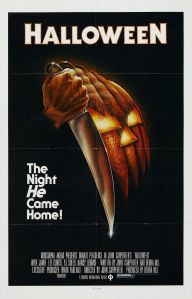
 The late 70’s and early 80’s were pretty good to the horror genre. Plenty of long running series were kicked off then. Halloween was the start of a really strong run for John Carpenter as well. He produced some of his finest work between about 1978 and 1987.
Halloween was actually just started as an idea of a psycho stalking babysitters. This is not entirely new, and it played off various urban legends that started in the preceding decades about stalkers and babysitters as their prey. At some point, they came up with the idea of setting it on Halloween, hence the name. Halloween caused a lot of “holiday” themed imitators not long after, such as a little film called Friday the 13th.
By today’s standards, Halloween is remarkably tame. It’s body count is small, it is not overly graphic in it’s deaths and it focuses more on it’s characters than it’s monster. The movie is not about “Michael Myers, Serial Killer.” Oh sure, it’s tag line is “The Night HE Came Home,” but do not be fooled. Instead, it is about young Laurie Strode (Jamie Lee Curtis-at that time an unknown to the public) and her efforts to protect herself and the kid she is babysitting.
Spoilers follow…
The story is pretty simple to follow. As a young by, Michael Myers inexplicably murders his sister and is institutionalized. It’s made creepy by the fact that we see Michael coming from a fairly average family and home. There seems to be no obvious trigger. That’s what makes Michael scary. His motives are unknown. Freddy is a sadistic murderer getting revenge on the parents who killed him. Jason is killing careless camp counselors. But Michael? Michael does not seem to have a reason for what he does.
The film’s opening is masterfully creepy, as we see everything from a stalker’s point of view. Carpenter deftly walks through the opening entirely through Michael’s eyes, allowing the viewer to make their own conclusions about who the killer might be. The killer puts on a clown mask, and even then the camera continues to see through Michael’s eyes, now peering through the eye slits of a mask. The camera enters the room of a young attractive woman who clearly recognizes our stalker. It is not until moments later, as we go outside that the camera steps from behind Michaels eyes and his parents get out of their car do we discover that Michael is but a young child.
Carpenter quickly introduced us to Dr. Loomis (played by the ever entertaining Donald Pleasence) who is a passionate and seemingly caring doctor trying to get through to Michael, at least for a time. The films makes a leap of about fifteen years, where we discover Loomis has had a change of heart. He determined Michael is unreachable and simply needs to be locked away forever.
Loomis is on his way to the institution to plead against Michael’s being moved on a dark and stormy night, and is surprised to see patients wandering in the rain. While Loomisleaves the car, a nurse sits patiently. She is startled by the noise of someone on top of the car, the person scares the nurse out of the car and then steals it, leaving the nurse and Loomis behind. Dr. Loomis is no fool and realizes it was Myers.
We are then introduced to Laurie Strode with her family. Clearly, this is a loving family that has strong ties, and Carpenter manages to establish this in less than five minutes at the breakfast table. Laurie is asked by her real estate agent father to drop a key off at the old Myers house for a showing. his sequence sets a lot of information before us. First, Myers is a bit of a local legend. Something has happened to Michael’s parents, and judging from the home, it has been vacant for years. in fact, it has a reputation of the local haunted house, with a young local boy Tommy Doyle (Brian Andrews) begging Laurie not to go up to the house.
The story snowballs from there as Laurie and her friends notice both an unfamiliar car and stranger showing up near by. Laurie keeps thinking she sees Michael behind trees or in the back yard. In the script Michael is described, quite reasonably as the shape. Michael is not defined at all, other than he appears large. Even his mask, iconic as it is, has no real features to it. It’s lifeless, as is his jumpsuit.
Laurie and her friend Annie (Nancy Loomis) both go to babysit some kids, while another friend, Lynda (P.J. Soles) hooks up with her boyfriend. This all leads to the inevitable series of deaths that culminate in Laurie trying to protect Tommy, Lindsey (Kyle Richards) and herself from the “boogey man”.
All the while Dr. Loomis is running around town with the local sheriff trying to locate and capture Michael. Attracted by screaming kids (Lindsey and Tommy, who Laurie sent out of the house) Loomis runs into the house and saves Laurie, shooting Michael multiple times. Michael falls out of a window and hits the ground below. But when Dr. Loomis looks out the window he sees Michael is gone. It’s a classic ending, and one that now we all recognize as an opening for a sequel (though Carpenter states that this was not the plan, it was simply meant to be a creepy ending-the sequel was a total afterthought).
What makes Halloween work is it’s use of shadows to obscure Myers, and it’s skillful use of POV shots. Many moments are shown from Michael’s perspective, keeping him mysterious, even as we see things through his eyes. Then there are the musical stings. Much like Psycho, the stings hit at the exact right moments. And that creepy theme!
Halloween is a definite classic, and though it’s unfortunate that it paved a way for cheap slashers, it is noteworthy for it’s focus on the characters. The fact is, most of the copycats missed what made Halloween work and created a genre almost unrecognizable as being compatible with Halloween. Modern slashers create such unlikable characters you quickly start to root for the killer. Carpenter never confuses the audience. Dr. Loomis and Laurie Strode are our heroes, Michael Myers is the villain. The film is a great example of film making with limited resources as well.

 Halloween 6: The Curse of Michael Myers was terrible. It was Plodding, confusing and a genuine mess. I went back and revisited it and even realized I had filled in the blanks. The cult that oversees Michael is barely seen. Oh, we meet some of the characters, but it is unclear why or how they know stuff. Instead, I was filling in my memory with stuff I had heard about the ideas behind the film.

 Tripping Through Gateways