Oh Oh It’s Magic PT 7 uh PT 2 (Harry Potter and the Deathly Hallows: Part 2, 2011)

Harry_Potter_008_PosterTen years of film-making culminates with Harry Potter and the Deathly Hallows Part 2.  After managing to destroy a couple of the Horacruxes and escaping the clutches of Bellatrix Lestrange, the trio realizes they need to return to Hogwarts.  But this is not so simple.  Snape is now Headmaster, Dementors patrol the grounds and Death Eaters are on the watch for Harry Potter.

They find themselves seeking the help of Dumbledore’s brother Aberforth. They were never aware of a brother, and he seems embittered towards his brother.  In the Trio’s absence, Neville Longbottom has rallied their fellow students to be ready for war against Voldemort.  Harry realizes what the final Horacruxes are.  He seeks one, while Hermione and Ron work on a plan to destroy the other. There is a large battle at the school, which Voldemort brings a halt to.  He promises to let everyone go if they only turn over Harry Potter.

But Harry realizes he must face Voldemort on his own.  This leads to a rather touching moment with our three heroes as it is clear, this may be the last time they ever see each other.

Part two, while a logical progression from the dark part one, is far more exciting and even fun.  The drama is more hopeful. The funny thing is, taken as a whole, both films work quite well. Part one feels less oppressive when directly followed up by part two (as opposed to the theatrical releases which were several months apart).

Part two brings the series to a close with a sense of hope and optimism.  There are many moments that are thoughtful next to the exciting battles. And yet, even split among two films, you feel like we don’t get enough of some of those favorite characters (such as Remus and Tonks). I enjoy the series and feel this film brings it all to a close quite nicely.

Oh Oh It’s Magic! PT 5 (Harry Potter and the Order of the Phoenix, 2007)

Harry_Potter_005_PosterThe film opens with a rather heartbroken Harry Potter, haunted by the death of Cedric Diggory and the rise of Voldemort.  The Ministry of Magic has worked very hard to portray Harry and Dumbledore as crackpots. Confronted by cousin Dudley and his friends, Harry becomes angry with Dudley and pulls his wand on him.  This is a nicely acted scene, as the moment Dudley sees the wand, his expression goes from cocky to scared (while his friends all laugh, having no idea Harry is a wizard).
The skies go dark and Harry finds he and Dudley under an attack from Dementors. Harry fights off the Dementors, but this results in his being expelled from Hogwarts for being an underage wizard using spells off campus. Harry must face a brief hearing to address if he will be punished.  Dumbledore prevents this from being permanent.

Harry is also frustrated by the fact that nobody has been in contact with him.  He discovers that Dumbledore has brought together several people to form the Order of the Phoenix.  It includes Lupin, the Weasleys, Sirius Black, Mad-Eye Moody and shockingly to Harry, Professor Snape.

Once back at Hogwarts, the kids are introduced to the new professor of Defense Against the Dark Arts.  Delores Umbridge is really there as an eye for the Ministry of Magic, which does not trust Dumbledore.  She does not teach the children spells. Instead, she focuses on books, arguing the children will never need to put such things into action.

Umbridge slowly takes over the school, enforcing ridiculous and endless rules.  She forces out Dumbledore, inspiring Harry to bring together like-minded students to prepare to fight Voldemort.

this is the heart of the film, as Harry and his friends strive to prepare for the coming battle.  But Harry also struggles with nightmarish visions, some of which turn out to be true. This causes him to believe Sirius is in great danger, causing Harry and a few members of his class to set out to save Sirius by breaking into the Ministry of Magic’s archives department.  This leads to an all-out battle royale.

Order of the Phoenix is notable as being the only Harry Potter Film without a Steve Kloves screenplay. And in some ways, this film feels the least connected.  It also suffers from issues like setups not being addressed.  It never explains the Dementor attack.

Certainly, we can assume it  was due to Voldemort or even the Ministry of Magic…but while the event is questioned, it is never answered.

Still, this is a generally good film within the franchise, even if we only get glimpses of characters like Sirius Black (blunting his overall impact). The introduction of Bellatrix LeStrange (played with gleeful delirium by Helena Bonham Carter) and Luna Lovegood (who, in some ways is a sweetly natured reflection of LeStrange) are welcome.  Imelda Staunton makes Delores Umbridge gloriously hateable.

The film also introduces one of my favorite characters from the books, Tonks.  She is kind of what I figure a young and modern witch or wizard would be like (for example, using magic change hair color and styles).

This film brings on David Yates as director and visionary for the rest of the series (under the watch of Rowling and Kloves). Primarily a television director, Yates acquits himself quite well in this big budget picture.

Oh Oh It’s Magic! PT 3 (Harry Potter and the Prisoner of Azkaban, 2004)

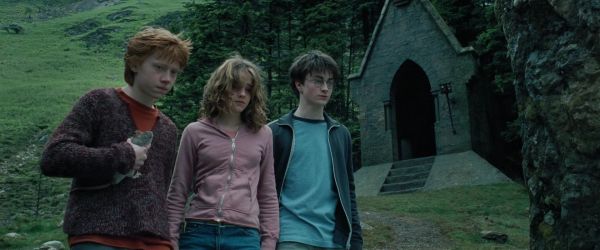
Harry_Potter_003_PosterContinuing to steamroll on, the third film introduces the concept of the wizard prison Azkaban.  It appears to be the only prison, and it is a place you do not want to go.  The wizarding community is on edge, because of the notorious killer, Sirius Black has escaped.  He is infamous among good wizards of his betrayal of his friends James and Lily Potter.

The kids meet their new Professor for the Defense Against the Dark Arts.  Professor Remus Lupin is another mysterious character who appears to harbor a dark secret (but magically, was born with the last name that gives it away).  He, however, seems very kind and Harry learns that Lupin was close to his parents.

The film also brings in two important plot devices.  One is a cloak of invisibility (which will figure greatly later in the series) and the other is the Marauder’s Map.  The map shows everyone who exists in the school and where they are.  When Harry notices a person on the map believed to be dead, it kicks off a mission to determine what is going on.

A large focus of the story is Lupin teaching the kids to conjure a defensive spell known as a Patronis.  The Patronis allows defense against mystical creatures and in this film, that is primarily the Dementors.  Looking like a grim reaper, the Dementor is an Azkaban guard.  They can literally suck the joy and will to live from your body, leaving the victim in torment.

Harry, Hermione, and Ron uncover information hinting that Black may not be who everyone claims he is. The story culminates in Harry and Hermione pulling a magical stunt to pull off some rescues and save the day.

Columbus stepped away as director for this film Warner Brothers brought in Alfonso Cuarón. This turns out to have been a good choice, as instead of being dedicated to forcing the novel into a couple of hours, he (and screenwriter Steve Kloves) focus on the tone of the story.  Azkaban represented a turn towards darker themes in the books, and the film matches that.

Gary Oldman and David Thewlis are welcome additions to the cast, with Oldman turning in a manic performance, reflecting the decade or so of imprisonment. But the biggest change occurred because between Chamber of Secrets and this film, Richard Harris passed away. Harris was just about 70 when the first film was being made, and he did seem quite fragile in the first two films.  This played into the warmness of Dumbledore found in the books.  He was replaced by Michael Gambon (Ian McKellen was offered the role, but turned it down on the reasons that he thought it would be risky trying to play another iconic character after playing Gandalf and felt it inappropriate to take over for Harris who had considered McKellen a “dreadful” actor). Gambon’s approach to Dumbledore is very different from Harris.  His Albus is a bit tougher and sterner. This gets tempered out as the series progresses. Part of this difference is likely due to Gambon never reading the books.

The visuals of the film stand out in this film, with far better CGI than the previous films.

After two decent films, the Prisoner of Azkaban represents a step up for the franchise.

Blog at WordPress.com.

Up ↑