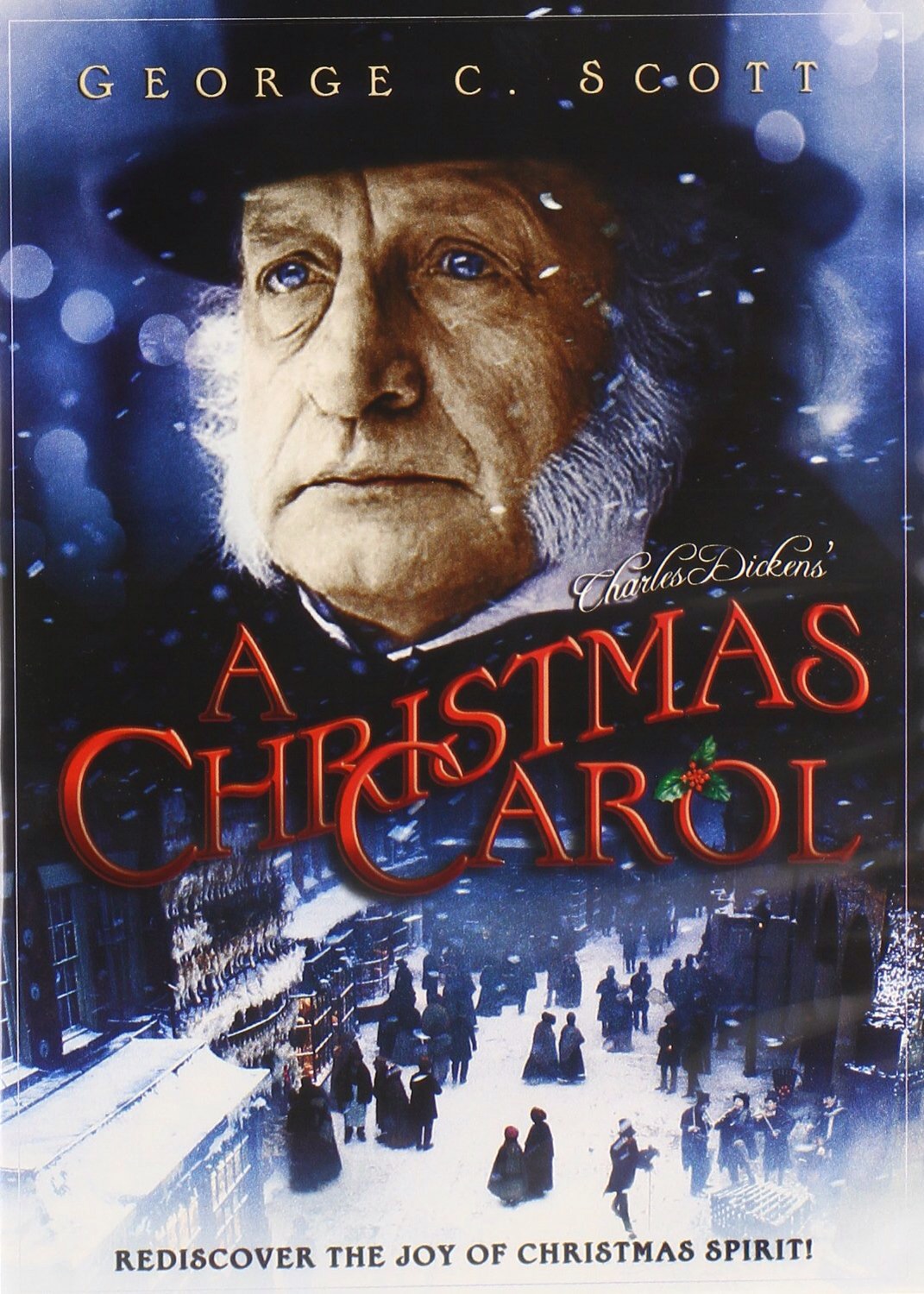
What a Scrooge Part 9 (A Christmas Carol, 1984)

 For some reason, the definitive version for me as a child was the 1984 George C. Scott version. Scott plays Scrooge as someone who seems to enjoy being mean to people. He likes dancing on other people’s joy and belittling their situations. Scott’s Scrooge is bitter and proud, and a bit spiteful. But I think what always made the movie for me was the Marley sequence. It was terrifying.

It still is. Scott sits in the corner, huddled by a small fire. Above the flames, Marley’s tormented visage starts to fade in and out. Then, the bells start to ring. And Scott turns towards a loud thump at the bedroom door. Slowly, the locks come undone and the door swings open. Marley (Frank Finlay) fades in as he marches into Scrooge’s room. He faces Scrooge, unties a bit of cloth around his head and his jaw falls to his chest. Marley is horrifying as he stands there, mouth agape and covered in chains. And his voice is loud and tortured. Every word seems labored. Marley is walking sorrow and regret. And he convinces you that this is no mere figment.

The first ghost is oddly youthful, yet ageless (Angela Pleasence). She takes Ebenezer from past Christmas to past Christmas. Scrooge is defensive at these moments. The Ghost even mocks him a bit cruelly. When she denounces Fezziwig as a silly man, Scrooge (who is caught up in fond memories) defends him to her. You begin to see the cracks in Scrooge’s armor as he goes through each moment. Finally, he can take no more and tries to snuff out the light of the Ghost’s truth. Scrooge is visited next by the host of Christmas Present (of course).

This incarnation (played by Edward Woodward) is boisterous, yet hides an ominous side. He seems to relish every opportunity to use Scrooge’s own words against him. At one point he angrily (yet with a hint of a smile) tells Scrooge that it may be that in Heaven’s eyes he is worth far less than the people who he has no time to help. His words sting both viewer and Ebenezer. Then he leaves Scrooge to wander a lonely part of town.

Then Ebenezer sees the final Ghost. What I find so interesting is that we only get little glimpses of the Ghost of Christmas Future. We see it at a distance (with waves of fine fog cascading across the ground.

The few close ups are from behind or of the Ghost’s almost crippled and deformed hand. Mostly, though, we see the long shadow it casts into the street and doorways. It’s all used to powerful effect. Scott again shows a new side of Scrooge, this time terror and desperation. And even though it never speaks, this ghost has its own moments of cruel mockery. When Scrooge demands to be shown some human emotion in regards to the death of a man (unwilling to accept the truth of who the dead man is), he is brought to a seedy part of town where people jovially mock the deceased why going over goods stolen from the deceased’s home. Even upon seeing his own watch, Scrooge refuses to accept the reality. Only when forced to look upon his own grave does he accept the inevitable. And that’s when Scott’s Scrooge loses it. There is no doubt that he fears all is lost, and the night is a waste. He finds himself at his bedside, praying out loud, begging in tears for another chance. And then morning comes to find Ebenezer still on his knees, but having fallen asleep from exhaustion. Scott is very convincing in his turn to a man of generosity.

He comes across as a man excited to repent of his past and to make up for lost time. His excitement is infectious. One interesting note is that Scott is a departure from the typical Scrooge. Often Scrooge is a frail looking slender man. Scott, on the other hand, is more stout and robust. It’s very effective with his gruff demeanor and slightly gravelly voice.

Throughout the film, Scott bounds between arrogant pride and a fear of the reality that beats back against his coldness.  It is a wonderful performance, and a large reason in the end why this remains my favorite and most recommended version of a Christmas Carol.

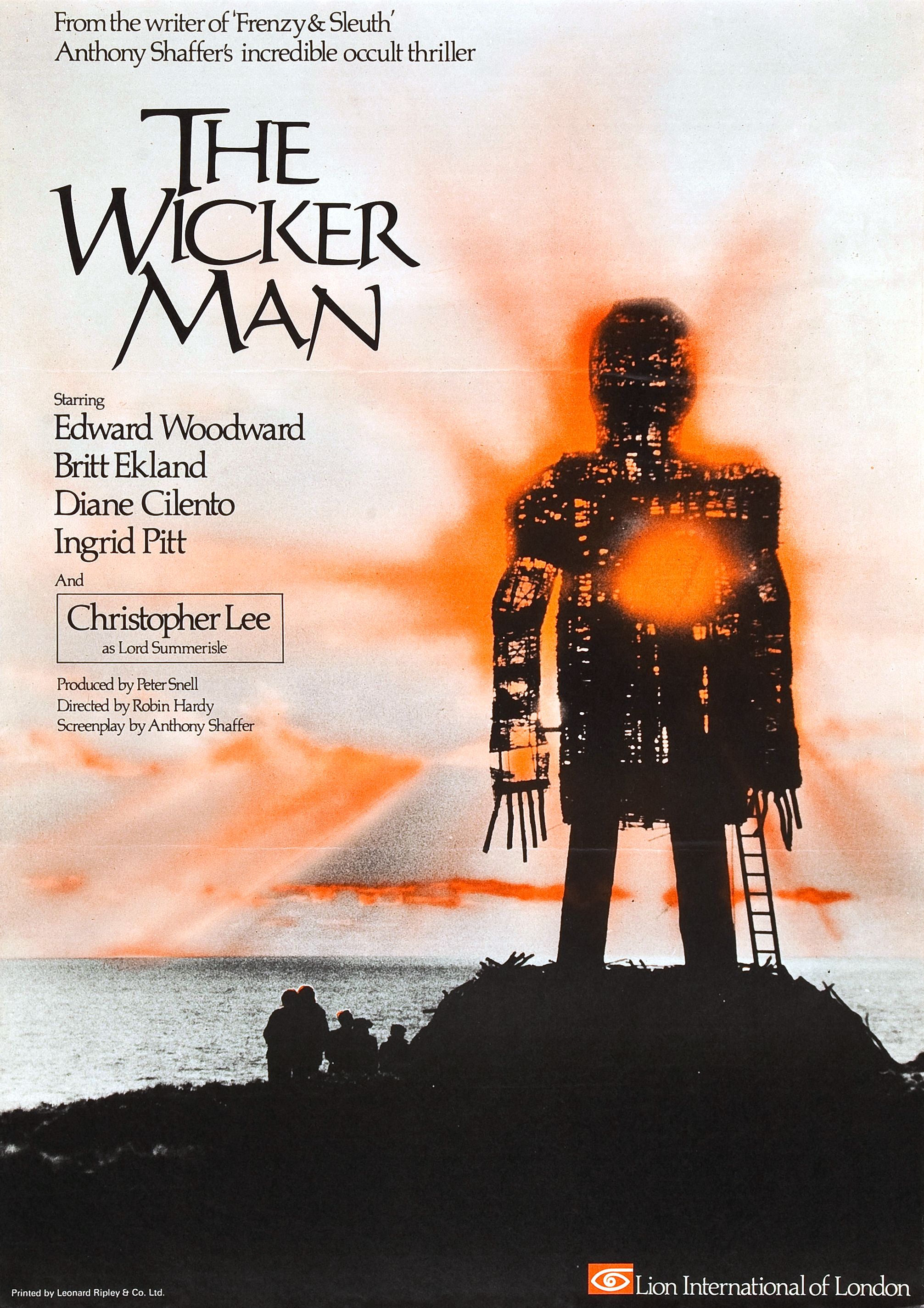
Generation Clash (the Wicker Man, 1973)

wicker_man_poster_orange1973’s the Wicker Man, starring the late Edward Woodward and Christopher Lee is one of those hard to classify films.  For one, while it is considered horror, it’s a movie lacking much carnage.  The horrors center around the mystery and the struggles of young, repressed Police Sergeant Howie.

Beware of dreadful Spoilers…

Almost immediately, Sgt. Howie finds himself at odds with the locals, who initially refuse him access to Summerisle, a rather isolated Scottish island, as it is private property.  Once he provides his reason, a letter he has received indicating a child has gone missing from the isle.

Howie is revealed to be a devout Catholic.  He prays fervently, as we see flashbacks to him reading scripture and partaking in communion.  This leads to one of the films more…silly…but memorable moments.  Willow (Britt Ekland) lies in the room next to Howie’s singing a song to tempt Howie, putting his purity to the test.  Howie struggles in his room to fight the temptation.  Did I mention Ekland performs the entire scene naked?

Howie seeks to try and continue his investigation.  When he goes to the local school, he becomes appalled (Howie is like a one man Catholic League).  The teacher (Diane Cilento) is telling the children of the meaning of the penis in their worship.  Howie runs into trouble when people claim the young girl never existed in the first place.

When Howie goes to the Summerisle library, the Librarian shows him the death records, but Rowan is not among them.  He decides it is time to meet Lord Summerisle (Christopher Lee) at the Lord’s mansion.  Howie is surprised to hear he is expected.  While waiting, he looks out the window to see a small Stonehenge like set up where young people are frollicking naked.  Summerisle enters and asks if Howie finds them refreshing, of course, he does not.  Howie becomes more and more incredulous, asking how they function with a false religion.  Know they nothing of Jesus?  But Summerisle proclaims Jesus dead, and the old gods still living.

Howie can barely stand the things Summerisle tells him, giving the history of the island’s citizens turning from Christianity to the old pagan ways.  That evening, when they go to exhume the body of Rowan so Howie can bring it back to determine the cause of death, they discover her casket contains, instead of the young girl’s body, that of a dead rabbit.  The groundskeeper reacts not in shock, but laughter.  Enraged, Howie returns to Summerisle.  Miss Rose tries to say that the rabbit is Rowan.  This further angers Howie.

Howie goes through pictures and is able to locate the missing image from the previous May Day celebrations.  Unlike the other photos (all a young woman surrounded by the Harvest), Rowan is sitting sans harvest.  Howie does some research and comes to a new conclusion.. Rowan is not dead, she is going to be the Mayday sacrifice because the crops failed.

Howie plans to take his plane to the mainland and bring back reinforcements.  But his plane doesn’t start.  He starts to search the island and spies the town members preparing for their May Day celebrations.  They proclaim that the evening will bring a sacrifice.  Howie decides to conduct a house to house search.  The townspeople are surprising cooperative, but his end results are less than he had hoped for.

It is this clash of religions that makes the film so effective.  The joyous celebration of Lord Summerisle and his people as their sacrifice burns is a frightening juxtaposition.  The film is a mystery, with a heavy sense of dread pervading it.  Is Rowan real?  Is she dead?  Watching Howie struggle to find the answers, and also dealing with his temptations, never realizing that he is being played for a fool creates a compelling tale.  Woodward plays Howie both sympathetically and with a repressed rigidity that really sells the character.  His devoutness is never in question.  This is not the typical “Christian Hypocrite” of mainstream film.  Howie is dedicated to his job and faith, and the film never makes light of this.  Of course, not being some terrible hypocrite is really the point of the story.  Even when he is angry, Howie maintains a sense of cool.

On his opposite is Lord Summerisle, whom Lee portrays as always calm.  I am not sure he ever even gets angry, to be honest.  He is a calm, gentle and confident man.  It’s effective watching him and Howie, as Howie never seems able to offend him, but he can kindly get under Howie’s skin.

The three women most prominently featured in the story, seem to represent different ideals of the religion.  Willow is the siren, Miss Rose is the educator and the Librarian the religion’s administrator.

Also notable is the use of music, you could easily argue this is a musical.  The music is fun and folksy, very tied to the folk music of the British isles.  It’s far more effective than one would expect, as these cheerful songs cover a dreadful truth.

One of the reasons the 2006 “re-imagining” of the film starring Nick Cage is such an abysmal failure is it does away with the fight between Paganism and Christianity.  They replaced it with a poorly realized battle of the sexes and a tortured and flawed “hero.”  Howie needs to be less “flawed” and more pure.  Otherwise his character does not truly stand out from the citizens.

In the end, I consider this one of my favorite films, because it is horror, dark and foreboding without relying on cheap thrills and scares.  It’s beautifully filmed, well acted, written and directed.  It’s a film worth checking out.

One final note, but I am blocking it because it is a massive spoiler.

Continue reading “Generation Clash (the Wicker Man, 1973)”

Create a free website or blog at WordPress.com.

Up ↑