Friendship is Science! (Deadly Friend, 1986)

Paul is a tech genius teen who has built his own robot named BB. BB has the ability to learn and grow in intelligence. When Paul and his mother move to a new neighborhood, he is befriended by Sam (a girl abused by her father) and Tom. The three form a bond which is shaken up when Sam is accidentally killed by her father.

Paul uses BB’s brain to re-animate Sam’s body. Paul hides Sam in a shed, but she goes out to explore and starts killing people who wronged Sam and BB. Paul finds this a problem as he tries to cover for Sam, but he is terrible at this. Instead, his lies start falling apart and when Tom threatens to go to the police and expose him, Sam goes on the attack. Seeing the threat, Paul tries to stop her so she is not killed (again). But it is clear that Sam and BB are not the girl Paul wanted to bring back.

Deadly Friend is an interesting concept and one of the early forays into the idea of IA and learning computers. BB’s design falls into the cute robot category and has a fun vocal provided by Roger Rabbit’s Charles Fleischer.

The film makes use of dreams and nightmares, much like a lot of Craven’s work. And the early parts of the film are equal parts fun and ominous. The film makes it clear that Sam’s father beats her showing bruises. But there is also the disturbing implication that he has raped her as well.

But where the film goes wrong is the choices made with the resurrected Sam. To show Sam is more reanimated flesh, they give her dark under-eyes and pale skin with light blue lips. This would be fine, if the choice was made to give her slightly more natural movement. While you could argue that her movements should be awkward, as BB is not used to walking. And there are moments where it is clear Sam/BB are trying to understand what is going on. But there was a clear and conscious choice for Kristy Swanson to move like a robot. BB had metal pincers for hands. So Sam walks around like this…

“I AM ROBOT”
“Kill!!!!”

It just looks hilarious, rather than scary or threatening. I do not know who thought this was a good idea. But it definitely makes it hard to take anything in the film seriously.

Deadly Friend had real potential on paper, but the execution is a pretty big disappointment. I mean, except for Anne Ramsey as the mean old neighbor who gets killed in a rather funny and memorable kill.

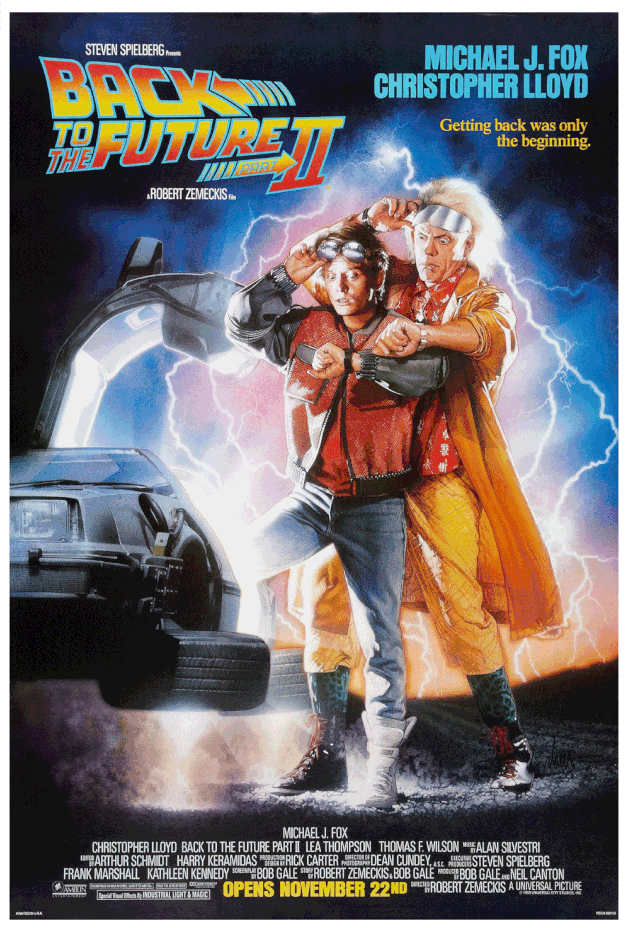
Out of Time Part II (Back to the Future Part II, 1989)

back_to_the_future_2_poster-e1514977762521.pngSpoilers occur throughout…Back to the Future had one of those endings that worked both as a setup for future films, as well as just a cute way to end a time travel movie.  Marty’s life looks awesome and then Doc Brown shows up saying they need to fix the future. I suspect that the reality is, it was just meant to be a cute little throw away ending.  But then, Back to the Future was a big hit…and both the film makers and audiences wanted to see more. And so they set forward with plans for two sequels.
Back to the future begins right where the first film left off, Doc Brown urgently telling Marty they have to go into the future to do something about Marty’s kid. They bring along Jennifer for the trip to the future, but she becomes so excited by the notion of being able to see her future, the Doc opts to knock her out, telling Marty she will just think it is a dream.  Doc tells Marty to go to a local hang out, meet Griff (grandson of Biff) and simply tell him “no”.  It turns out that if Marty Jr. goes along with Griff’s peer pressure, he will end up in jail.

But after fixing that potential future, other things go awry.  The police find Jennifer and bring her to her future home. Meanwhile, Marty gets the idea to buy a sports almanac so he can go back to the present and make bets based on future knowledge.  Doc puts the idea to bed, but someone overheard the idea…and while Doc and Marty go to get Jennifer? Old Man Biff seeks to reverse his fortune.

They return to the present and leave the unconscious Jennifer on her porch. Marty slips in through his bedroom window, only to discover a whole new family is living in the house.  After being chased off by an angry father, Marty comes across a newspaper.  Certain they came back to the wrong time, Marty discovers that, indeed, they returned to 1985…but everything is off.

Marty is knocked out, and when he awakens (in a scene mimicking the sequence from the first film where he awakens to find his teen mother watching over him) he is startled by a mother who looks very different from before.  He is horrified to discover that Biff is his step-father…and Biff is the richest man in America. Biff tries to kill Marty based on a warning from the man who gave him the sports almanac.  Doc Brown intervenes and explains to Marty that an alternate timeline has been created.

To fix the timeline, they must go back to 1955 and steal the almanac from young Biff.  Then, hijinks ensue.  Marty has to get the almanac from Biff, while avoiding Biff’s thugs, yet also save his other self from those thugs.  It is a crazy last act, filled with alternative views of sequences from the original film.

The most memorable part of the film for audiences was the future of 2015, where Marty rides a hover board, is wearing self drying clothes and everything is super technologically advanced. And apparently Gale and Zemeckis believed the height of future technology would be TV screen communications, swiping credits cards and…fax machines all over the house, built into walls.

It is a fun sequence though, for my money alternate 1985 is an interesting idea.  Biff’s rich and famous routine is absurdly entertaining in it’s obvious allusions to the Donald Trump of the 80’s.  And the notion of 80’s nostalgia is certainly not inaccurate.

The film ends on a cliff hanger, with it seeming that they solved the problem of the Dark 1985 timeline, but the Delorean is hit by lightning, causing it to appear as if Doc Brown was incinerated…but it is all a set up for the third chapter.  A Western Union guy arrives with a letter addressed to Marty from 70 years earlier.

They introduce a a variation on the photo gimmick from the first film, instead using newspaper clippings. As they make changes, the paper headlines and photos change.

This is a flawed film, mainly because halfway through it just starts to seem endlessly complicated. But, in some ways, I really like it for daring to mess around with it’s formula.

Boys and Ghouls Go to the Movies Part 1 (Tales From the Crypt Presents Demon Knight, 1995)

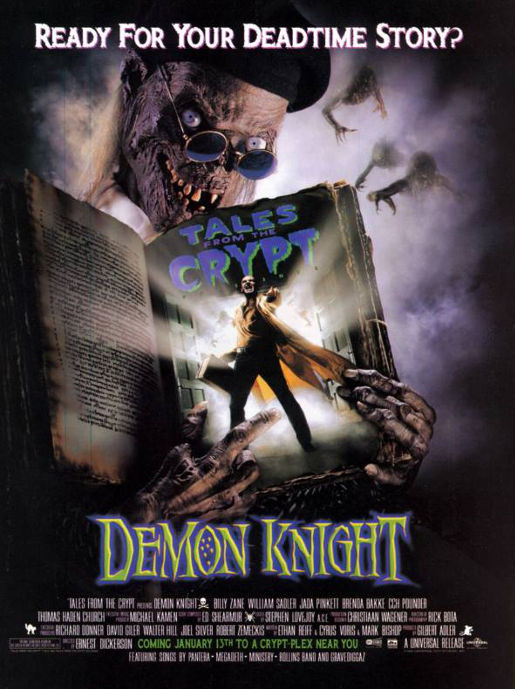
TFtC_Demon_Knight_PosterHBO’s Tales From the Crypt was in it’s sixth Season when they started a bold plan to break out into movies. There had been a Tales from the Crypt film in the seventies, but this would be different. Instead of being an anthology film, the Tales from the Crypt movies would tell a theatrical length tale.  They assembled a series of scripts, none of which were specifically written for the franchise.  This resulted in three films of varying success.

The first up was Demon Knight.  It introduces us to Brayker (William Sadler) a man running from a conflict.  He arrives at a remote hotel which houses a motley crew of broken people.  Brayker is frantic and  mysterious, so nobody takes him seriously before Hell literally arrives in the form of Billy Zane…the Collector.  Brayker has something he wants.

The Collector is actually a demon who needs a “key” that Brayker is trying to protect.  This key will allow Hell to overrun the world.  So Brayker tries to keep him out of the hotel.  Except, the barriers he erects also depend on the personal strengths of the people in the hotel.  If they let the Collector in to themselves, he can use them as fresh demons.

And that is where Billy Zane gets to shine.  This is really his movie.  The Collector appeals to your hopes or desires.  He promises one person love and respect, the two things she does not get in her life.  And then he tempts another character as a friendly bartender.  Zane has fun with these moments and is highly effective, you understand why characters cave.

The effects are low budget, but effective.  The demons are creepy, and the practical effects work really deliver for the story.  The characters are easy to root for, most of them having decent qualities, even if rough around the edges.  And the film has CCH Pounder.  Every film should have her in it.

In spite of the film being outside the typical stories in the Tales catalog (they are usually tales of bad people getting a comeuppance.  Demon Knight is a Heroes Journey), it is an effective tale.  It is fun, exciting and well told.  The film has a strong cast that really sell the situation.  This is the best of the three Tales From the Crypt films, and the one truly worth watching.

Blog at WordPress.com.

Up ↑