Choke On Em! (Day of the Dead, 1985)

Day_of_the_Dead_PosterDay of the Dead begins with the films heroes landing a helicopter at the edge of a city. They are calling out as the camera explores a desolate empty world seemingly only occupied by animals.  But then we see a shadow and the camera pans up to the mutilated face of a zombie.

Day of the Dead shows us a world over run by zombies.  There are few members of the living.  In fact, our heroes are part of a secret base of scientists and soldiers who are starting to wonder if they are all alone on the world.  Set on a small island in an underground base, tensions between the civilian staff and military men are running high.

Captain Rhodes and his men are starting to become more aggressive, believing the scientists work unimportant.  The military men just want to find another outpost and leave.  But the lead scientist Logan is obsessed with the idea that he can “domesticate” zombies.  His best example is the zombie Bub (which he explains is a nickname of his father).  Bub seems to remember things like tools, books, phones.  He mainly is mimicking what other people do (he simply thumbs through a Stephen King book, runs a disposable razor down his cheek, etc).  But Logan believes it is more, and the end of the film does suggest that Bub is not as mindless as he seems.

Eventually, it all explodes, the scientists plan an escape, while Rhodes and his men plan to leave the island and the scientists behind.  You might be surprised to find that not everything goes as planned.

A new theme enters Romero’s films with Day of the dead…one of…”Who is worse?”  Not unlike Ripley telling Burke you don’t see the aliens “f***ing each other over for a percentage”, Rhodes and his men may be more terrifying as they bully and abuse the scientists.  It has been said that as the movies have gone on, George Romero started to side with the zombies.  Day of the Dead is the seeds of that.

It is not just the callous obsession of Logan or the cruelty of Captain Rhodes.  It is, ultimately, Bub.  Bub, who barely says a word is remarkably sympathetic.  Sherman Howard packs a lot of emotion into his performance, and it is no surprise that Bub is a popular character.

Truthfully, Day of the Dead is my favorite Romero zombie movie.  I like and admire the previous two films, but Day is my unabashed favorite.  Being set beyond the zombie outbreak allows an exploration of that world based in something other than confusion and desperation.  It asks the most intriguing questions about human nature and our desire to control situations that may be far from our grasp.

Leapin’ Lizards (Crocodile, 2000)

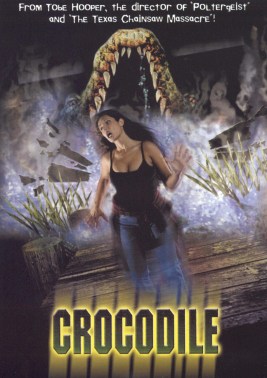
Crocodile_PosterA bunch of teens go on a trip to the lake, staying in a houseboat.  They stumble on a nest of crocodile eggs and take one.  So then they are pursued by the huge crocodile momma.  Meanwhile, the local police chief is investigating a series of grisly deaths.  With help from a shady alligator farm owner, he figures out what is going on.

Crocodile is not very good.  It is pretty standard, it’s pretty teens are bland and only two characters are really defined… the nice girl and the slut, who wants the nice girl’s man. But no worries…the slut gets eaten.

The egg plot seems directly lifted from the third Jurassic Park movie…right down to a female character returning the egg.  And let’s be honest…this is a poor man’s Lake Placid…and it is indeed poor.  This is one of those films where people are ten feet away, but still end up in the crocodile’s mouth.  The crocodile is a mix of practical and digital.  And all the digital looks terrible.

Even for a die-hard Hooper fan, this is not a movie worth checking out.

Comics Are Rotten (Creepshow, 1982)

Creepshow_Poster

The Horror anthology has always been risky.  There are few true classics.  Mostly what you get are movies with a couple good tales among some duds. George Romero and Stephen King teamed up to create Creepshow.

The five stories included here are all pretty strong.  The first is Fathers Day, the story of a somewhat rotten family gathering to celebrate the birthday of the late patriarch.  This year, he intends to get his birthday cake.

The second story is the Lonesome Death of Jordy Verrill is about a simple-minded farmer who discovers a meteor on his land. After touching the meteor, Jordy finds frass growing uncontrollably, consuming his body.

Something to Tide You over features an adulterous couple who are discovered by the woman’s husband.  He seeks to take revenge trapping them on the beach (so to speak).

The Crate follows an older professor who is constantly belittled by his alcoholic gossip wife.  His respite is his fellow professor, Dexter.  Dexter is called to the school by a janitor who finds a mysterious crate tucked away.  The crate seems to be decades old…but to also contain something still alive.  And hungry.

Finally, They’re Creeping Up on You is about an old man obsessed with cleanliness finding his home seems to be under siege by cockroaches.

The film is framed as a comic book, with art by Jack Kamen (an E.C. comics artist, which is the inspiration for Creepshow).  As each story begins and ends, we see comic book art that fades into the live image (or Vice Versa).  The art is great and provides a unique look to the film.  The film also has an extra framing device of a story about a young boy (Played by King’s real-life son Joe) whose father (played by veteran character actor Tom Atkins) is angry when he finds him reading a horror comic book.

Tom Savini provides a great series of effects, with visuals that mimic the color of comics. The gruesome visuals are not interested in realism, rather in being lush and colorful.

The cast is really terrific.  You have veterans like E.G. Marshall and Hal Holbrook along with upcoming stars like Ed Harris and Ted Danson.

Most of the film has a tone of cartoonish horror.  The Lonesome Death of Jordy Verrill struggles the most in this regard because at times it gets absurdly comical.  But overall, Creepshow is still one of Romero’s straight up most fun works.

It’s Alive! (The Mangler, 1995)

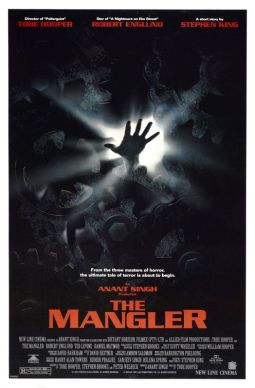
The_Mangler_PosterThis is…a weird film.  Englund is back for another round with Hooper and he is clearly having a blast this time around.After a tragic accident with an old and giant folding machine at the local laundry, Detective John Hunton finds himself drawn into a dark and supernatural world.
Based on a ten page Stephen King short story, the Mangler is a folding machine possessed by a demon that is served by the elderly Bill Gartley.  Hunton, with help from a spiritualist friend and elderly photographer/mortician he uncovers a dark history of human sacrifice and works to save Gartley’s young niece Sherry.

Among the odd choices in the film are having the mortician be played by a young man in old man make-up.  Jeremy Crutchley turns in a good performance, but the make-up is so obvious it is distracting when he is on screen.  There is an exorcism of an old fridge.  Most of the characters are largely unpleasant or annoying.  Of course, it gets downright hilarious when the giant machine starts running after the leads in the factory like a wild animal.  As mentioned, the short story is pretty short, so they add a lot of stuff…but funny enough?  The machine chasing people?  Not one of them.  In the story, it runs around town killing people. Oh, Stevie.

Truthfully, this is really only good for a bunch of friends to watch and laugh together.  It is also worth noting that although Hooper is the credited director, he was actually replaced after having filmed the majority of the film.

Making Friends (Night Terrors, 1993)

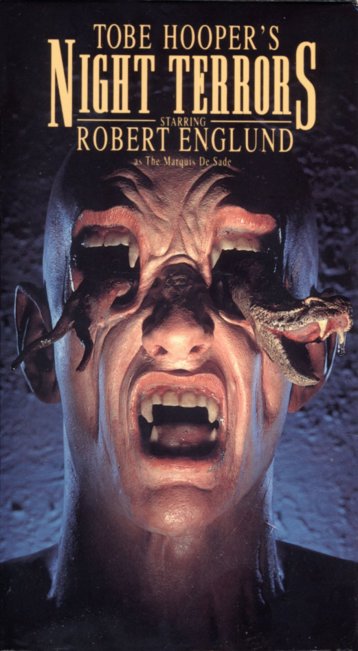
Night_Terrors_PosterThe film opens with the Marquis de Sade in prison.  We witness him being tortured and then once in his cell, he starts to mentally torment the man in the cell next to him until the man rips his own eyeballs from his head. The film jumps to the present day where Genie is visiting her father in Cairo.  After an attempted rape by some locals, she is saved by Sabina.
Genie’s father recommends that she avoid Sabina…that Sabine is not a…good influence.  Dad is kind of right as Sabina pulls Genie into a cult led by Paul, a descendant of the Marquis de Sade. There is murder, betrayal, and sex!  Of the dullest kind! Anything resembling sensuality is comically inept.  The threat of the cult is never there, in spite of them killing Genie’s friends and family.

There is a very fumbled attempt to present this all as a Christianity vs Depraved Cult…but Genie’s religious father makes your average Stephen King religious nut look nuanced.  She has visions of her father walking into the room with a Bible and a big cross and yelling about the cult being unclean.  He is an archeologist who proclaims “Thanks be to God” at weird times.  “Look at this wall carving…thanks be to God!”

Most of the performances are weak and stiff.  Even Robert Englund seems to just sleepwalk through this one, giving one of his least interesting performances.

Night Terrors is not only lacking in scares, it is terribly boring.

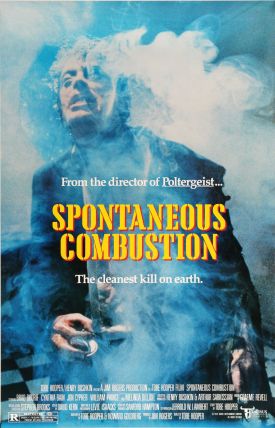
Up In Flames (Spontaneous Combustion, 1990)

Spontaneous_Combustion_PosterSam discovers that his parents were part of an experiment with nuclear power while he was in the womb.  Upon being born, he is proclaimed a perfectly healthy baby.  Shortly after his parents burst into flames (spontaneously!).
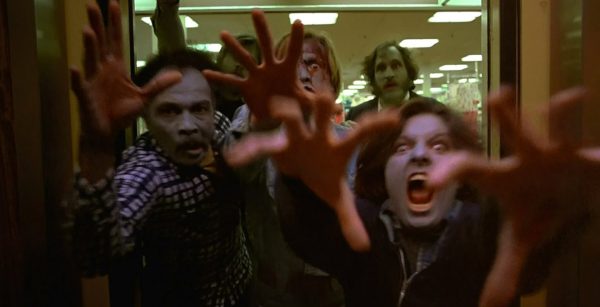
Sam discovers he has the power to make things burst into flames.  When he gets angry, he causes people to erupt in violent flames.  But it is not just other people.  When a victim burns, so does he.

There are some goofy moments, like when staring into a fire, he has memories from before he was born. Or the fact that they talk about Spontaneous Human Combustion as a totally scientific fact and common occurrence. Or the psychic radio host.


What really makes this work is Brad Dourif’s performance.  Sam is kind and sweet, so when he starts to struggle with his power, he is pretty sympathetic.  This is especially true as he becomes unable to know who he can trust.

The ending gets a little convoluted, trying to be both tragic and “happy”.

The effects in the film are quite good, if somewhat hyper-dramatic.

Overall, though largely forgotten, this is a pretty strong effort from Hooper.

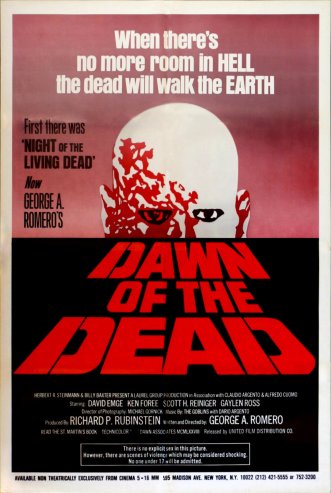
When There Is No More Room In Hell (Dawn of the Dead, 1978)

Dawn_of_the_Dead_PosterIt took about ten years for Romero to find something new to explore with zombies.  It was the Dawn of the Shopping Mall, with large insular buildings housing a variety of stores.  At the time, this encapsulated the concerns of modern life and consumerism.  George Romero looked at the shopping mall and thought “What a terrifying place!”
The film opens amidst a frenzied newsroom trying to make sense of what is happening.  It appears this may be the same night as the original film, though the film is never that explicit.  It does not reference Night of the Living Dead.  None of the films do, actually.  Each film seems to take place in an ever present “now”, regardless of if it makes sense in the greater context of all the films.

Two newsroom employees escape in a helicopter, along with two S.W.A.T. team members.  They end up landing on a mall roof.  What follows is an adventure of survival as they build a small fortress and use the mall stores to wait out the zombie situation.    At first, this works out quite well, and they get creative, building fake walls to hide stairwells from Zombies, blocked glass doors with trucks, using the mall keys to move from store to store and get supplies.

But you know their paradise cannot last as outside forces close in.  Romero keeps his central cast to a tight four.  This is a good choice, as we are allowed to connect with our leads and root for their success in a way that can be hard if there are to many people to keep track of.

The gore effects are improved over the previous effort, though as Tom Savini noted making many zombies grayish colored actually results in zombies looking blue.  And the blood splatter from some zombies seems far to large for shambling dead creatures.

This is the film that really set up the “Zombie represents mindless consumption” metaphor.  Which is kind of funny, since there have been an endless supply of bad zombie films over the years for the masses to consume.  But Dawn of the Dead is a great film and important to the horror (and especially zombie films) genre.

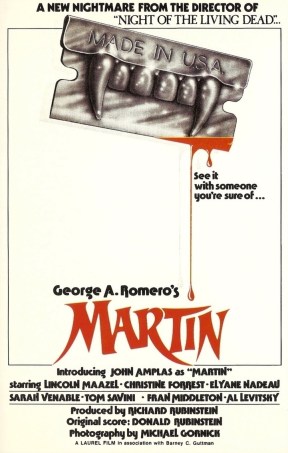
It’s Only a Costume (Martin, 1976)

Martin_PosterMartin is one of the more interesting vampire films of the 70’s.  Martin believes himself to be a vampire.  It does not help that his family feeds this belief.  He has faced exorcisms and now is being sent to live with his cousin Cuda.  Cuda calls Martin Nosferatu and has filled his house garlic and crosses. Cuda’s daughter is less impressed with the family’s old world beliefs.

As he approaches his first victim in the film, he gets flashes in black and white that show his perception.  He envisions entering a room and being welcomed by a beautiful woman in lingerie.  The reality is she is wearing face cream and in a mundane robe.  And rather than reach out to him, she is understandably horrified.  There are flashbacks to his past as well (also in black and white).  These are very effective ways of bringing the viewer into the mind of Martin.

Martin is also haunted by the voice of a relative who was believed by the family to be a vampire as well, and had committed suicide.  Presenting a evidence for the viewer that Martin is not a supernatural being is his lack of fangs.  He attains his blood not through entrancing his victims, but drugging them.  He has no fangs, rather uses a razor blade to draw blood.  Martin claims he is 84 years old, but there is no evidence to back this up. He has no physical reaction to the traditional weapons of garlic or crucifixes.

Cuda represents the old school, classic vampire film, but he is trapped in a modern and faithless world of vampires. The final act of the film is Martin discussing his vampirism with a talk radio host using the name “The Count”.  This is juxtaposed with Martin’s mundane life, as he laments how hard it is to choose a victim.

The film ends both tragically and ambiguously, with voices on the radio asking what has happened to the Count.  Martin is a strong entry into the world of Vampire Cinema.  Romero explores the vampire myth through skeptical eyes, which really works in the film’s favor,

Careless in Suburbia (Poltergeist, 1982)

Poltergeist_PosterThe Freeling family have a good life.  Steve and Diane have three children.  One evening they are awakened by their youngest, Carol Anne, who is talking to the TV.
As days go by they notice unusual phenomena and not just Carol Anne watching static on the television.  The dog responds to something nobody can see, the son is sure the tree outside his window is alive.

After a traumatic night which results in Carol Anne being taken by the spirits she has been communicating with.  When paranormal researches come in, they are floored by what they find.  It is decided they need the help of an exorcist to try and get Carol Anne back.

There are two things people likely recall most vividly.  Cute little Carol Anne turning to the camera to say (eerily) “They’re Heeeeere” and Zelda Rubinstein as Exorcist Tangina.  Her most famous line has been quoted in many films and TV shows…”This house is clean.”

Rubinstein is memorable in both appearance and performance.  A small older woman, she brings an otherworldly vibe, and at times, her purposes almost seem at odds with the Freelings.

The effects still stand up, with only a few exceptions.  The most obvious being a sequence with a character clawing his face off and it is obviously a dummy head.  But otherwise, the ghost effects still work very well.

There is a longstanding belief that Spielberg is the director of Poltergeist, and it appears he was on set, though so was Hooper.  He was filming E.T. the Extra-Terrestrial at the same time (a movie he offered to Hooper to direct).  Hooper is the only credited director, but according to at least some individuals who were there, it was primarily Spielberg. It sounds like this was not one of those situations where Hooper was being replaced, and he had some creative input.  It would appear they got along fine and Hooper was providing Spielberg cover in regards to contractual rules with E.T.

Regardless of who directed it, Poltergeist is an entertaining and somewhat unique horror film with a terrific cast.

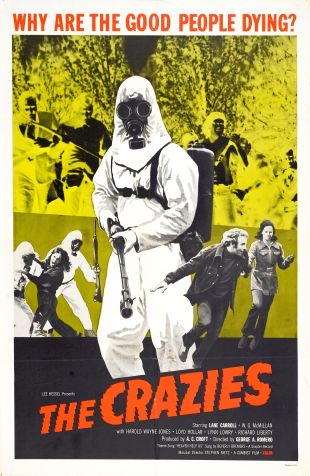
Going Slightly Mad (The Crazies, 1973)

Crazies_1973_PosterNot unlike Night of the Living Dead, the Crazies presents a situation in which our loved ones may be the biggest threat.  Unlike his first film, of course, the threat is solely from the living.

The film opens up in the middle of things.  Two kids are playing in their house, only to be chased by their father.  What is quickly revealed is that the military has already arrived and started to close off the town to deal with an apparent viral outbreak.  When contracted, the virus slowly begins to turn you violent.  The military begins to bring the town to a central location while arguing with the local government.

A small group of locals escape the military and start hiding in the town while trying to get out entirely.

The Crazies goes back and forth between these two groups, with a surprisingly heavy focus on the military side.  It becomes increasingly clear as the story goes forward, the military was ill-prepared for this situation and are rapidly losing their grasp on it.

The film has some really disturbing moments, including the violent threat to children, people self-immolating and a scene in which a young woman’s father attempts to rape her.  Within the context of the story, these scenes show the breakdown and destructive nature of the virus, but they are uncomfortable none the less.

Romero and fellow writer Paul McCollough clearly gave a lot of thought to how the government might try and handle an outbreak of this nature…so much that the characters who feel like they ought to be the leads seem entirely secondary to the soldiers and scientists.

The Crazies has a pretty bleak ending which fits in with much of Romero’s work.  This was a vast improvement over Season of the Witch and other than being slightly long is a good film.

Blog at WordPress.com.

Up ↑