The Night He Came Home (Again) (Halloween 4: The Return of Michael Myers, 1988)

halloween-4-returnI doubt most people cared, outside of the producers…but the failure of Halloween 3: Season of the Witch (a movie without a single witch) certainly killed interest in another Halloween film. It certainly killed the plan to make each film a separate entity.

In 1987 or so, the producers decided it was safe or a good idea or something to revive Halloween. And they apparently felt that # 3 was far enough away that they could try it again. But this time, they returned to the well that started it all.  They got the future director of Free Willy 2, Dwight H. Little, to direct.

Jason had been brought back from the dead already, and Freddy was enjoying success. And yet, the producers decided not to bring Michael Myers back from the dead. Spa-lars follow.

Instead of returning Michael from the dead, they simply had him in a coma in the ten years since the end of Halloween 2(which, although it was released in 1981, took place in 1978). They were not likely to get Jamie Lee Curtis back, as she had become a household name, and in the 80’s, horror was something you did at the start of your career and then disavowed later. But since Halloween 2 had created the importance of family ties for Michael, they felt they had to have a relative. So the writers and producers came up with Laurie Strode’s daughter Jamie and killed Laurie off in a car crash.

Like her mother, Jamie was growing up with an adoptive family, none of whom seemed aware of the dark family member from her past. They did get Donald Pleasence back as Dr. Loomis. This gave the film some legitimacy. Sure, the cynical part of me presumes Pleasence was collecting a check. But honestly, he seemed to genuinely want to be a part of the series. And he certainly tried. Loomis came off creepier and more devoted than ever.

When Loomis learns Michael has awakened from his ten year coma, he knows what this means and heads for Haddonfield. He ends up walking most of the way, as he catches up to Michael at a gas station. Michael blows it up and leaves Loomis stranded.

Michael gets to town and starts stalking his niece as she gets ready for the Halloween festivities. She keeps seeing the boogey man, but no one really believes her until it is to late. Loomis gets to town and convinces the Sheriff that Myers is back. The town goes on high alert (people were skittish, as the power has gone out) and a posse forms to hunt Michael down.

They end up chasing him to a school, and then the posse take Jamie and her older adopted sister Rachel (Ellie Cornell) with them to keep the girls safe from Michael. But if it were that easy, well, it would not be a Halloween movie, silly duck. No, Michael manages to kill every member of the posse. Rachel takes over the truck and crashes it, launching Michael a few hundred feet. The police arrive just in time. as Michael lumbers closer The cops unload a hail of bullets into him and he falls down an abandoned mine shaft to his death (who am I kiddin’?).

Probably one of the strongest moments of the film is at the end, when the camera gives us a “killer’s eye view”-reminiscent of the original Halloween in which we see a person getting stabbed, everyone runs over to the stairs when they hear the scream, and Donald Pleasence just starts screaming “NO! NO! NO!” over and over, finally the camera pans to the top of the stairs where Jamie stands, a blank look on her face and a bloody pair of scissors in her hand. It evokes this idea that Michael lives on, that Loomis cannot beat the evil that resides in Myers. It’s particularly effective. There are also some really nice visual uses of shadow and reveals of Michael that cause genuine jump moments.

Director Dwight H. Little shows a lot of promise, and this was his fourth feature. He has gone on to direct a lot of action/suspense based television. The dialog is a bit stiff, but the characters over come it for the most part. The character of Rachel is especially pleasing, because she is confident and strong. It’s interesting that the Halloween films seemed devoted to a small town look and aesthetic. The prettiest girl in town doesn’t look like a California blond pin-up. While attractive, Rachel seems real, both in personality and appearance.

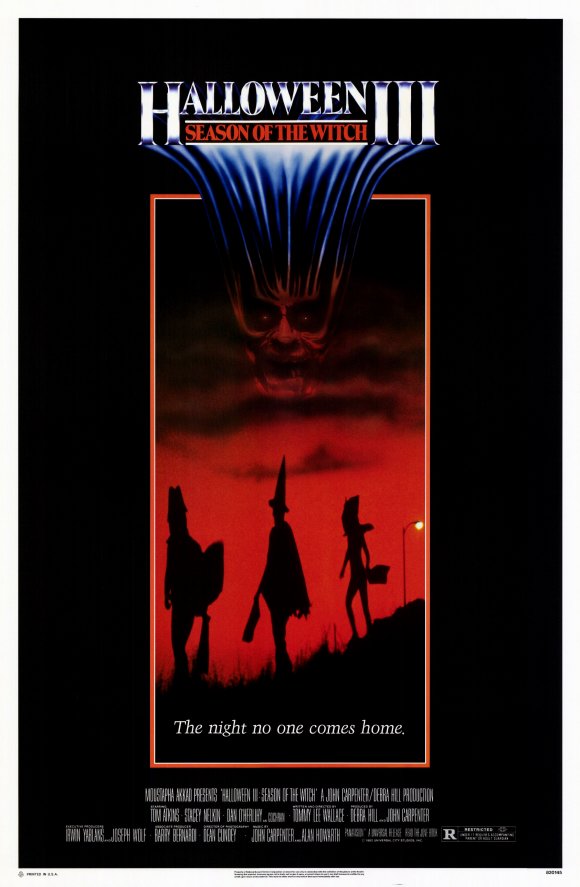
The Night He (Never) Came Home (Halloween 3: Season of the Witch, 1982)

halloween-3-season-of-the-witchAs I noted on Monday, Halloween 2 was supposed to be the end of Michael Myers. Halloween 3 was to signal a new era for the franchise. Each movie would have a different cast of characters, story and be unconnected to the previous film. The only connection is that they would generally take place around Halloween. I think the producers believed this would give the franchise a long, long life and keep it from getting stale.

Lo and behold, they were wrong. Very wrong. See, the theory might have worked. If, you know, 1982’s Halloween 3 had been…you know…good. But as anyone who has seen it can attest to? It is…well…not good.

This was the directorial debut for Tommy Lee Wallace, who had gained a lot of experience working behind the scenes with John Carpenter on all his late 70’s work. As debuts go, it’s not very strong, and it’s plot is very…odd.

Spoilers are coming your way…

So, as I noted, Halloween 3 bears no relation to the Michael Myers mythology. Instead it follows down on his luck Doctor Dan Challis (the very great character actor Tom Atkins), who is working the night a crazy man with a mask clutched in his hands drives his car into the hospital apparently killing another man. However, while sifting through the remains of the car, he discovers strange items that do not appear human. The items appear mechanical, but do not appear to be car parts.

While Dan speaks to the old man’s daughter a stranger in a suit walks in and kills the old man. This all leads Dan and the daughter on a chase. They end up in a small town where the Silver Shamrock Corporation manufactures and distributes it variety of Halloween masks (by variety I mean three). The company is run by the Old Man from Robocop (Dan O’Herlihy), named Conal Cochran. Oh sure, he seems like a kindly old man, but this is a horror movie, and if he was truly just a kindly old man? It would be a short and pointless film (instead of a pointless average length film).

No, Mr. Cochran has a devious plan. He has added computer chips to the base pf each mask. At the appointed time, the mask will fire a laser and bugs and snakes will pour out of the head of the wearer. Really. Apparently, this plan involves a commercial that will air simultaneously on every channel. Why the kids are supposed to be excited to watch this commercial flew past me. But when they watch the commercial, along with a big chunk of rock from Stonehenge make the kids heads collapse and spew out snakes and spiders and other unpleasant creatures that will apparently eat the parents. There is even a scene where Cochran shows Dr. Challis the plan by having the top seller of the masks sit with his family in a small room and he kills them. This all apparently has something to druids and and ancient druid worship.

And all his employees are robots, by the way. And this all leads to Challis starting the commercial and then dumping a bunch of the laser micro chips down and they zap all the robots and the Old M-sorry, Cochran gets hit with a pure white beam of light and is…vaporized? We do not really know. Not sure I really care.

After they drive away, the daughter of the old guy from the beginning attacks Dr. Challis in the car. This causes an accident and we discover that she is a robot. Now, has she been a robot since we met her at the start of the film? Since Cochran kidnapped her and Challis? If it was later in the film, what happened to the real her? Is she dead? This is one of the many unanswered questions the film raises. Finally, Challis comes upon a gas station and begs the attendant to use the phone. Just like any other American, he clearly has the phone numbers for every local network memorized as he calls one network, actually, come to think of it, apparently there is just one office for every channel. He only talks to one person and gets multiple channels to stop airing the Silver Shamrock Commercial of Death. All but ONE.

I’ve heard claims from some fans (and the film crew behind the movie) that it just gets an unfair rap, and that if it had not had the heavy burden of Halloween in the title, somehow, people would not think it was a bad movie.

Do not believe it. At all. This would be a bad movie if the title was Evil Old Druids. Or Killer Shamrocks. The story makes no sense, the entire film is incoherent and full of plot holes. Many questions are left unanswered. It lacks suspense or even real scares. Druids, robots, laser beams… where are the leprechauns?! No, this movie is probably the reason that there was not another Halloween film until 1988.

(Still) The Night He Came Home (Halloween II,1981)

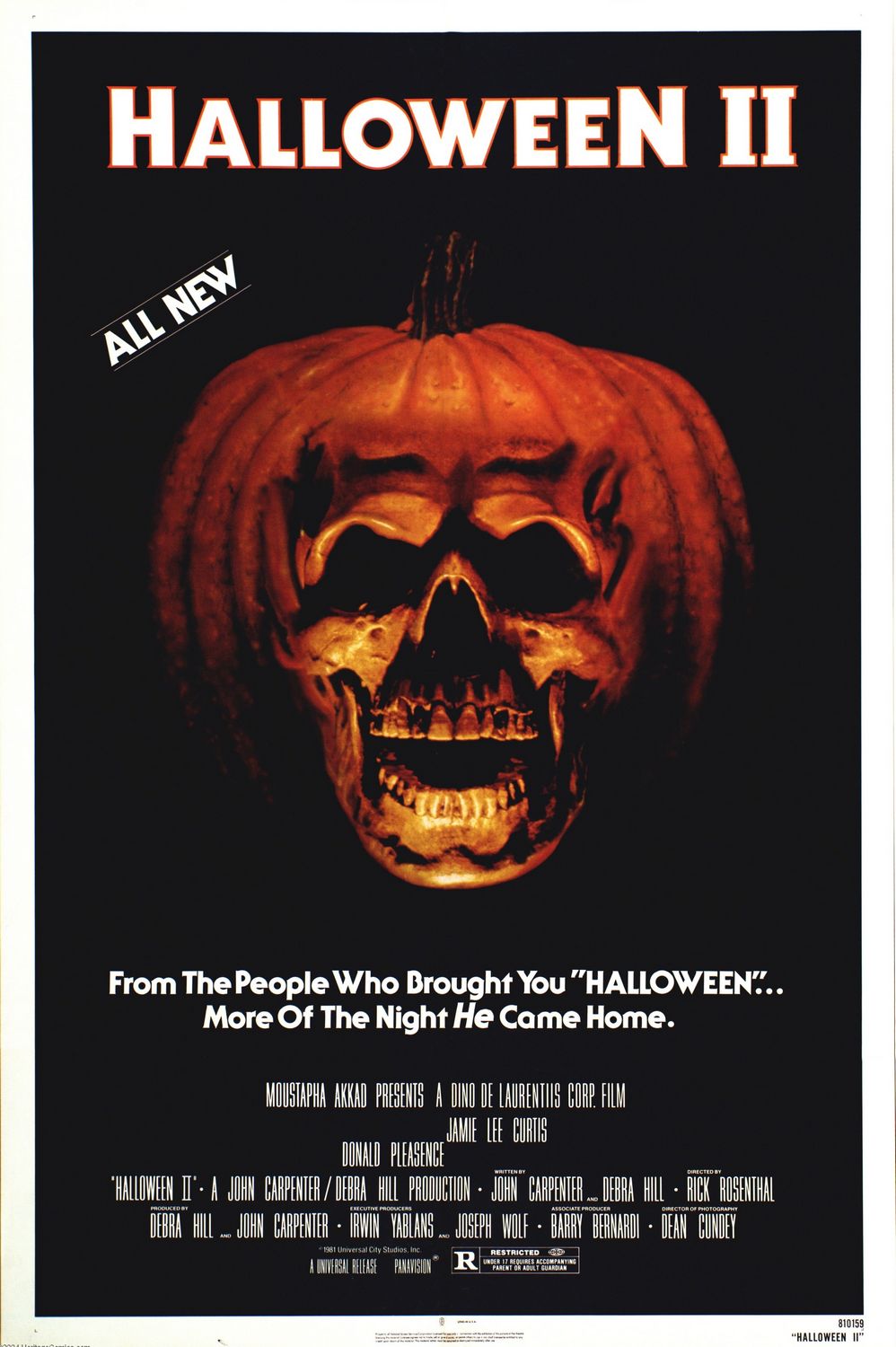
halloween_2Halloween 2 is guilty of kicking off a lot of horror sequel trends. You remember that kid Randy from the Scream movies? The one who explained all the rules of the slasher genre? Halloween 2 pretty much nailed every one of the rules of a sequel that Randy talks about in Scream 2.

Halloween 2 does not suck. On the other hand, it is not quite as good as the first film. Carpenter and Hill are producers and helped with the script, but the film was directed by first time film director Rick Rosenthal (who has gone on to direct a lot of television, especially in the horror/fantasy genre such as Buffy the Vampire Slayer and Smallville) who returned to the last film before Rob Zombie’s reboot. So, as with many sequels, this was someone cutting their teeth.

Spoilers are cutting up next.  Ouch. Sorry about the pun.

The part of this film that works is we have our main cast returning and it continues on the same night as the original film.  This one picks up as Dr. Loomis believes he shot Michael dead, only, of course to look over the edge and see Michael is gone.

The story continues Michael’s unrelenting attack, though it becomes more refined.  People often forget,  it was Halloween 2 that introduced the idea that Michael and Laurie were siblings (It was also the second film that first used the song Mr. Sandman to creepy effect).  Nearly the entire second film takes place in a hospital, with the majority of film’s victims being hospital employees.

As the film starts, Laurie Strode is taken to the local hospital, which is pretty sparcely populated at the time, we see no patients (other than some newborns in the nursery at one point), only a skeletal staff of nurses and ambulance drivers.  Of the two drivers, we have the kind hearted Jimmy Lloyd (played by Last Starfighter Lance Guest) and the sex obsessed, crass Graham (played by Jeffrey Kramer).  Graham is constantly trying to get some alone time with his girlfriend, Nurse Bailey (Pamela Susan Shoop).  Jimmy on the other hand keeps trying to sneak in to talk to Laurie, though head nurse Mrs. Alves (Gloria Gifford) keeps interfering, insisting Jimmy let Laurie rest.

Dr. Loomis is still working with police to try and catch Michael, but that relationship becomes increasingly strained as the sheriff discovers that one of the dead teens is his own daughter.  It is when Marion Chambers (who we saw in the first film) comes to tell Loomis he must leave with her under state orders that they discover a truth that was hidden from even Loomis.  Michael had another sister, little Laurie Strode.  Loomis, being the determined guy he is, will not go down without a fight and demands to be taken to the hospital.

Of course, in the meantime, hospital staff have dropped like flies.  Laurie has been sedated, but she refuses to give up and stumbles through the hospital trying to escape the ever present Michael Myers.  If it sounds familiar, this is because many films have duplicated this cat and mouse since in the slasher and horror genre.  But Halloween 2 pulls it off well, it is one of the film’s strong points.

Loomis arrives at the hospital for a final showdown with Michael.  In one of the less plausible moments, Laurie manages to shoot both Michael’s eyes out with a gun…which only blinds him.   Holding a scalpel, he swings wildly as Laurie and Dr. Loomis turn on the various gas tanks in the room.  Loomis sends Laurie out of the room and then flicks a Bic lighter (okay, maybe it was some generic brand of lighter) blowing himself and Michael up.

This film ups the killings, using various implements found in the hospital (such as needles).  The kills are more gruesome and elaborate, the characters less dimensional (hardly a shock as there are more characters introduced).  It carries through pretty seamlessly from the first.  But it lacks something without Carpenter’s skilled eye for the use of shadows and light to obscure Michael.  So it has a different feel.

They do try and advance the story, rather than re-hash it (which is where we get the family connection exploited both well and poorly in later films).  It is notable that they killed Michael off believing that they were done with stories about Myers.  I mean, where else could they go?  The idea was that now they could make other movies with the Halloween title, but all new stories and characters.  And then they made Halloween 3.

The (First) Night He Came Home (Halloween, 1977)

halloween_originalThe late 70’s and early 80’s were pretty good to the horror genre. Plenty of long running series were kicked off then. Halloween was the start of a really strong run for John Carpenter as well. He produced some of his finest work between about 1978 and 1987.

Halloween was actually just started as an idea of a psycho stalking babysitters. This is not entirely new, and it played off various urban legends that started in the preceding decades about stalkers and babysitters as their prey. At some point, they came up with the idea of setting it on Halloween, hence the name. Halloween caused a lot of “holiday” themed imitators not long after, such as a little film called Friday the 13th.

By today’s standards, Halloween is remarkably tame. It’s body count is small, it is not overly graphic in it’s deaths and it focuses more on it’s characters than it’s monster. The movie is not about “Michael Myers, Serial Killer.” Oh sure, it’s tag line is “The Night HE Came Home,” but do not be fooled. Instead, it is about young Laurie Strode (Jamie Lee Curtis-at that time an unknown to the public) and her efforts to protect herself and the kid she is babysitting.

Spoilers follow…

The story is pretty simple to follow. As a young by, Michael Myers inexplicably murders his sister and is institutionalized. It’s made creepy by the fact that we see Michael coming from a fairly average family and home. There seems to be no obvious trigger. That’s what makes Michael scary. His motives are unknown. Freddy is a sadistic murderer getting revenge on the parents who killed him. Jason is killing careless camp counselors. But Michael? Michael does not seem to have a reason for what he does.

The film’s opening is masterfully creepy, as we see everything from a stalker’s point of view. Carpenter deftly walks through the opening entirely through Michael’s eyes, allowing the viewer to make their own conclusions about who the killer might be. The killer puts on a clown mask, and even then the camera continues to see through Michael’s eyes, now peering through the eye slits of a mask. The camera enters the room of a young attractive woman who clearly recognizes our stalker. It is not until moments later, as we go outside that the camera steps from behind Michaels eyes and his parents get out of their car do we discover that Michael is but a young child.

Carpenter quickly introduced us to Dr. Loomis (played by the ever entertaining Donald Pleasence) who is a passionate and seemingly caring doctor trying to get through to Michael, at least for a time. The films makes a leap of about fifteen years, where we discover Loomis has had a change of heart. He determined Michael is unreachable and simply needs to be locked away forever.

Loomis is on his way to the institution to plead against Michael’s being moved on a dark and stormy night, and is surprised to see patients wandering in the rain. While Loomisleaves the car, a nurse sits patiently. She is startled by the noise of someone on top of the car, the person scares the nurse out of the car and then steals it, leaving the nurse and Loomis behind. Dr. Loomis is no fool and realizes it was Myers.

We are then introduced to Laurie Strode with her family. Clearly, this is a loving family that has strong ties, and Carpenter manages to establish this in less than five minutes at the breakfast table. Laurie is asked by her real estate agent father to drop a key off at the old Myers house for a showing. his sequence sets a lot of information before us. First, Myers is a bit of a local legend. Something has happened to Michael’s parents, and judging from the home, it has been vacant for years. in fact, it has a reputation of the local haunted house, with a young local boy Tommy Doyle (Brian Andrews) begging Laurie not to go up to the house.

The story snowballs from there as Laurie and her friends notice both an unfamiliar car and stranger showing up near by. Laurie keeps thinking she sees Michael behind trees or in the back yard. In the script Michael is described, quite reasonably as the shape. Michael is not defined at all, other than he appears large. Even his mask, iconic as it is, has no real features to it. It’s lifeless, as is his jumpsuit.

Laurie and her friend Annie (Nancy Loomis) both go to babysit some kids, while another friend, Lynda (P.J. Soles) hooks up with her boyfriend. This all leads to the inevitable series of deaths that culminate in Laurie trying to protect Tommy, Lindsey (Kyle Richards) and herself from the “boogey man”.

All the while Dr. Loomis is running around town with the local sheriff trying to locate and capture Michael. Attracted by screaming kids (Lindsey and Tommy, who Laurie sent out of the house) Loomis runs into the house and saves Laurie, shooting Michael multiple times. Michael falls out of a window and hits the ground below. But when Dr. Loomis looks out the window he sees Michael is gone. It’s a classic ending, and one that now we all recognize as an opening for a sequel (though Carpenter states that this was not the plan, it was simply meant to be a creepy ending-the sequel was a total afterthought).

What makes Halloween work is it’s use of shadows to obscure Myers, and it’s skillful use of POV shots. Many moments are shown from Michael’s perspective, keeping him mysterious, even as we see things through his eyes. Then there are the musical stings. Much like Psycho, the stings hit at the exact right moments. And that creepy theme!

Halloween is a definite classic, and though it’s unfortunate that it paved a way for cheap slashers, it is noteworthy for it’s focus on the characters. The fact is, most of the copycats missed what made Halloween work and created a genre almost unrecognizable as being compatible with Halloween. Modern slashers create such unlikable characters you quickly start to root for the killer. Carpenter never confuses the audience. Dr. Loomis and Laurie Strode are our heroes, Michael Myers is the villain. The film is a great example of film making with limited resources as well.

Deadly Night At the Museum (The Outing, 1987)

The-Outing-CoverWell before the Wishmaster series, films were trying to mine horror the concepts of genies.  The Outing (originally released as the Lamp) was one of the attempts of the 80’s.

It begins with a break in of an old woman’s house.  She is some sort of hoarder of ancient artifacts.  The three thugs discover a magical lamp and are promptly dispatched by an unseen force.  But not before the female thug strips.

Anyways, a bunch of artifacts, including the lamp are sent to a local museum.  There we meet Alex Wallace and her father Dr. Wallace, the curator.  They have a decent but stressed relationship due to the death of Alex’s mother.

But the real problems start when Alex finds a bracelet among the old woman’s things.  Soon the lamp is opened, on the very night she in her friends hide out in the museum to party overnight.

The film is pretty mediocre, never rising to the level of “So Awful it is good”.  The acting is pedestrian, giving little life to the characters.  There are a variety of supernatural deaths using zombie snakes, ceiling fans and masks.

The genie monster looks decent enough when we see it by the end, but as monsters go, it lacks personality.  It does not appear on screen or say a word until the end of the film.  Which makes the genie rather underwhelming.

Ultimately, this is a rather underwhelming film as a whole.  It has a decent core concept

Cold Fear (Harbinger Down, 2015)

harbinger_down_poster

This film, in part, was a response to the 2011 Thing prequel.In early interviews, (Harbinger Down Director) Alec Gillis had emphasized that it was going to be a mostly practical film.  Even the special features show an awful lot of practical work in the behind the scenes.  The studio “had a change of heart” and decided the film should favor digital over practical.

There is a place for the tool of digital.  But the avoidance of practical hurts film.  Alec Gillis, coming from an award winning practical effects background, knows this well.

Harbinger Down was a film made in part to showcase practical effects.  It is for lovers of monster movies.

It tells the tale of Sadie, a student studying climate change effects on Beluga Whales who brings her professor and fellow student on her grandfather’s crabbing boat the Harbinger.  They discover an old soviet ship in the ice and once on board, horror based mayhem ensues.

Evoking memories of John Carpenter’s the Thing (right at the beginning there is an easter egg for those of us who love the Thing) and the films of the Alien franchise, Gillis clearly set out to make a classic monster movie.  Using the familiar elements of people trapped in a remote location facing a scary unknown, Gillis charges forward.

The film has great practical effects driving the action and scares.  The monster is lifelike and gruesome.  but it is not enough to have cool effects.  If the cast cannot hold up their end, a film will fall apart.  Luckily, Gillis has a terrific cast.  The characters feels defined and are entertaining.  Especially likable is Winston James Francis as Big G.  Star Lance Henrikson is great in the role of gruff but decent Graff (captain of the ship and Sadie’s grandfather).

The film has moments of humor that allow us to get to know the characters before it all falls apart on them.  The cast makes the most of their roles, whether large or small.

Harbinger Down is a solid monster movie, one that pays tribute to the great monster movies of the early 80’s.  It deserves a watch by lovers of monster movies and practical visual effects.

Hardly a Drag (Drag Me to Hell, 2009)

drag_me_to_hell_posterTwenty some years ago Sam Raimi made an impression on the film world with a low budget horror film called the Evil Dead.  Now a cult classic, he turned his skills to the big leagues with some varied success in the Spider-Man franchise.  For a long time fans have hoped Sam would re-visit his horror roots as more than a producer.

This year he did, and it was well worth the wait.  Drag Me To Hell is a full return to form of films like Evil Dead 2:Dead By Dawn and Army of Darkness.  It’s filled with jumps and humor.

Drag Me to Hell is the story of Christine, (Alison Lohman) a young loan officer.  She has a boyfriend, a psychology professor named Clay (Justin Long), and is trying to get a promotion to assistant manager at her bank.  Christine is, however, nice and sweet.  While this makes her appealing to her boyfriend, but her sweetness and honesty is hampering her ability to be the aggressive shark her boss (David Paymer) wants.  It doesn’t help that her competition, Stu (Reggie Lee) is an unethical and lying jerk.

When a elderly Hungarian woman, Mrs. Ganush, (Lorna Raver) comes in and begs for an her third extension on her mortgage.  Due to illness, she has fallen behind in her payments yet again.  Christine’s initial instinct is to help this woman who is clearly in need.  When she speaks to her boss, he hints that making the tough decision may be needed here, but leaves the decision in her hands.  She has the opportunity to be a good Samaritan but instead denies Mrs. Ganush the extension, recommending she move in with her family.  The old woman falls to her knees begging for mercy, and she is dragged out by security.

After this, things start looking up, her boss is impressed with her willingness to be tough, and even looks over a plan she has written up and decided he wants to show corporate.  But this is a horror movie!  Christine is met by the woman after work, and after a literal knock down and drag out fight (Stapler to the forehead!!!) between the two, the old woman puts a curse on on Christine and promises that someday soon, Christine  will be the one begging for help.

Then things really go downhill for Christine.  She hears voices, gets attacked by unseen demons and has an extreme nosebleed.  Christine and her Boyfriend (a true skeptic and non-believer in a spiritual world) visit psychic Rahm Jas (Dileep Rao).  He quickly shows himself to be invaluable, helping Christine understand the nature of the curse and how she might avoid the consequences.

As the situation escalates, Christine starts to take more and more extreme measures to avoid her terrible fate.  The trouble is, she has three days to do it, once the third day passes, the demon (called a Lamia) will drag her to hell.

The cast does a good job with making it seem believable, considering how over the top things get.  Justin Long was surprising effective as the caring boyfriend.  Raver plays Mrs. Ganush at first with great sympathy, she is easy to take pity on, yet she becomes intensely scary after she is humiliated by Christine.

Raimi makes terrific use of shadows and sound to produce scares.  The film has much cartoonish grossness that becomes so outrageous, it is hard not to laugh.  But the thing here is that it’s okay to laugh.  You are not laughing because Raimi is failing-he is succeeding.  This is a humorous film, as well as a scary morality play.  The effects are a blend of natural make up and CGI, which Raimi has worked to master through the Spider-Man films. And it’s very effective here.

The twists at the end of the film make for a classic horror payoff, and I would not want it to end any other way.

Back when the film hit theaters, I remember a feminist writer stating that the film was anti-woman.  That it’s moral was that women should not be assertive and should be punished when they are.  This is a woeful misread of the film.  First and foremost?  You could have had a guy in the lead and told the exact same story.  The moral is that you should not be cruel just to achieve more for yourself.  Christine had a choice, and yes, doing the right thing may have meant she would not get the promotion.  But often in life, doing the right thing…the ethical thing can cost you.  Just because I want a success does not mean I should achieve it at the expense of hurting someone in need of help.  This film is not anti-business woman.  Nor is it anti-woman in general.  It is “anti-being a dick.”  As I said, you could have easily put a man in the role.  I suspect the reason the story is about a woman and not a man is…well, I think horror audiences are quicker to be sympathetic to female leads.

One of the wonderful things is that Lohman is so likable that you dread the notion she might fail and hope she is able to remove the curse.

Swimtime (The Bay, 2012)

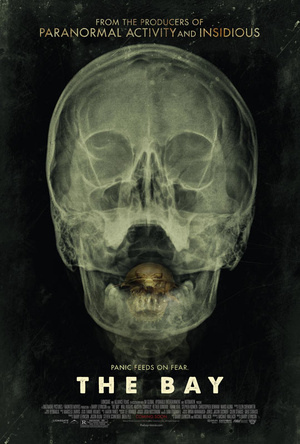
the-bay-movie-posterSo, Barry Levison (director of Rain Man, Good Morning Vietnam) decided it was time to dip horror waters.  Interestingly, he opted to go with the found footage format.  Found footage is risky, because it can be hard to stand apart.  I give Levison a lot of credit for making the choice he did.

The Bay opts for a “science gone wrong” theme that seems relatively uncommon for found footage.  It is presented as a compilation of footage collected by a reporter who witnessed the events.  This gives Levison a lot a freedom in telling the story.  The reporter is able to narrate the film, more in a documentary format.

The story begins with a series of footage regarding the strange phenomenon of the passed several years ( masses of dead fish, dead birds falling from the sky, etc).  The film states that while the news covered those stories, it never told this one.

We are introduced to a small town celebrating the 4th of July.  There is celebrating, but slowly, people are going to the ER with rashes.  In addition, two scientists who were doing research in the bay have washed ashore, mauled by…something.

As the day progresses, more and more people end up in the hospital, citizens complain of intense pain.  We discover that mutated isopods are infecting people and eating them from the inside out.  There is a terrific moment where the reporter the film is centered on shows us footage taken after people have evacuated the streets.  As she is attempting to make a report and then, in the distance hear an inhuman howling.  It is effectively creepy.

The format allows exposition, as we get to see hospital footage and sky conversations between the doctor trying to solve the problem and the CFDC, as well as news footage, police cruiser footage and home movies.

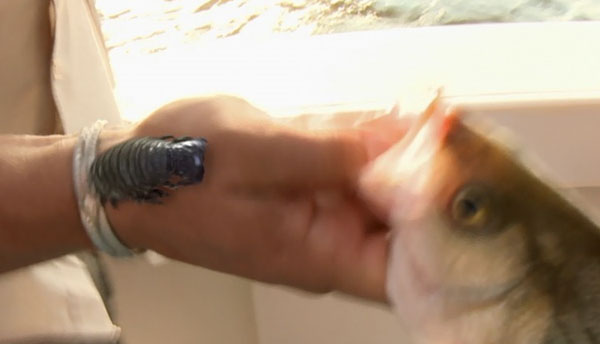
I appreciated the filmmaker’s starting with something quite real and gruesome(isopods that eat a fishes tongues and then live in their mouths as a faux tongue) and then tweak it.  It beats yet another haunted asylum.  I found the film pretty effective and interesting to follow.

While the majority of the film worked, I felt the end kind of fell flat.  It just seemed to end, we get some text telling us about the clean up and cover-up, but it seems like to important part of the story, deserving more than a brief bit of text.

Levison does a nice job overall, spicing the story up, knowing when to  keep us in the dark and when to illuminate the viewer.  In spite of my disappointment with the end, the overall film make for an entertaining watch.

Carnival Horror (The Funhouse, 1981)

funhouse_posterThe titles start out quite promising with a montage of rather creepy animatronic puppets.  The film then starts out as if Tobe was making a Halloween meets Psycho ripoff.  We see the killers point of view as an attractive girl takes a shower.  The killer even selects a clown mask (Ala young Michael Myers).  It’s clear the killer seems to live in the house with the girl…we get a point of view shot from behind the mask (again!  Like in Halloween).  There is a struggle and then the girl, Amy,  discovers her attacker is her little brother playing a practical joke.  Am I just really abnormal in finding this bizarre?  Am I really the only one?  It seems not uncommon in movies that you have brothers playing jokes that require them to ogle their sister.  I know I’ve seen it in other films…are screenwriters all only children?

The girl tells her brother she is not taking him to the carnival that weekend.  She then tells her father she is going out with her boyfriend Buzz, and her father tells her not to go to the carnival, as it the same carnival where two girls were found dead the prior year.  She promises not to go, but we all know this is a lie…as we do not have a movie without it..  Her boyfriend and their two friends go to the carnival.

The carnival Funhouse features one of the most uninspired carnival barkers ever (Kevin Conway).  He delivers everything in a low gravelly tone.  But the four friends go inside.  Meanwhile?  Amy’s little brother sneaks out and makes his way to the carnival.  The four hide behind the tents to smoke a joint, because, they need to work towards complete the “Horror Movie Sin List.”  Then they visit the fortune teller, whom they offend with their pot induced snickering.  Damn drugs.

The kids get the wild idea to stay overnight in the Funhouse.  At the Carnival where two dead girls were found the year before.  So, the kids call their parents to say they are staying at each others homes overnight.  They get on the funhouse ride and slip off once inside.  Damn drugs.

Then we get some long and drawn out shots of people leaving the carnival.  Amy’s Brother stays behind as while.  He’s frightened away as the animatronic dummy at the entrance seems to recognize that he is standing there.  Meanwhile, the teens are adding to the Sin List in the funhouse by making out and feeling each other up.  Damn teenagers.

They discover that they are above a room, so they watch what plays out…they discover that the fortune teller is a part time sex worker.  I am not exaggerating here, she takes money from men to perform sexual acts.  She is pretty lousy about it, because she is mean and rude to her john.  Unless that is his thing.  It might be, as her john cannot speak and wears a Frankenstein mask.  He’s unsatisfied with her performance and kills her.  Then he hides the body.

Our drug addled sex fiends, er, the kids decide it is time to get out and go home.  Not a bad idea, in theory.  But it turns it to not be so simple.  The exit is chained shut.  They are trying to figure out a new way to get free, only to witness the john (who is the carnival geek) being abused by his father…it turns out that the geek is a rather deformed mutant.  So, things are getting worse.

Then the killing starts.  I mean, after the first killing.  Turns out the geek is pretty sneaky, tricking the kids and separating them.

The film makes a good use of color, lighting and sound, the funhouse itself feels old and dilapidated, and is really more fearsome than the monster in that it feels like a rundown deathtrap.  Hooper doesn’t have a lot of victims to work with, so it is not some unrelenting spree of death, and he focuses as much on atmosphere and trying to build a real sense of dread.  It’s not successful, however as scenes are drawn out a bit to long to the point the final confront has you starting to get bored and want it to be over already.

The film is full of strangeness.  For example, there is the old woman who tells the girls that God is watching them.  And then there is Amy’s brother walking along the road and some guy pulls up and offers him a ride-then pulls out his shotgun…as the kid runs away? He laughs like a horror film mad scientist.  No reason given for that either.  And he never shows up again.  Damn drugs.

Unlike Hooper’s Texas Chainsaw Massacre, which is unrelenting towards the end and has you wanting the end to come as a release, here the end just needs to come period.  It hurts to say this, as I do like much of what the film has to offer.  It’s the drawn out ending that kills it for me.

Scientists Shouldn’t Play With Dead Things (Lazarus Effect, 2015)

lazarus-effectIf there is one story line that horror authors love to tell it is the one about the dangers of Scientific Hubris.  Part of this is that the stories pretty much write themselves.

In the case of the Lazarus Effect, the scientists in question are trying to conquer death.  After they succeed in resurrecting a dog, they lose their research to Big Pharma.  So they break in to attempt to recreate the success and one of the scientists (Olivia Wilde) is accidentally killed.  We can all see where this is going.

Upon being returned to life, her behavior becomes creepier and creepier and then progressively more violent.  The turn is quite quick, it happens overnight.

The film is visually interesting, but the philosophical questions are treated in a way that feels pretty pedestrian.  There is the scientist who has remnants of her religious upbringing causing her to wonder if what they are doing is very wrong (Wilde) and the scientist who thinks there is no spiritual afterlife, so only sees the potential (Mark Duplass).

The film never really asks big questions, and it never really addresses what it is that Zoe (Wilde) has become, or what her goal or purpose is, other than to be mean and cause mayhem.  The Lazarus Effect is an interesting idea that seems lazily executed.

Blog at WordPress.com.

Up ↑